
English Русский
Български
Беларускі
Український
Српски
Hrvatski
Română
Polski
Slovenský
Magyar
Bookmark Contacts Articles Sitemap
Company vehicles Peugeot Company vehicles Opel Company vehicles Skoda Company vehicles Land Rover Company vehicles Mitsubishi Company vehicles Volkswagen Company vehicles Honda
RenaultBook.ru


Duster   Fluence   Kangoo   Laguna   Logan   Megane   Sandero   Scenic   Symbol   Clio   Other
Renault 19 (1988-1996) Espace I and II (1984-1996) Espace III (1996-2002)

Possible turbocharger malfunctions (Renault Espace I)

  • Main
  • Renault
  • Espace I and II (1984-1996)
  • Power unit
  • Diesel fuel system
  • Possible turbocharger malfunctions
0
The turbocharger cannot be repaired, however the following instructions will be useful if you want to identify a fault in the turbocharger system and take the necessary measures.

The fuel pump is equipped with a boost pressure regulator. The main function of this regulator is to reduce exhaust emissions during acceleration or at low speeds and maximum load. The boost pressure regulator is mounted on the top of the pump. Figure 25.1 shows the design of the turbocharger with the location of its main components.
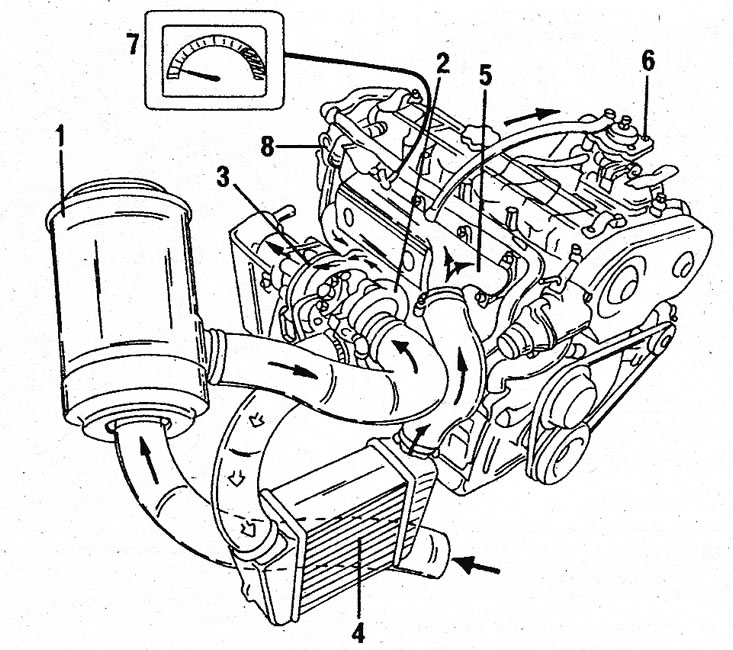
25.1 Turbocharger device1. Air filter; 2. Intake air compressor; 3. Drive mechanism turbine…

25.1 Turbocharger device1. Air filter; 2. Intake air compressor; 3. Drive mechanism turbine (turbocharger); 4. Charge air cooling radiator;5. Main air intake pipes;6.Fuel pump with boost pressure regulator; 7. Boost pressure indicator;8. Oil separator (drain to oil pan)


Problems and reasons


a) Loss of power: If the boost pressure is as specified, check that the connecting hose between the intake pipe (5) and the boost pressure regulator (6) is OK. It is also possible that the pump is not delivering enough fuel. Contact a workshop to fix the problem.

b) Black exhaust is due to insufficient boost pressure: check the intake air duct for leaks. Air leaks can occur, for example, at the air filter connection or the charge air cooler. A damaged turbocharger can also be suspect.

c) Black exhaust at normal boost pressure indicates too much fuel is being supplied. Have the pump checked by a workshop.
This article is available on: russian, bulgarian, belarusian, ukrainian, serbian, croatian, romanian, polish, slovak, hungarian
Article has been reviewed by editor: Fedoseev Denis
Share with friends:
Previous
Espace I and II: Diesel fuel system
Next

Turbocharger — removal and installation
Turbocharger — Precautions
Air filter
Maximum rotation speed
Thermal block cable tension
Injectors — removal and installation
Exhaust system
Other articles on other Renault models

➽ Turbocharger — removal, installation and testing Renault Duster 1 (2009-2017)
➽ Table of some malfunctions, their causes and solutions Renault Fluence 1 (2009-2020, petrol)
➽ Towing a vehicle in case of malfunctions Renault Kangoo 1 (1997-2007)
➽ Pneumatic actuator of turbocharger boost pressure regulator Renault Laguna 2 (2001-2007)
➽ Malfunctions in the starting system Renault Logan 1 (2004-2012, petrol)
Link to this article in different formats
Reviews and comments of visitors
No comments yet


Add two numbers 33 + 25


Renault 19 (1988-1996) 
  • General information
  • Maintenance
  • Power unit
  • Engine repair
  • Exhaust system
  • Cooling system
  • Supply system
  • Single-point injection
  • Multi-point injection
  • Diesel injection system
  • Transmission
  • Clutch
  • Car gearbox
  • Chassis, running gear
  • Car suspension
  • Steering
  • Brake system
  • Wheels and tires
  • Body and interior
  • Exterior (external elements)
  • Interior (internal elements)
  • Heating and ventilation
  • Electrical equipment
  • Equipment and devices
  • Headlights and lighting
  • Ignition system
  • Power devices
  • Electrical circuits
Espace I and II (1984-1996) 
  • General information
  • Introduction to the guide
  • Troubleshooting
  • Power unit
  • Engine repair
  • Cooling system
  • Carburetor fuel system
  • Injection fuel system
  • Diesel fuel system
  • Ignition system
  • Transmission
  • Clutch
  • Car gearbox
  • Drive shafts
  • Chassis, running gear
  • Brake system
  • Steering
  • Front suspension
  • Rear suspension
  • Body and interior
  • Exterior (external elements)
  • Interior (internal elements)
  • Doors, locks and windows
  • Electrical equipment
  • Equipment and devices
  • Electrical circuits
Espace III (1996-2002) 
  • General information
  • Introduction to the manual
  • User manual
  • Power unit
  • Petrol engines F3R
  • Petrol engines Z7X
  • Diesel engines G8T
  • Diesel engines G9T
  • Transmission
  • Clutch
  • Mechanical gearbox
  • Automatic gearbox
  • Drive shafts
  • Chassis, running gear
  • Steering
  • Front suspension
  • Rear suspension
  • Brake system
  • Body and interior
  • Exterior (external elements)
  • Interior (internal elements)
  • Doors, locks and windows
  • Heating and ventilation
  • Electrical equipment
  • Equipment and instruments
  • Power devices
  • Electrical circuits
RenaultBook.ru © 2018–2026 | Mobile version | News and articles | Sitemap: EN BG BY UA RS HR RO PL SK HU | Administration | Site search | Bookmark
Duster 1 (2009-2017) | Fluence 1 (2009-2020, petrol) | Kangoo 1 (1997-2007) | Laguna 2 (2001-2007) | Logan 1 (2004-2012, petrol) | Logan 2 (2012-2020) | Megane 1 (1995-2002) | Megan 2 (2002-2009, petrol) | Sandero 1 (2007-2012, petrol) | Scenic 1 (1996-2003) | Symbol 1 (1999-2008, petrol) | Symbol 2 (2008-2013, petrol) | Renault 19 (1988-1996) | Espace I and II (1984-1996) | Espace III (1996-2002) | Clio 1 (1990-1998) |
We want your visit to be comfortable 😌 and use cookies 🍪 to do so.