English Русский
Български
Беларускі
Український
Српски
Hrvatski
Română
Polski
Slovenský
Magyar
Bookmark Contacts Articles Sitemap
Company vehicles Peugeot Company vehicles Opel Company vehicles Skoda Company vehicles Land Rover Company vehicles Mitsubishi Company vehicles Volkswagen Company vehicles Honda
RenaultBook.ru


Duster   Fluence   Kangoo   Laguna   Logan   Megane   Sandero   Scenic   Symbol   Clio   Other
Renault 19 (1988-1996) Espace I and II (1984-1996) Espace III (1996-2002)

Injectors — removal and installation (Renault Espace I)

  • Main
  • Renault
  • Espace I and II (1984-1996)
  • Power unit
  • Diesel fuel system
  • Injectors — removal and installation
0
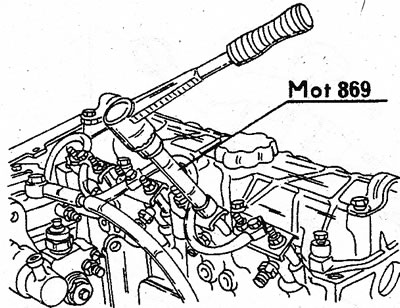
1. In Renault workshops, a curved key with a long socket head is used to unscrew the injectors (see illustration). To remove the injector, unscrew the hollow bolts of the oil drain line and disconnect the high-pressure fuel line.

26.1 Removing the injector. Use a special key in conjunction with a torque wrench. Tighten the nut…

26.1 Removing the injector. Use a special key in conjunction with a torque wrench. Tighten the nut to a torque of 17 Nm


2. Remove both nuts from the locking pin, remove the washers and remove the pins. Remove the nozzle, seal and fire washer, making a note of how the fire washer was installed.

3. Install in reverse order.

4. Install the fireproof washer in its original position (see illustration).
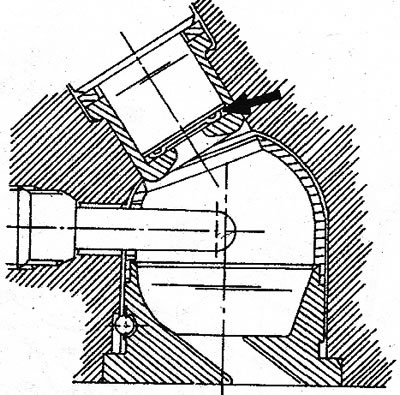
26.4 The arrow shows the correct position of the fireproof washer on the nozzle

26.4 The arrow shows the correct position of the fireproof washer on the nozzle


5. Install the injector and secure it evenly with the locking pin, washer, tighten the nuts with a tightening torque of 17 Nm. Tighten the union nut of the high-pressure fuel line with a tightening torque of 25 Nm.

6. After installing the injectors, the system must be bled of air, as described by the axle. when replacing the fuel filter. Make sure that the correct injectors are installed.

7. To ensure proper installation of the injector, remove the high-pressure fuel lines one by one and start the engine. Allow the engine to run at high speed.

8. If the engine's operating tone does not change without the action of the supposed cylinder, the injector of this cylinder is damaged.
This article is available on: russian, bulgarian, belarusian, ukrainian, serbian, croatian, romanian, polish, slovak, hungarian
Article has been reviewed by editor: Fedoseev Denis
Share with friends:
Previous
Espace I and II: Diesel fuel system
Next

Possible turbocharger malfunctions
Turbocharger — removal and installation
Turbocharger — Precautions
Air filter
Maximum rotation speed
Exhaust system
Other articles on other Renault models

➽ Diesel engine injectors Renault Duster 1 (2009-2017)
➽ Installation of cylinder injectors and piston bottom cooling for… Renault Fluence 1 (2009-2020, petrol)
➽ Removal and installation of the fuel distribution rail and… Renault Laguna 2 (2001-2007)
➽ Checking, removing and installing fuel injectors Renault Logan 1 (2004-2012, petrol)
➽ Checking, removing and installing injectors Renault Megane 1 (1995-2002)
Link to this article in different formats
Reviews and comments of visitors
No comments yet


Add two numbers 26 + 10


Renault 19 (1988-1996) 
  • General information
  • Maintenance
  • Power unit
  • Engine repair
  • Exhaust system
  • Cooling system
  • Supply system
  • Single-point injection
  • Multi-point injection
  • Diesel injection system
  • Transmission
  • Clutch
  • Car gearbox
  • Chassis, running gear
  • Car suspension
  • Steering
  • Brake system
  • Wheels and tires
  • Body and interior
  • Exterior (external elements)
  • Interior (internal elements)
  • Heating and ventilation
  • Electrical equipment
  • Equipment and devices
  • Headlights and lighting
  • Ignition system
  • Power devices
  • Electrical circuits
Espace I and II (1984-1996) 
  • General information
  • Introduction to the guide
  • Troubleshooting
  • Power unit
  • Engine repair
  • Cooling system
  • Carburetor fuel system
  • Injection fuel system
  • Diesel fuel system
  • Ignition system
  • Transmission
  • Clutch
  • Car gearbox
  • Drive shafts
  • Chassis, running gear
  • Brake system
  • Steering
  • Front suspension
  • Rear suspension
  • Body and interior
  • Exterior (external elements)
  • Interior (internal elements)
  • Doors, locks and windows
  • Electrical equipment
  • Equipment and devices
  • Electrical circuits
Espace III (1996-2002) 
  • General information
  • Introduction to the manual
  • User manual
  • Power unit
  • Petrol engines F3R
  • Petrol engines Z7X
  • Diesel engines G8T
  • Diesel engines G9T
  • Transmission
  • Clutch
  • Mechanical gearbox
  • Automatic gearbox
  • Drive shafts
  • Chassis, running gear
  • Steering
  • Front suspension
  • Rear suspension
  • Brake system
  • Body and interior
  • Exterior (external elements)
  • Interior (internal elements)
  • Doors, locks and windows
  • Heating and ventilation
  • Electrical equipment
  • Equipment and instruments
  • Power devices
  • Electrical circuits
RenaultBook.ru © 2018–2026 | Mobile version | News and articles | Sitemap: EN BG BY UA RS HR RO PL SK HU | Administration | Site search | Bookmark
Duster 1 (2009-2017) | Fluence 1 (2009-2020, petrol) | Kangoo 1 (1997-2007) | Laguna 2 (2001-2007) | Logan 1 (2004-2012, petrol) | Logan 2 (2012-2020) | Megane 1 (1995-2002) | Megan 2 (2002-2009, petrol) | Sandero 1 (2007-2012, petrol) | Scenic 1 (1996-2003) | Symbol 1 (1999-2008, petrol) | Symbol 2 (2008-2013, petrol) | Renault 19 (1988-1996) | Espace I and II (1984-1996) | Espace III (1996-2002) | Clio 1 (1990-1998) |
We want your visit to be comfortable 😌 and use cookies 🍪 to do so.