



General description
1. Illustrations show the exhaust systems being installed, including a front section on turbocharged diesel models, a system with and without a catalytic converter, and a system on V6 models. Not shown is the system on carburettor models. The design of this system is similar to that of a gasoline injection system, with a muffler pipe built into the exhaust pipe.
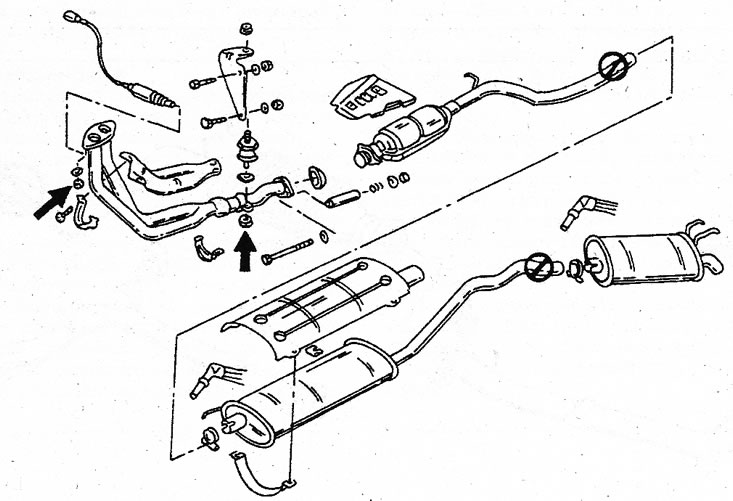
27.1a Exhaust system of a 4-cylinder engine with a gasoline injection system on second-generation vehicles
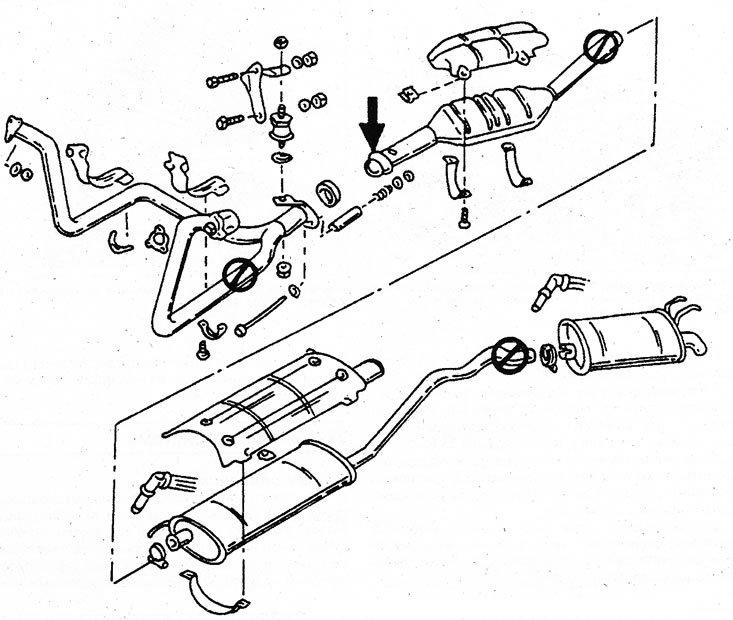
27.1b Exhaust system on V6 models
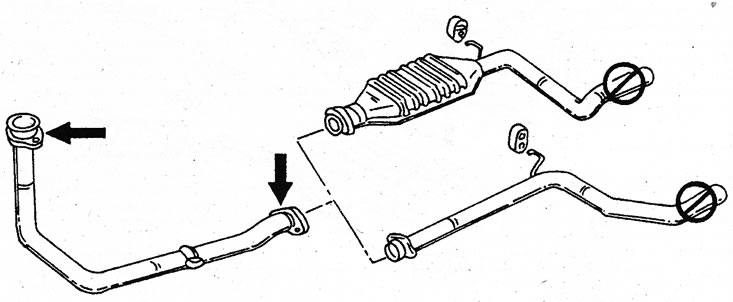
27.1c Front exhaust system on turbocharged diesel models
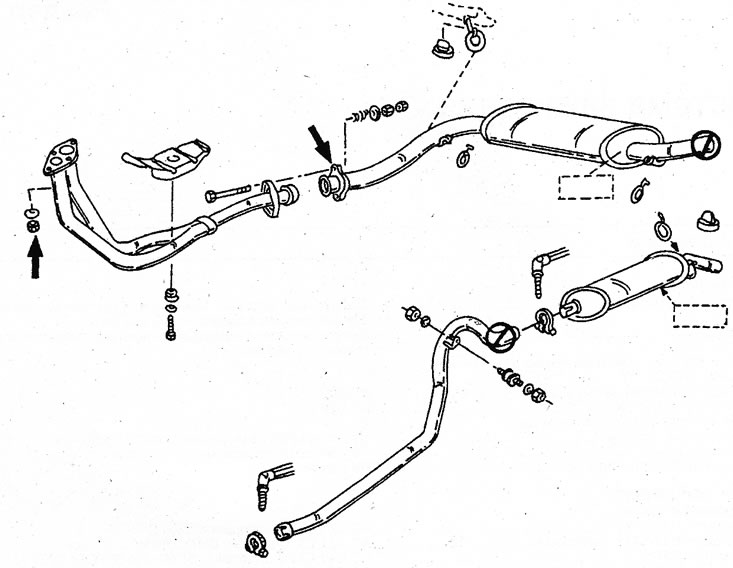
27.1 d Exhaust system on first generation models
Replacement of components
2. To replace the exhaust system, contact a car repair shop. When working, follow the illustrations. Pay attention to the following points:
3. To disconnect the front pipe from the exhaust manifold, disassemble the connections marked with black arrows or disassemble the connection between the two pipes.
4. The catalytic converter has a large flange connection at the front end and is secured with a clamp at the other end. Always replace the gasket between the flanges.
(Original publication on the portal renaultbook)
5. To remove the catalytic converter, disconnect the Lambda sensor wires, unscrew the sensor and then separate the front pipe and connecting pipe.
6. Also remove the heat shield.
7. Certain symbols in the illustrations show where the pipe sections should be separated. However, it is better to entrust this work to a specialist.
8. Always check the rubber hangers after removing the exhaust pipe. The system must be installed in such a way that the hangers are not under tension.
9. Always replace all seals. You can use sealant at your discretion.
10. Check the condition of the fastening brackets and bolts. When the brackets are removed, they are placed on the pipes so that both ends of the bracket grip the same parts of the pipe. Tighten the nuts and bolts with a tightening force of 20 Nm. Increasing the tightening force may cause deformation of the pipe.
11. Several joints are equipped with a spacer sleeve on both sides to determine the tension of the installed springs. In this case, tighten the nut until it is installed against the spacer sleeves.