
English Русский
Български
Беларускі
Український
Српски
Hrvatski
Română
Polski
Slovenský
Magyar
Bookmark Contacts Articles Sitemap
Company vehicles Peugeot Company vehicles Opel Company vehicles Skoda Company vehicles Land Rover Company vehicles Mitsubishi Company vehicles Volkswagen Company vehicles Honda
RenaultBook.ru


Duster   Fluence   Kangoo   Laguna   Logan   Megane   Sandero   Scenic   Symbol   Clio   Other
Laguna 2 (2001-2007)

Emergency braking system (Renault Laguna 2)

  • Main
  • Laguna
  • Laguna 2 (2001-2007)
  • Chassis, running gear
  • Brake system
  • Emergency braking system
0
Contents: Description 🠛 Operating principle 🠛 Electronic emergency braking system 🠛 Mechanical emergency braking system 🠛
Note: The emergency braking system complements the ABS.


Description


Two types of technologies can increase braking force during emergency braking. One is based on the use of electronic components (electronic Emergency Braking System), the other - on the use of mechanical components (mechanical emergency braking system).

The electronic emergency braking system operates under the following conditions:
  • vacuum booster with switch, activated when the brake pedal is pressed;
  • brake pedal travel sensor;
  • master brake cylinder.

The amplification control is performed by the ABS ECU.

The mechanical emergency braking system operates when the vacuum booster with a valve reacts to the speed of movement of the brake pedal.

In both cases, the speed at which the pedal is pressed is determined. This allows the brake booster to create additional pressure in the brake hydraulic drive, which is added to the pressure created when the driver presses the pedal.

The maximum pressure is limited by the vacuum level supplied to the booster.

Operating principle


Emergency Brake Assist enables the system to recognise the situation and act immediately to ensure the shortest possible stopping distance.

Emergency braking is determined by the speed of movement of the brake pedal; at the same time, the braking force immediately becomes maximum, which allows the ABS to be activated as quickly as possible.


ABS-controlled braking continues until the driver releases the brake pedal.

During normal braking, the system operates in normal mode.
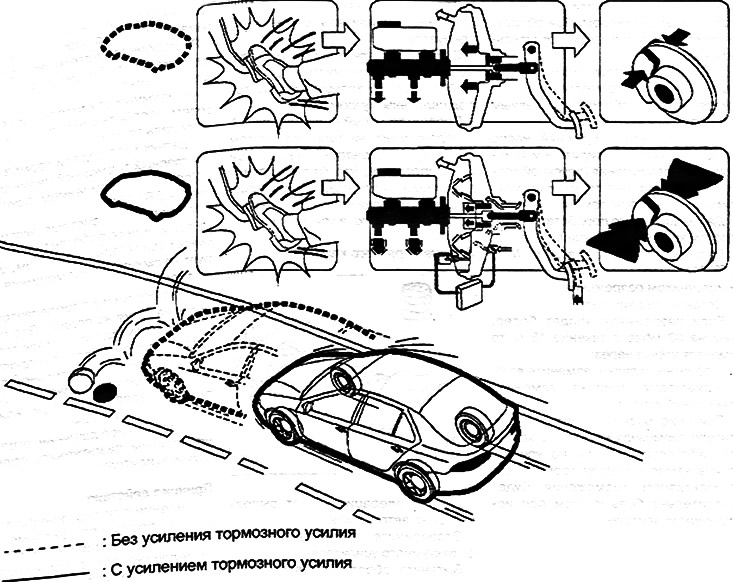
During normal braking, the system operates in normal mode.


Electronic emergency braking system


When braking, the driver presses the brake pedal, which acts on the travel sensor 1 and the deactivator switch 2.

When braking, the driver presses the brake pedal, which acts on the travel sensor 1 and the…


The control unit determines the speed of the pedals and corrects it using two coefficients:
  • correction by pedal position;
  • correction based on vehicle speed.

If the obtained result exceeds the set threshold and if the switch is turned on as quickly as possible, the control unit activates the brake booster solenoid valve of the vacuum booster, which moves the piston of the main brake cylinder. Otherwise, the vacuum works as usual. The emergency braking system is deactivated as soon as the driver releases the brake pedal.


Mechanical emergency braking system


Built-in mechanical inertia valve in the vacuum booster (spring l ball for maintaining gain) allows you to activate the brake booster in the vacuum booster depending on the speed of pressing the pedal; thereby increasing the pressure in the brake hydraulic drive.

Note: The method for removing the vacuum booster is the same for both electronic and mechanical emergency braking systems.


The only difference is in disconnecting the wiring harness, see Removing the Brake Booster.
This article is available on: russian, bulgarian, belarusian, ukrainian, serbian, croatian, romanian, polish, slovak, hungarian
Article has been reviewed by editor: Podkrepilov Maxim
Share with friends:
Previous
Laguna 2: Brake system
Next

Air filter — check valve
Checking the tightness of the brake booster
Installing a vacuum brake booster
Vacuum brake booster (automatic transmission SU1) — removal
Vacuum brake booster (MKP RK6) — removal
Removal and installation the diaphragm displacement sensor
Removal and installation the brake pedal travel sensor
Removal, installation and adjusting the parking brake lever
Removal and installation brake hoses
Brake system diagnostics
Other articles on other Renault models

➽ Emergency alarm system Renault Duster 1 (2009-2017)
➽ General information about the braking system Renault Fluence 1 (2009-2020, petrol)
➽ Anti-lock braking system Renault Kangoo 1 (1997-2007)
➽ Checking the efficiency of the braking system Renault Logan 1 (2004-2012, petrol)
➽ Emergency alarm system Renault Megan 2 (2002-2009, petrol)
Link to this article in different formats
Reviews and comments of visitors
No comments yet


Add two numbers 39 + 49


Laguna 2 (2001-2007) 
  • General information
  • User manual
  • Maintenance
  • Power unit
  • Engine repair
  • Cooling system
  • Fuel system
  • Fuel injection (petrol)
  • Power system (petrol)
  • Fuel injection (diesel)
  • Fuel system (diesel)
  • Exhaust system
  • Transmission
  • Clutch
  • Mechanical gearbox
  • Automatic gearbox
  • Drive shafts
  • Chassis, running gear
  • Wheels and tires
  • Car suspension
  • Steering
  • Brake system
  • Body and interior
  • Exterior (external elements)
  • Doors, locks and windows
  • Electrical equipment
  • Power devices
  • Equipment and devices
  • Headlights and lighting
  • Breakers and switches
  • Safety system
  • Electrical circuits
RenaultBook.ru © 2018–2026 | Mobile version | News and articles | Sitemap: EN BG BY UA RS HR RO PL SK HU | Administration | Site search | Bookmark
Duster 1 (2009-2017) | Fluence 1 (2009-2020, petrol) | Kangoo 1 (1997-2007) | Laguna 2 (2001-2007) | Logan 1 (2004-2012, petrol) | Logan 2 (2012-2020) | Megane 1 (1995-2002) | Megan 2 (2002-2009, petrol) | Sandero 1 (2007-2012, petrol) | Scenic 1 (1996-2003) | Symbol 1 (1999-2008, petrol) | Symbol 2 (2008-2013, petrol) | Renault 19 (1988-1996) | Espace I and II (1984-1996) | Espace III (1996-2002) | Clio 1 (1990-1998) |
We want your visit to be comfortable 😌 and use cookies 🍪 to do so.