



The exhaust system consists of an exhaust manifold, an exhaust pipe, a catalytic converter and mufflers.
Exhaust pipes provide connections between the elements of the exhaust system.
Mufflers are designed to smooth out pulsations in the exhaust gas flow and reduce noise levels. Mufflers operate based on two physical effects - resonance and sound absorption. Mufflers usually use a combination of these effects.
Resonant mufflers consist of chambers of different lengths, connected to each other by pipes. The difference in the cross-sectional areas of the pipes and chambers, the change in the direction of the exhaust gas flow and the presence of resonators together with connecting pipes and chambers, ensures optimal noise reduction, especially at low frequencies.
The exhaust system is attached to the bottom of the car using elastic elements to reduce vibration from the passage of exhaust gases. After working on the exhaust system, check that the system is installed freely, without tension and that there is sufficient clearance from the body elements.
The Z7X engine exhaust system is equipped with "METEX" ring clamps at the junctions of the inlet pipe with the manifolds and catalytic converter.
Resonator and catalytic converter
- Despite the fact that the resonator and muffler are connected by a solid pipe, it is possible to replace these elements separately.
- In this case, it is necessary to cut the pipe as follows.
- Remove the resonator-muffler assembly.
- Mark the cutting location.
- The cutting area is marked by two punched dots on the exhaust pipe (on the left or right side of a straight section of pipe).
- The distance between two marks is 90 mm.
- To cut the pipe, you need to draw a line in the middle between the marks.
- The marks may not be visible due to corrosion and dirt, in which case clean this section of the pipe with sandpaper.
- Use the Mot. 1199 tool to cut the pipe. Position the Mot. 1199 tool at the desired location on the exhaust pipe. Loosen the chain as much as possible and wrap it around the pipe and attach the tool to the chain. Rotate the tool around the pipe, tightening the chain as you cut (do not tighten too much to avoid deforming the pipe when cutting).
- Remove the element to be replaced.
- Install and secure the repair pipe. To ensure the tightness of the exhaust system, it is important to install the pipe on the pipes correctly, i.e. so that the pipe rests against the protrusions inside the pipe. First, install the pipe on the old pipe and slightly press it with a clamp. Check that the pipe rests against the protrusions.
- Install a new exhaust system component
- Before installing the branch pipe, apply a special mastic to the inner ring of the branch pipe to seal the connection. Mastic for the exhaust system, catalog number 77 01 421 161. SODICAM.
(You can find the original at this link: RENAULTBOOK.ru)
Attention: To avoid contact with the body, the clamping bolt with the nut of the branch pipe must be oriented vertically on the left side of the pipe.
- Before finally tightening the nut, make sure that the catalytic converter and resonator are securely fastened to the underbody of the vehicle.
- Once removed, the clamp cannot be reused.
- The clamp nut has a groove (A, Fig. 2.79), to indicate the correct tightening torque. When the groove disappears during tightening, it makes a characteristic click, this means that the nut has been tightened to a torque of 25 N·m.
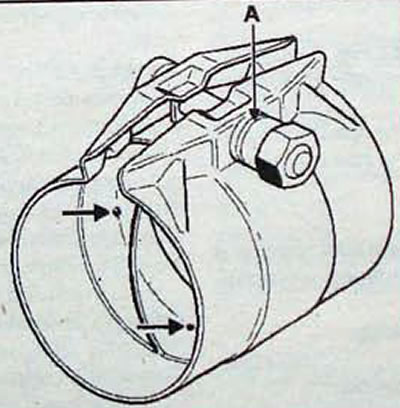
Fig. 2.79. Repair pipe of the exhaust system: A - groove that determines the tightening torque of the nut
Note: For vehicles with Z7X engines, 55mm diameter pipes must be used.
- Before assembling the unit, make sure that there are no contaminants or metal particles in the exhaust pipe up to the resonator.
- Replace the gasket at the outlet of the catalytic converter.
- When installing the resonator-muffler assembly, release the catalytic converter-resonator connection to align the pipe.
- After installation, check that the pipe does not touch the bottom anywhere