
English Русский
Български
Беларускі
Український
Српски
Hrvatski
Română
Polski
Slovenský
Magyar
Bookmark Contacts Articles Sitemap
Company vehicles Peugeot Company vehicles Opel Company vehicles Skoda Company vehicles Land Rover Company vehicles Mitsubishi Company vehicles Volkswagen Company vehicles Honda
RenaultBook.ru


Duster   Fluence   Kangoo   Laguna   Logan   Megane   Sandero   Scenic   Symbol   Clio   Other
Symbol 1 (1999-2008, petrol) Symbol 2 (2008-2013, petrol)

Front suspension — design description (Renault Symbol 2)

  • Main
  • Symbol
  • Symbol 2 (2008-2013, petrol)
  • Chassis, running gear
  • Front suspension
  • Front suspension — design description
0
The front suspension is independent with McPherson shock absorber struts, lower triangular arms and anti-roll bar mounted on a subframe. The shock absorber struts with coil springs are attached to the reinforced body supports with their upper part, and are screwed with two bolts to the upper part of the steering knuckles with their lower part. The front wheel hubs rotate in radial thrust bearings pressed onto the steering knuckles.

The lower part of the steering knuckles is connected to the suspension arms by means of ball joints. The ball joints are attached to the suspension arms with bolts and are secured to the steering knuckle by means of a bolted clamp connection.

The suspension arms are connected to the body via rubber-metal bushings – silent blocks.
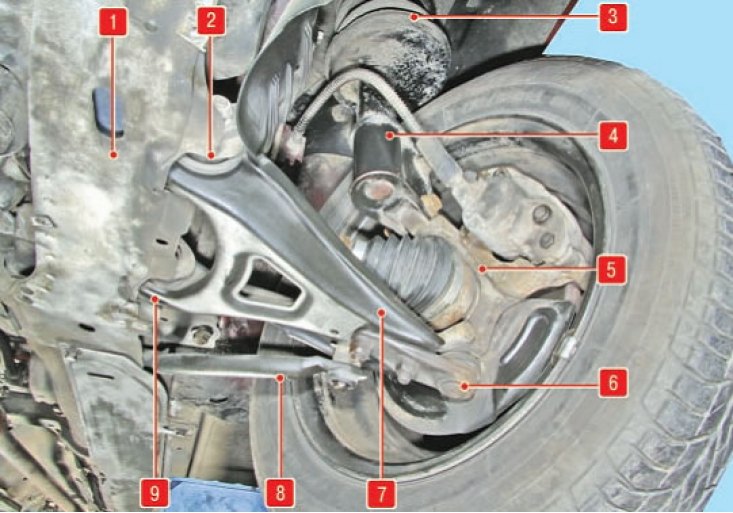
Front suspension: 1 - front suspension subframe; 2 - front hinge (silent block) front suspension…

Front suspension: 1 - front suspension subframe; 2 - front hinge (silent block) front suspension arm; 3 - spring; 4 - front suspension shock absorber; 5 - steering knuckle; b - ball joint; 7 - front suspension arm; 8 - anti-roll bar; 9 - rear hinge (silent block) front suspension arm
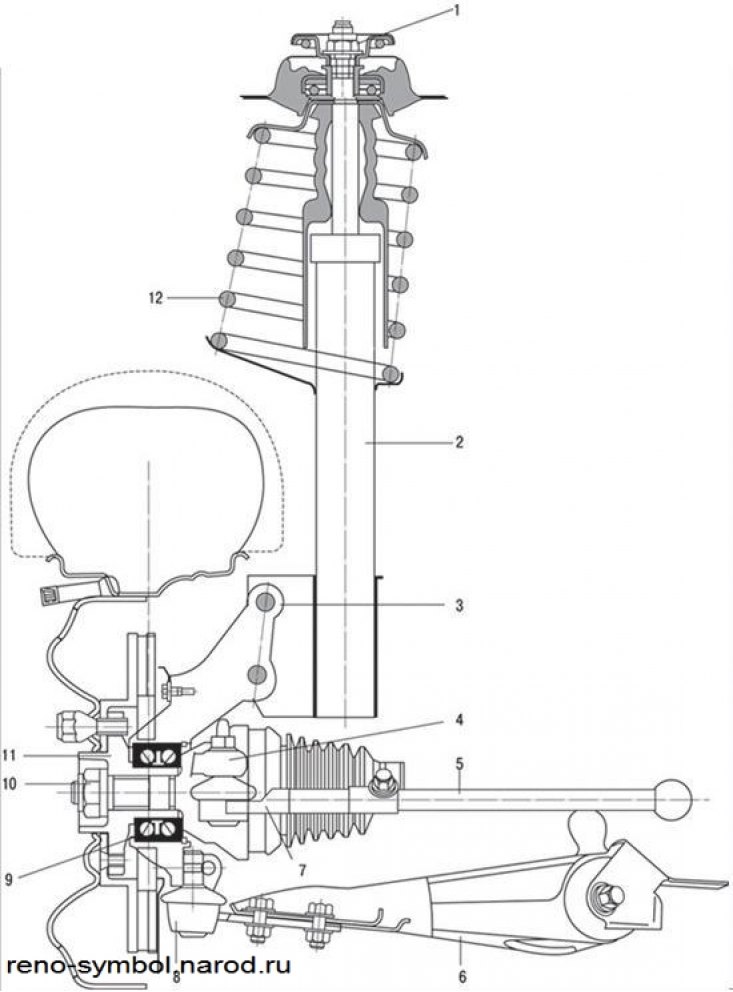

Figure 5.1. Front suspension view: 1 – nut for fastening the upper end of the shock absorber strut;…

Figure 5.1. Front suspension view: 1 – nut for fastening the upper end of the shock absorber strut; 2 – shock absorber strut; 3 – steering knuckle; 4 – steering rod joint; 5 – steering rod; 6 – lower suspension arm; 7 – steering rod end; 8 – suspension arm joint; 9 – wheel hub bearing; 10 – front wheel drive shaft nut; 11 – hub; 12 – spring
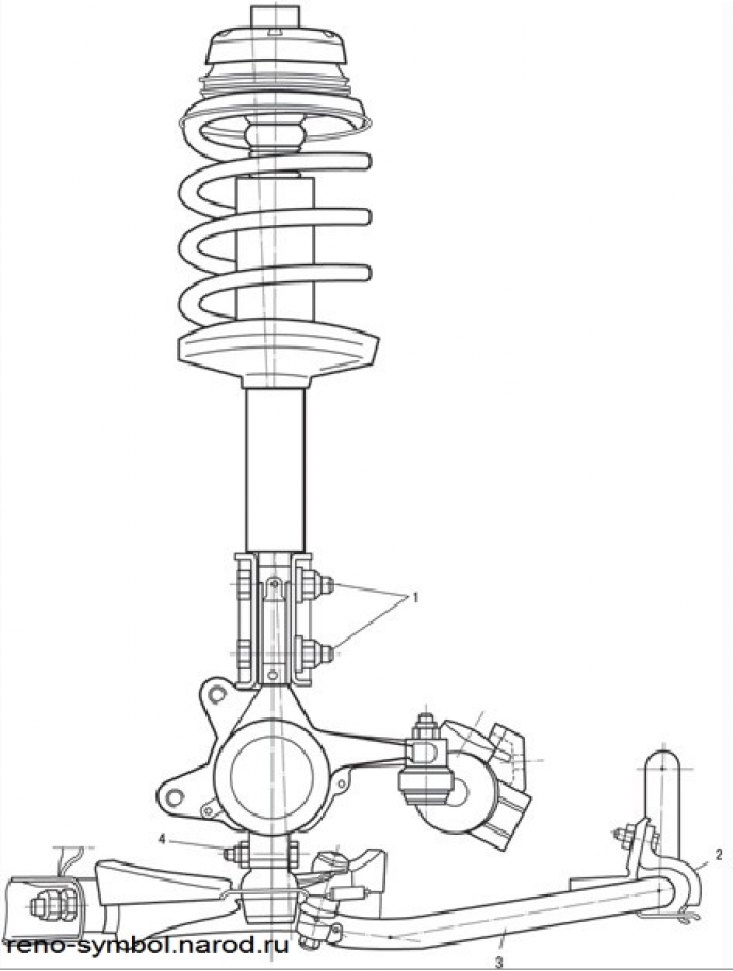


Figure 5.2. Front suspension view: 1 – shock absorber strut mounting bolts; 2 – anti-roll bar…

Figure 5.2. Front suspension view: 1 – shock absorber strut mounting bolts; 2 – anti-roll bar mounting clamp; 3 - transverse stabilizer bar; 4 – bolt for fastening the lever joint to the steering knuckle


The rear suspension is of a semi-independent type with longitudinal levers attached to the car body via silent blocks. Coil springs are installed separately from the double-acting hydraulic shock absorbers. The shock absorbers are attached to the body with their upper ends, and to the longitudinal levers with their lower ends.
This article is available on: russian, bulgarian, belarusian, ukrainian, serbian, croatian, romanian, polish, slovak, hungarian
Article has been reviewed by editor: Kupriyanov Sergey
Share with friends:
Previous
Symbol 2: Front suspension
Next

Front and rear wheel alignment angles
Front suspension faults and how to fix them
Tightening torques of front suspension components (Nm)
Replacing the front shock absorber
Disassembly and repair of the shock absorber
Replacing the anti-roll bar
Other articles on other Renault models

➽ Description of the front suspension design Renault Logan 1 (2004-2012, petrol)
➽ Front suspension — design features Renault Sandero 1 (2007-2012, petrol)
➽ Description of the front suspension design Renault Scenic 1 (1996-2003)
➽ Front suspension — design description Renault 19 (1988-1996)
➽ Lower control arm of the front suspension Renault Duster 1 (2009-2017)
Link to this article in different formats
Reviews and comments of visitors
No comments yet


Add two numbers 26 + 41


Symbol 2 (2008-2013, petrol) 
  • General information
  • User manual
  • Maintenance
  • Power unit
  • Engine repair
  • Cooling system
  • Fuel system
  • Exhaust system
  • Ignition system
  • Transmission
  • Clutch
  • Mechanical gearbox
  • Automatic gearbox
  • Drive shafts
  • Chassis, running gear
  • Front suspension
  • Rear suspension
  • Steering
  • Brake system
  • Body and interior
  • Exterior (external elements)
  • Interior (internal elements)
  • Doors, locks and windows
  • Heating and ventilation
  • Electrical equipment
  • Equipment and devices
  • Headlights and lighting
  • Power devices
  • Electrical circuits
Symbol 1 (1999-2008, petrol) 
  • General information
  • User manual
  • Car care
  • Maintenance
  • Power unit
  • Engine repair
  • Cooling and lubrication system
  • Supply system
  • Exhaust system
  • Ignition system
  • Transmission
  • Clutch
  • Mechanical gearbox
  • Automatic gearbox
  • Drive shafts
  • Chassis, running gear
  • Car suspension
  • Steering
  • Brake system
  • Body and interior
  • Exterior (external elements)
  • Interior (internal elements)
  • Doors, locks and windows
  • Restoration and repair
  • Electrical equipment
  • Equipment and devices
  • Headlights and lighting
  • Power devices
  • Heating and ventilation
  • Electrical circuits
RenaultBook.ru © 2018–2026 | Mobile version | News and articles | Sitemap: EN BG BY UA RS HR RO PL SK HU | Administration | Site search | Bookmark
Duster 1 (2009-2017) | Fluence 1 (2009-2020, petrol) | Kangoo 1 (1997-2007) | Laguna 2 (2001-2007) | Logan 1 (2004-2012, petrol) | Logan 2 (2012-2020) | Megane 1 (1995-2002) | Megan 2 (2002-2009, petrol) | Sandero 1 (2007-2012, petrol) | Scenic 1 (1996-2003) | Symbol 1 (1999-2008, petrol) | Symbol 2 (2008-2013, petrol) | Renault 19 (1988-1996) | Espace I and II (1984-1996) | Espace III (1996-2002) | Clio 1 (1990-1998) |
We want your visit to be comfortable 😌 and use cookies 🍪 to do so.