
English Русский
Български
Беларускі
Український
Српски
Hrvatski
Română
Polski
Slovenský
Magyar
Bookmark Contacts Articles Sitemap
Company vehicles Peugeot Company vehicles Opel Company vehicles Skoda Company vehicles Land Rover Company vehicles Mitsubishi Company vehicles Volkswagen Company vehicles Honda
RenaultBook.ru


Duster   Fluence   Kangoo   Laguna   Logan   Megane   Sandero   Scenic   Symbol   Clio   Other
Symbol 1 (1999-2008, petrol) Symbol 2 (2008-2013, petrol)

Replacing the front wheel hub bearing (Renault Symbol 1)

  • Main
  • Symbol
  • Symbol 1 (1999-2008, petrol)
  • Chassis, running gear
  • Car suspension
  • Replacing the front wheel hub bearing
0
The front wheel hub bearings do not require maintenance during vehicle operation and are replaced only in the event of increased wear. To determine the bearing condition, a dial indicator is used, the bracket (stand) of which is fixed on the steering knuckle. The indicator leg is placed against the brake disc, the rocking of which will give an assessment of the bearing condition. If the indicator reading exceeds 0.05 mm, the bearing must be replaced.

Caution: Attempting to reduce bearing clearance by over-tightening the hub nut will result in accelerated bearing failure.


When a bearing is pressed out, it is destroyed and replaced with a new one.

Removal procedure:
  • remove the steering knuckle as described above;
  • install the steering knuckle on wooden supports;
  • using a suitable tubular mandrel, press the hub flange out of the bearing only. If the hub was pressed out together with the inner double bearing race, pull the race off the hub using a puller;
  • remove the snap ring from the groove on the steering knuckle;
  • press out the remaining part of the bearing using a press, applying force to the inner ring of the bearing;
  • clean the steering knuckle and hub thoroughly from grease and dirt, remove any nicks and burrs with a file. Inspect the parts for cracks and other damage. Replace the bearing and retaining ring with new ones.

Installation procedure:
  • make sure (if possible) the presence of grease in the internal cavity of the bearing;
  • lightly lubricate the bearing ring surfaces with grease;
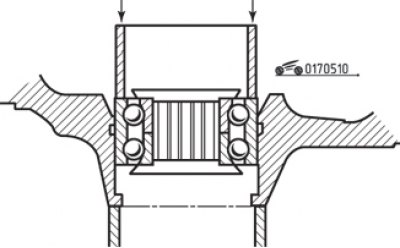
Fig. 5.10. Pressing the bearing into the steering knuckle

Fig. 5.10. Pressing the bearing into the steering knuckle


  • using a press, press the bearing into the steering knuckle using a mandrel with an outside diameter of 70 mm and an inside diameter of 66 mm, applying force to the outer ring (Fig. 5.10);
  • install a new snap ring into the groove on the steering knuckle;
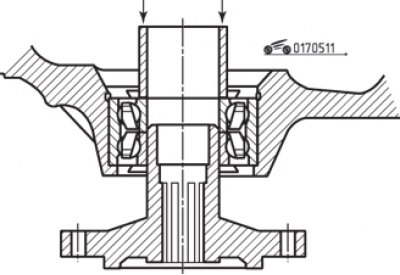
Fig. 5.11. Pressing the bearing onto the front wheel hub

Fig. 5.11. Pressing the bearing onto the front wheel hub

  • place the inner race on the hub and press the bearing onto the hub using a mandrel with an outer diameter of 48 mm and an inner diameter of 42 mm, applying load to the inner ring of the bearing (Fig. 5.11);
  • make sure the hub flange rotates freely and remove excess grease;
  • install the steering knuckle as described above.
This article is available on: russian, bulgarian, belarusian, ukrainian, serbian, croatian, romanian, polish, slovak, hungarian
Article has been reviewed by editor: Podkrepilov Maxim
Share with friends:
Previous
Symbol 1: Car suspension
Next

Removal and installation the lower arm ball joint
Replacing silent blocks of the lower arm
Removal the lower arm
Removal and installation the steering knuckle
Removal and installation the anti-roll bar
Removal and installation the rear shock absorber
Removal and installation the rear suspension spring
Replacing the rear wheel hub bearings
Replacing the rear suspension silent blocks
Rear wheel alignment angles
Other articles on other Renault models

➽ Replacing the front wheel hub bearing Renault Sandero 1 (2007-2012, petrol)
➽ Front wheel hub bearing Renault Duster 1 (2009-2017)
➽ Front wheel hub bearing Renault Fluence 1 (2009-2020, petrol)
➽ Replacing the front hub bearing Renault Logan 1 (2004-2012, petrol)
➽ Checking and replacing front wheel hub bearings Renault Megane 1 (1995-2002)
Link to this article in different formats
Reviews and comments of visitors
No comments yet


Add two numbers 27 + 44


Symbol 2 (2008-2013, petrol) 
  • General information
  • User manual
  • Maintenance
  • Power unit
  • Engine repair
  • Cooling system
  • Fuel system
  • Exhaust system
  • Ignition system
  • Transmission
  • Clutch
  • Mechanical gearbox
  • Automatic gearbox
  • Drive shafts
  • Chassis, running gear
  • Front suspension
  • Rear suspension
  • Steering
  • Brake system
  • Body and interior
  • Exterior (external elements)
  • Interior (internal elements)
  • Doors, locks and windows
  • Heating and ventilation
  • Electrical equipment
  • Equipment and devices
  • Headlights and lighting
  • Power devices
  • Electrical circuits
Symbol 1 (1999-2008, petrol) 
  • General information
  • User manual
  • Car care
  • Maintenance
  • Power unit
  • Engine repair
  • Cooling and lubrication system
  • Supply system
  • Exhaust system
  • Ignition system
  • Transmission
  • Clutch
  • Mechanical gearbox
  • Automatic gearbox
  • Drive shafts
  • Chassis, running gear
  • Car suspension
  • Steering
  • Brake system
  • Body and interior
  • Exterior (external elements)
  • Interior (internal elements)
  • Doors, locks and windows
  • Restoration and repair
  • Electrical equipment
  • Equipment and devices
  • Headlights and lighting
  • Power devices
  • Heating and ventilation
  • Electrical circuits
RenaultBook.ru © 2018–2026 | Mobile version | News and articles | Sitemap: EN BG BY UA RS HR RO PL SK HU | Administration | Site search | Bookmark
Duster 1 (2009-2017) | Fluence 1 (2009-2020, petrol) | Kangoo 1 (1997-2007) | Laguna 2 (2001-2007) | Logan 1 (2004-2012, petrol) | Logan 2 (2012-2020) | Megane 1 (1995-2002) | Megan 2 (2002-2009, petrol) | Sandero 1 (2007-2012, petrol) | Scenic 1 (1996-2003) | Symbol 1 (1999-2008, petrol) | Symbol 2 (2008-2013, petrol) | Renault 19 (1988-1996) | Espace I and II (1984-1996) | Espace III (1996-2002) | Clio 1 (1990-1998) |
We want your visit to be comfortable 😌 and use cookies 🍪 to do so.