
English Русский
Български
Беларускі
Український
Српски
Hrvatski
Română
Polski
Slovenský
Magyar
Bookmark Contacts Articles Sitemap
Company vehicles Peugeot Company vehicles Opel Company vehicles Skoda Company vehicles Land Rover Company vehicles Mitsubishi Company vehicles Volkswagen Company vehicles Honda
RenaultBook.ru


Duster   Fluence   Kangoo   Laguna   Logan   Megane   Sandero   Scenic   Symbol   Clio   Other
Megane 1 (1995-2002) Megan 2 (2002-2009, petrol)

Replacing the protective cover of the inner CV joint of the left drive shaft (models with manual transmission) (Renault Megane 1)

  • Main
  • Megane
  • Megane 1 (1995-2002)
  • Transmission
  • Drive shafts
  • Replacing the protective cover of the inner CV joint of the left drive shaft (models with manual transmission)
0
1. Remove the drive shaft (refer to Section Removal and installation the drive shaft).

2. Using special pliers, remove the retaining ring securing the tripod to the drive shaft. Please note that on some models the CV joint may be secured with a locking rim; in this case, remove the joint using a file. Mark the position of the tripod part of the CV joint on the drive shaft.

3. Remove the tripod. If this is not possible, use a puller. Make sure that the puller legs are positioned behind the tripod and do not touch its rollers. Alternatively, use a hydraulic press.

4. The protective cover/bearing assembly is removed in the same way. Remove the mounting plate, remembering its correct location.

5. Purchase a protective cover that comes with a bearing.

6. Since the bearing is sealed with a sealing lip, a press must be used to install the boot/bearing assembly onto the drive shaft. The usual method (hammer and tubular punch) will inevitably lead to damage to the seal.

7. Install the mounting plate onto the drive shaft, making sure it is oriented correctly.
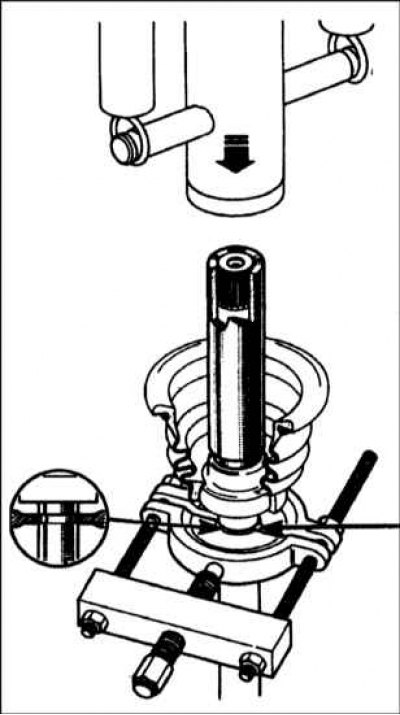
7. Install the mounting plate onto the drive shaft, making sure it is oriented correctly.


8a. Tighten the drive shaft and press the bearing/boot assembly onto it, using a hollow drift that only contacts the inner race of the bearing.


8a. Tighten the drive shaft and press the bearing/boot assembly onto it, using a hollow drift that…


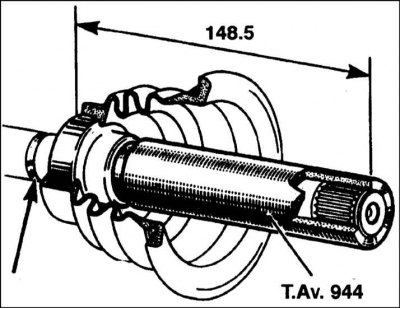
8b. Position the bearing so that the distance from its inner surface to the end of the drive shaft is 148.5 mm (refer to the illustrations).

9. Align the marks made during removal and install the CV joint tripod onto the drive shaft grooves. Use a hammer and a soft metal punch or a press.

10. Secure the tripod with the locking ring (it should fit into the groove of the shaft). Where a snap ring is not used, secure the end of the drive shaft with a hammer and punch by tapping along its edge at three equally spaced points.

11. Install the drive shaft as described in Section Removal and installation the drive shaft.
This article is available on: russian, bulgarian, belarusian, ukrainian, serbian, croatian, romanian, polish, slovak, hungarian
Article has been reviewed by editor: Fedoseev Denis
Share with friends:
Previous
Megane 1: Drive shafts
Next

Replacing the protective boot of the inner CV joint of the right…
Replacing the protective cover of the outer CV joint of the drive…
Removal and installation the drive shaft
Specifications and description of drive shafts
General description of replacement of the protective cover of the…
General description of drive shaft overhaul
Other articles on other Renault models

➽ Replacing the protective cover of the CV joint together with the… Renault Espace III (1996-2002)
➽ Left Drive Shaft Inner CV Joint Boot (Manual Transmission… Renault Clio 1 (1990-1998)
➽ Front Drive Shaft Outer Joint Protective Cover (F4R) Renault Laguna 2 (2001-2007)
➽ Front wheel drive shaft protective cover, wheel side Renault Duster 1 (2009-2017)
➽ Left front wheel drive shaft (cars with automatic transmission) Renault Fluence 1 (2009-2020, petrol)
Link to this article in different formats
Reviews and comments of visitors
No comments yet


Add two numbers 22 + 16


Megan 2 (2002-2009, petrol) 
  • User manual
  • Introduction to manual
  • Controls and instruments
  • Salon equipment
  • Operation and driving
  • Maintenance and care
  • Power unit
  • Engine repair
  • Fuel system
  • Injection system
  • Intake and exhaust system
  • Starting and charging system
  • Cooling system
  • Decreased toxicity
  • Transmission
  • Clutch
  • Mechanical gearbox
  • Automatic gearbox
  • Wheel drive mechanism
  • Chassis, running gear
  • Suspension and wheels
  • Steering
  • Brake system
  • Body and interior
  • Exterior (external elements)
  • Interior (internal elements)
  • Doors, locks and windows
  • Heating and air conditioning
  • Electrical equipment
  • Equipment and devices
  • Headlights and lighting
  • Electrical circuits
Megane 1 (1995-2002) 
  • General information
  • User manual
  • Maintenance
  • Power unit
  • Petrol engines 1.4/1.6 l
  • Petrol engines 2.0 l
  • Diesel engines 1.9 l
  • Overhaul of engines
  • Cooling system
  • Fuel system (petrol)
  • Fuel system (diesel)
  • Decreased toxicity
  • Charge and launch systems
  • Ignition system (petrol)
  • Preheat system (diesel)
  • Transmission
  • Clutch
  • Mechanical gearbox
  • Automatic gearbox
  • Drive shafts
  • Chassis, running gear
  • Brake system
  • Car suspension
  • Steering
  • Body and interior
  • Exterior (external elements)
  • Interior (internal elements)
  • Doors, locks and windows
  • Electrical equipment
  • Equipment and devices
  • Electrical circuits
RenaultBook.ru © 2018–2026 | Mobile version | News and articles | Sitemap: EN BG BY UA RS HR RO PL SK HU | Administration | Site search | Bookmark
Duster 1 (2009-2017) | Fluence 1 (2009-2020, petrol) | Kangoo 1 (1997-2007) | Laguna 2 (2001-2007) | Logan 1 (2004-2012, petrol) | Logan 2 (2012-2020) | Megane 1 (1995-2002) | Megan 2 (2002-2009, petrol) | Sandero 1 (2007-2012, petrol) | Scenic 1 (1996-2003) | Symbol 1 (1999-2008, petrol) | Symbol 2 (2008-2013, petrol) | Renault 19 (1988-1996) | Espace I and II (1984-1996) | Espace III (1996-2002) | Clio 1 (1990-1998) |
We want your visit to be comfortable 😌 and use cookies 🍪 to do so.