



Contents: Inner CV joint of the right shaft…🠛 Option with ring spring 🠛 Option with metal cuff 🠛 Left drive shaft joint with ball…🠛
If the CV joint seal is changed due to a defect, it is recommended, especially for vehicles with high mileage, to also replace the seal of the second CV joint. The inner CV joints on the left and right drive shafts are different. The inner CV joint of the left shaft has a seal with a bearing. The CV joint seal of the right drive shaft does not have a ball bearing. To replace the seal, the drive shaft must be disassembled.
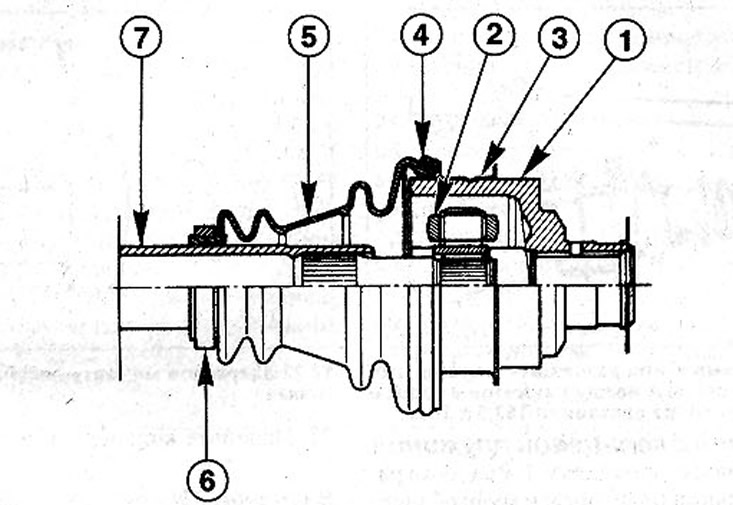
12.0 Inner CV joint of the right shaft without ball bearing
1 - coupling; 2 - crosspiece; 3 - metal cuff; 4 - ring spring; 5 - rubber cuff; 6 - rubber ring; 7 - shaft
Inner CV joint of the right shaft with a cuff without a ball bearing (see illustration 12.0)
Removal
1. Remove the drive shaft.
2. Option with a metal cuff. Bend the cuff with pliers at three points (see illustration).
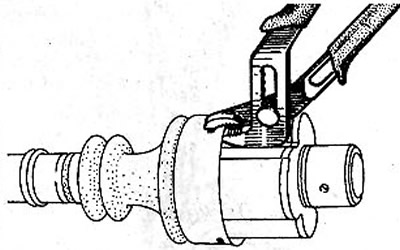
12.2 Bend the cuff with pliers at three points
3. Remove the rubber seal and knock the metal seal off the shaft using a punch.
Option with ring spring
4. Remove the ring spring 1 from the cuff on the coupling 2 of the CV joint (see illustration).
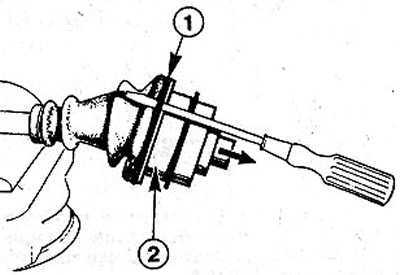
12.4 Remove the ring spring 1 from the cuff on the CV joint coupling 2
5. Cut the rubber cuff lengthwise and remove it.
6. Remove the CV joint grease. Do not use solvent.
7. Bend back the tabs of the limiting plate 1 (see illustration).
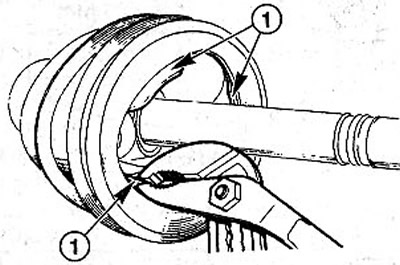
12.7 Bend back the tabs of the limiting plate 1
8. Disconnect the CV joint.
Attention! The rollers must not fall out. The rollers and journals are matched to each other and cannot be installed arbitrarily. Secure the rollers to the sprocket using tape.
Caution! Do not use solvents to clean parts.
9. Remove the retaining ring, if present, using needle-nose pliers and press the shaft out of the CV joint housing (see illustration).
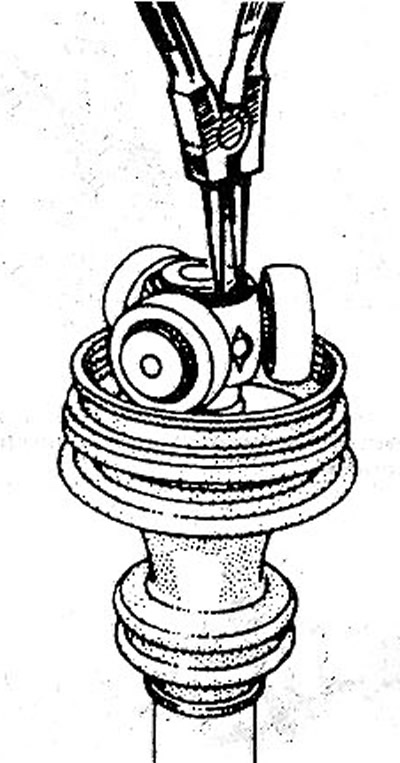
12.9 Remove the retaining ring, if present, using needle-nose pliers and press the shaft out of the CV joint housing
Installation
10. Clean all parts thoroughly with a rag.
11. Install the rubber ring together with the shaft seal. To facilitate installation, lubricate the end of the shaft with a thin layer of grease.
12. Press the joint sprocket onto the shaft end.
13. Install the retaining ring. If there was no ring, then secure the sprocket with three notches at a distance of 120° from each other, applying the notches to the splines of the shaft (see illustration).
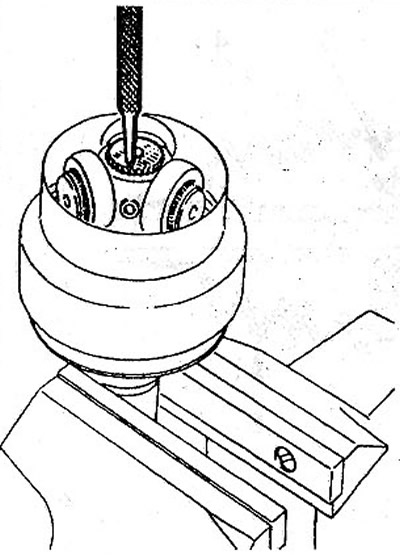
12.13 Install the retaining ring. If there was no ring, secure the sprocket with three notches at a distance of 120° from each other
14. Fill the entire quantity of MOBIL CVJ 825 or MOBIL EXF 57 C grease (130 g) included in the kit into the cuff and into the CV joint.
Option with ring spring
1.5 Insert spacer 1 between the limit plate and the hinge sleeve (see illustration). You can make the gasket yourself using the drawing.
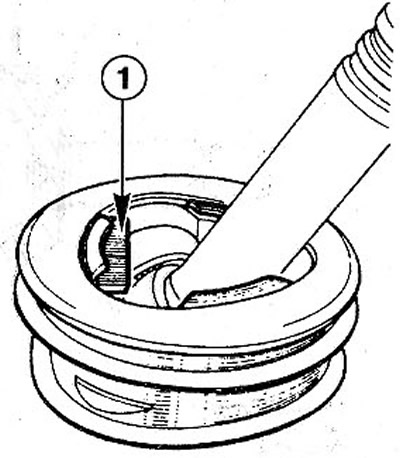
12.15 Insert spacer 1 between the limit plate and the joint sleeve
16. Make a 2.5mm thick gasket using the drawing as a guide (see illustration).
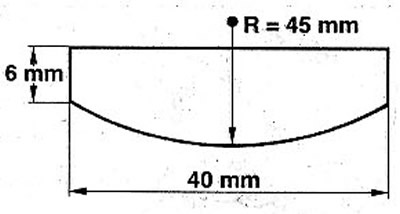
12.16 Gasket drawing
17. Use a bronze punch to press the limiting plate back to its original position and remove gasket 1.
18. Insert the ends of the cuff into the grooves on the shaft and on the joint sleeve.
19. Compress or release the joint so that the distance A between the cuff and the end of the joint coupling is 153.5±1 mm (see illustration).
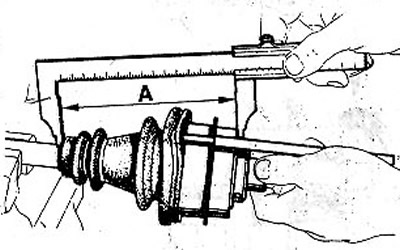
12.19 Compress or release the joint so that the distance A between the cuff and the end of the joint coupling is 153.5 ±1 mi
20. Insert a round punch between the cuff and the joint sleeve to equalize the pressure.
Attention! When installing, the cuff is often pressed in, which leads to the creation of a vacuum inside the CV joint, which during movement pulls one rib of the corrugation inward. Therefore, before installing the ring spring, it is necessary to remove air from under the cuff.
21. Put on the ring spring.
Attention! When seated, the spring should not expand. When seated correctly, the spring rings should touch each other.
Option with metal cuff
22. Put on the metal cuff so that the guide lightly touches the joint coupling. In this position, secure the cuff with notches at three points (see illustration).
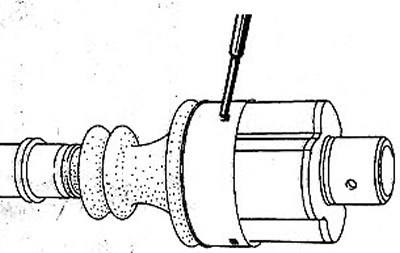
12.22 Secure the cuff with notches at three points
23. Compress or release the joint so that the distance A between the cuff and the end of the joint coupling is 156±1 mm (see illustration).
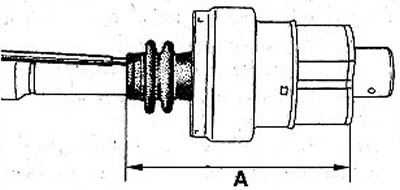
12.23 Compress or release the joint so that the distance A between the cuff and the end of the joint coupling is 156±1 mm
24. Insert a round punch between the cuff and the joint sleeve to equalize the pressure.
25. Attach a new clamp to the small diameter of the cuff and clamp it with pliers, for example, HAZET 1847-1.
Left drive shaft joint with ball bearing seal
Removal
Removing the cuff on this joint is done in the same way as on a joint without a bearing.
26. Press the shaft out of the joint sprocket using a press.
27. Press the shaft out of the bearing using a press on the small diameter of the cuff.
Installation
28. Press on the seal with the bearing. To avoid damaging the outer joint, secure the appropriate clamp to the G groove of the drive shaft (see illustration).
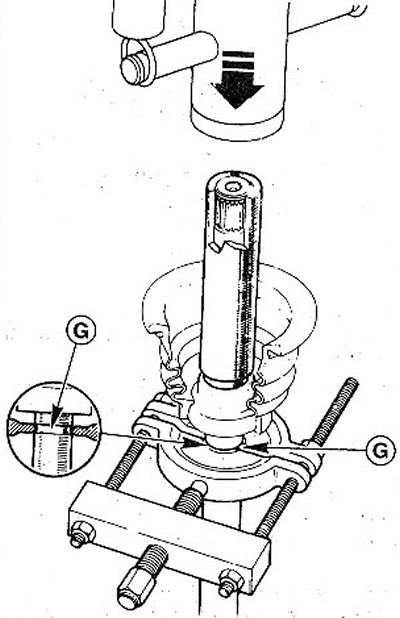
12.28 Press on the seal with the bearing
Caution! Do not hammer the bearing. This will cause deformation of the bearing, which will cause leaks and rapid wear. For this reason, press the bearing slowly and carefully.
29. When pressing on the bearing, maintain the distance L between the end of the bearing and the end of the shaft (see illustration). This distance is 118 mm ±0.2 mm. For cars with a 2.0 liter engine 123.2 mm ±0.2 mm.
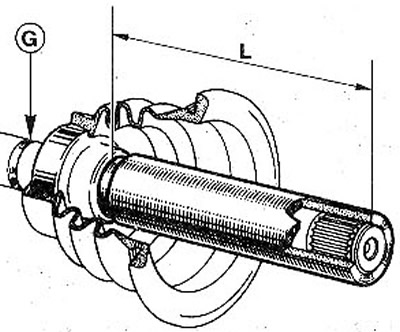
12.29 When pressing on the bearing, maintain the distance L between the end of the bearing and the end of the shaft
Source is located on the website www.RenaultBook.ru
Subsequent installation of the cuff is carried out in the same way as for a CV joint without a bearing.