



Contents: Removal 🠛 Installation 🠛
Removal
1. Mark the position of the rear wheels on the hub with paint. This will allow you to install the balanced wheel in its original position during assembly.
2. Loosen the wheel nuts. The car must be standing on its wheels when performing this operation.
3. Place the car on jack stands and remove the rear wheels.
4. Disconnect the parking brake cable.
Cars with drum brakes on the rear wheels
5. Move the brake shoes away from the brake drum. To do this, insert a screwdriver into one of the holes for the wheel bolt and press the parking brake lever toward the center of the car.
In this case, pin E will be released and lever D can be pressed in the direction of movement (see illustration).
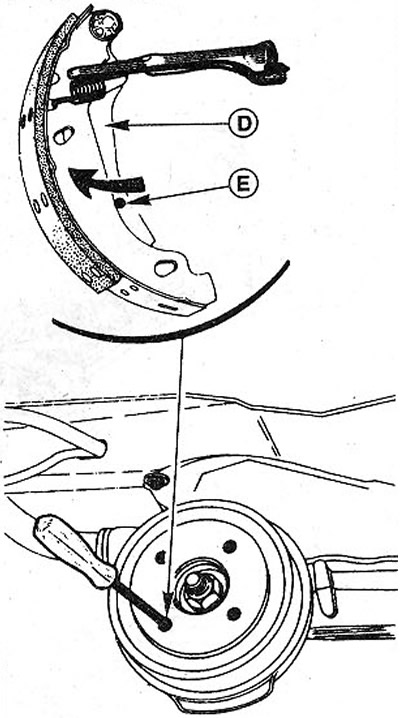
16.5 Move the brake shoes away from the brake drum. To do this, insert a screwdriver into one of the holes for the wheel bolt and push the parking brake lever towards the center of the car. This will release pin E and lever D can be pushed in the direction of travel
6. Press the brake shoe drive lever in the direction of vehicle movement, which will move the shoes away from the inner walls of the drum.
Cars with rear disc brakes
7. Remove the rear wheel brake pads, see the relevant chapter.
8. Disconnect the parking brake cable from the caliper.
9. Loosen the brake hose fastening on the caliper with an overhead wrench. Do not unscrew the hose completely.
10. Unscrew the two bolts A securing the caliper and remove them together with the washers (see illustration).
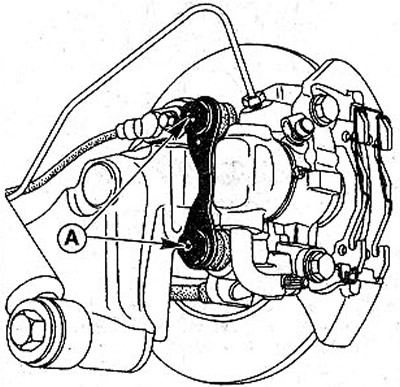
16.10 Unscrew the two bolts A securing the caliper and remove them together with the washers
11. Disconnect the brake hose from the caliper.
Attention! Some brake fluid will leak from the hose, which must be collected.
12. Remove the caliper.
13. Remove the hub nut cap using a suitable hammer type puller (see illustration). If there is no puller, carefully knock off the cap with a chisel and a rubber or plastic hammer, moving the chisel around the circumference of the cap. The cap must be replaced with a new one.
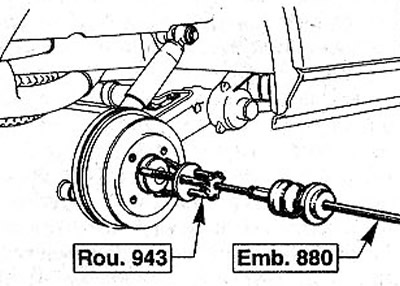
16.13 Remove the hub nut cap using a suitable hammer type puller
14. Install the wheel and lower the vehicle.
15. Loosen the hub nut without unscrewing it completely.
Attention! The hub nut is tightened with a high tightening torque. When unscrewing the nut, the car must be standing on its wheels with the gear engaged and the parking brake applied.
16. Unscrew the nut from the hub and remove it together with the adjusting washer.
17. Remove the brake drum or brake disc. If necessary, they can be removed using a puller that is attached to the wheel bolts and rests against the tailpiece.
Installation
18. Thoroughly clean the brake drum or brake disc. Inspect it for damage, wear, and compliance of the residual thickness with the permissible values.
19. Lubricate the hub mounting tail with a small amount of motor oil of specification S AE 80W so that the hub does not "grow" during operation of the car. After this, install the hub. If necessary, it can be hammered into place with a rubber hammer.
20. Install the adjusting washer.
21. Screw on the new hub nut and tighten it to 180 Nm.
Attention! The tightening torque is very high, so place the wrench horizontally on the nut and press on it from above so that the car does not shift or fall off the support sawhorses when tightening.
22. Put some bearing grease into the hub nut cap and tap the cap onto the nut with a rubber mallet.
Attention! A damaged cap must be replaced. If the nut is not sealed, water will get into the hub and the hub bearing will be destroyed.
Cars with rear disc brakes
23. Connect the brake hose to the caliper and tighten it by hand.
24. Before installing the caliper, clean the threads of the caliper mounting bolts, and then lubricate them with LOCTITE FRENBLOC protective grease.
25. Install the caliper in place and secure it with bolts and washers. The tightening torque of the bolts is 100 Nm.
26. Install the brake pads, see the relevant chapter.
27. Tighten the brake hose nut on the caliper with a torque of 20 Nm.
28. Remove air from the wheel brake cylinder.
Attention! Make sure that there is enough fluid in the expansion tank. If the tank is empty, you will have to bleed the entire brake system.
29. Secure the parking brake cable to the caliper.
30. Install the removed rear wheel, following the marks made before dismantling.
31. Lower the vehicle onto its wheels and tighten the wheel bolts in a cross pattern to 90 Nm.
32. Press the brake pedal several times to allow the brake pads to self-align.
33. Adjust the parking brake, see the relevant chapter.
This note was copied from the resource: RENAULTBOOK.ru