



Contents: Removal 🠛 Installation 🠛
The hub bearing is a double ball bearing. A defective hub bearing is manifested by a difficult wheel movement when the brake is not applied, as well as noise when making a tight turn. Hub bearings are very tightly seated in the steering knuckle. A bench press is required to press them out, so replacement of the hub bearing should be entrusted to a workshop. Knocking out the bearing with a suitable punch is not allowed. A pressed out bearing must be replaced with a new one.
Removal
1. Remove the cap from the hub nut using a large screwdriver.
2. Loosen the hub nut using a 30mm socket.
Attention! The wheel hub nut has a very high tightening torque. When unscrewing the nut, the car must be standing on its wheels with the gear engaged and the parking brake applied.
In workshops, the hub nut is unscrewed by raising the car.
3. Remove the wheel brake caliper, see the relevant chapter.
4. Vehicles with ABS: Unscrew the mounting bolt and remove the wheel speed sensor 3 (see illustration). To unscrew the sensor mounting bolt, you need a key for bolts with a TORX T30 head.
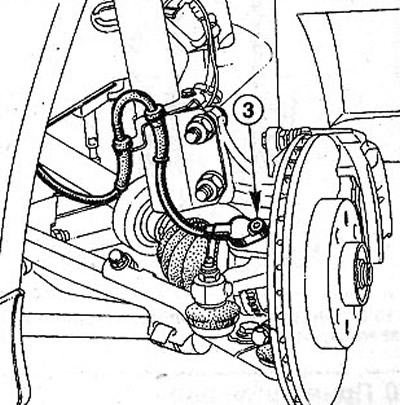
9.4 Unscrew the mounting bolt and remove the wheel speed sensor 3. Vehicles with ABS9.4 Unscrew the mounting bolt and remove the wheel speed sensor 3. Vehicles with ABS
You can find the original at this link (Renaultbook.ru)
5. Unscrew the two bolts securing the brake disc to the hub using a TORX T40 key and remove the brake disc (see illustration 9.4).
6. Unscrew the hub nut. In workshops, when unscrewing the nut, use the Rou. 604-01 device to prevent the hub from turning (see illustration). This device can be made independently from strip iron.
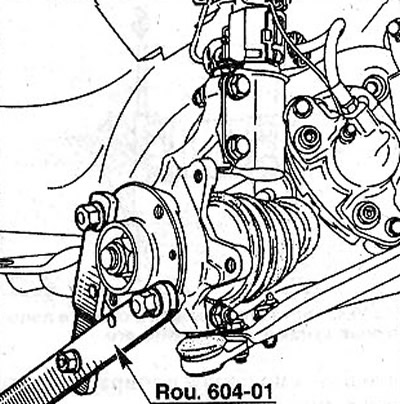
9.6 In workshops, when unscrewing the nut, use the Rou. 604-01 device to prevent the hub from turning
7. Press out the ball joint pin of the tie rod end from the steering knuckle, see the corresponding chapter.
8. Disconnect the wishbone from the steering knuckle by unscrewing the nut of the clamping bolt 2 of the ball joint pin (see illustration). Remove the clamp bolt and press the control arm down.
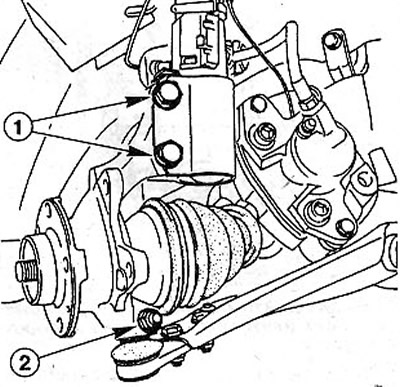
9.8 Disconnect the transverse arm from the steering knuckle by unscrewing the nut of the clamping bolt 2 of the ball joint pin
9. Unscrew bolts 1 securing the lower part of the shock absorber strut to the steering knuckle (see illustration 9.8).
10. Remove the hub from the drive shaft end using a suitable puller, such as HAZET 787N (see illustration). Before doing this, secure the drive shaft with wire so that it does not fall off after removing the hub. Otherwise, this may cause damage to the CV joints.
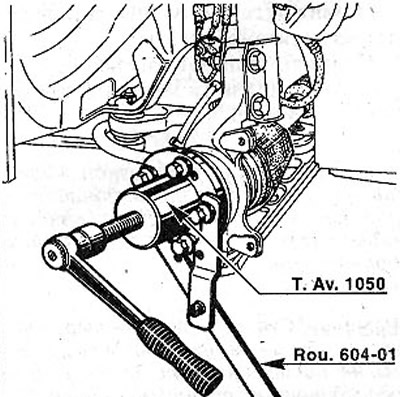
9.10 Remove the hub from the drive shaft end using a suitable puller, e.g. HAZET 787N
11. Press out hub 1 using a press (see illustration).
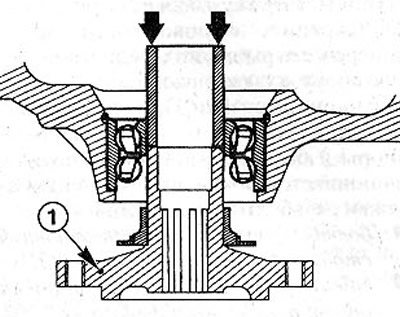
9.11 Press out the hub1 using a press
12. Remove the inner bearing race from the hub using a cam puller, such as HAZET 775 (see illustration).
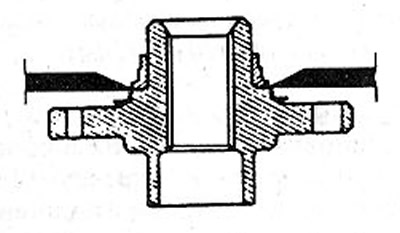
9.12 Remove the inner bearing race from the hub using a cam puller, e.g. HAZET 775
13. Remove the bearing retaining ring A from the groove on the hub (see illustration 9.18). To do this, you need needle-nose pliers to squeeze the ring.
14. Press the outer ring out of the steering knuckle using both inner rings (see illustration). It is not necessary to remove the bearing races and sealing rings before pressing out the outer ring.
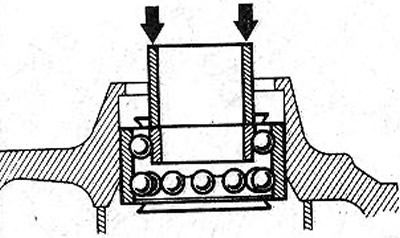
9.14 Press the outer ring out of the steering knuckle using both inner rings
Installation
15. Install the bearing assembly into the steering knuckle and press it in. Depending on the diameter of the bearing, a piece of pipe is used for this purpose, which is installed on the outer ring of the bearing (see illustration).
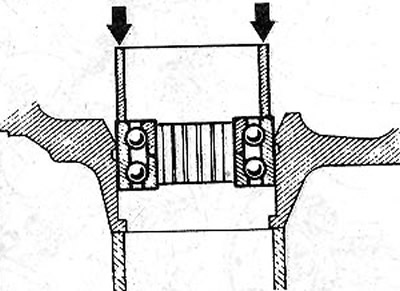
9.15 Install the bearing assembly into the steering knuckle and press it in
Caution! Do not rest the pressing tube against the inner ring, as this will damage the bearing balls under the pressing pressure.
16. Remove the plastic sleeve (used for transporting and storing bearings) from a new bearing.
17. Lubricate the bearing working surfaces with bearing grease (lithium grease).
18. Insert the new retaining ring A into the groove on the hub (see illustration).
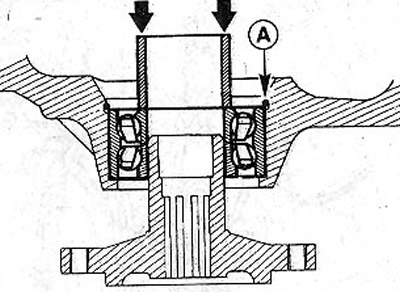
9.18 Insert the new retaining ring A into the groove on the hub
19. Connect the hub and steering knuckle. To do this, you will need a piece of pipe that needs to be supported against the inner ring of the bearing.
20. Apply LOCTITE SCEBLOC protective grease to the splines of the drive shaft shank, after cleaning and degreasing them, for example, with a rag soaked in alcohol (see illustration).
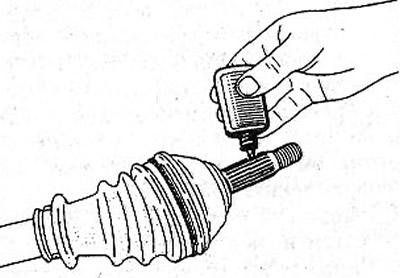
9.20 Apply LOCTITE SCEBLOC protective grease to the splines of the drive shaft shank, after cleaning and degreasing them, for example, with a rag soaked in alcohol
21. Insert the drive shaft end into the hole in the hub and steering knuckle.
22. Screw a new hub nut onto the tailpiece. Do not tighten the nut.
23. Secure the wishbone to the steering knuckle by connecting the ball joint and the lower part of the shock absorber strut. At the same time, replace the nuts of the ball joint clamp bolt and the shock absorber strut mounting bolts with new ones. Tightening torques for threaded connections:
- shock absorber strut mounting bolts to steering knuckle - 170 Nm;
- nut of the clamping bolt of the ball joint of the transverse arm - 80 Nm.
Caution! Install the shock absorber strut mounting bolts to the steering knuckle from front to back, with the bolt heads facing the direction of vehicle travel.
24. Install the ball joint pin of the tie rod end, see the relevant chapter.
25. Attach the internal polyhedron head bolts (TORX) to the hub and tighten them with a force of 20 Nm.
26. Install the brake caliper, see the relevant chapter.
27. Install the ABSh sensor on the hub and tighten it.
28. Install the wheel, following the marks made before removal, and screw in the wheel bolts.
29. Lower the vehicle onto its wheels and tighten the wheel bolts in a cross pattern to 90 Nm.
30. Tighten the hub nut to 250 Nm.
Attention! The car must be standing on its wheels with the gear engaged and the parking brake applied.