English Русский
Български
Беларускі
Український
Српски
Hrvatski
Română
Polski
Slovenský
Magyar
Bookmark Contacts Articles Sitemap
Company vehicles Peugeot Company vehicles Opel Company vehicles Skoda Company vehicles Land Rover Company vehicles Mitsubishi Company vehicles Volkswagen Company vehicles Honda
RenaultBook.ru


Duster   Fluence   Kangoo   Laguna   Logan   Megane   Sandero   Scenic   Symbol   Clio   Other
Renault 19 (1988-1996) Espace I and II (1984-1996) Espace III (1996-2002)

Replacement of components (Renault Espace I)

  • Main
  • Renault
  • Espace I and II (1984-1996)
  • Power unit
  • Injection fuel system
  • Replacement of components
0
Warning: Only work on the system if you have experience working with the injection system. People with a pacemaker are not allowed to work on the electronic injection system and the associated ignition system. Keep the system clean when disassembling.


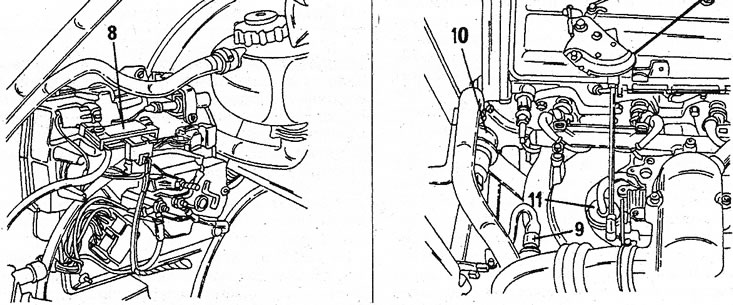
The following figures show some components of the injection system of a 4-cylinder engine (see illustrations 10.1-10.4).
10.1 Position of the electronic module (1), both fuel pump relays (2) and injection system (3) on…

10.1 Position of the electronic module (1), both fuel pump relays (2) and injection system (3) on J636/J637 models. On earlier models, the module is located in the center console. The fuel pump and injection relays are located next to the left fog lamp. The remaining components indicated by numbers are listed below


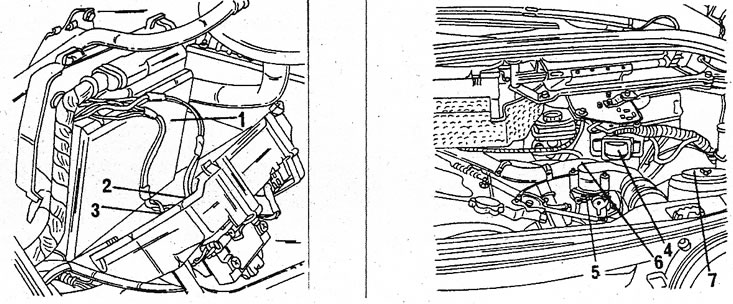
10.2 Location of some parts on models J636 and J637. Numerical designations are given in the text
10.2 Location of some parts on models J636 and J637. Numerical designations are given in the text


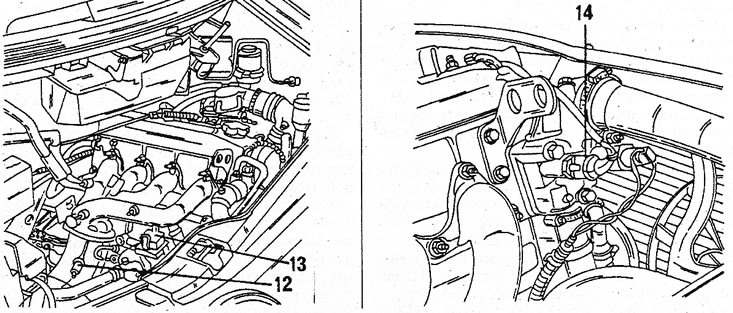
10.3 Location of the Lambda sensor (12), central plug socket for connecting the diagnostic stand…

10.3 Location of the Lambda sensor (12), central plug socket for connecting the diagnostic stand (13) and coolant temperature sensor (14)
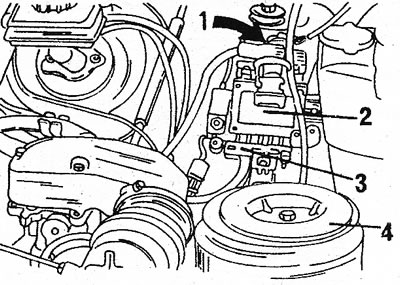

10.4 The CO adjustment bolt (1) is located behind the ignition module (2) on earlier models. Also…

10.4 The CO adjustment bolt (1) is located behind the ignition module (2) on earlier models. Also shown is the MAP sensor (3) and air cleaner (4)


Illustration 9.1 shows the location of most of the V6 engine components. The 4-cylinder engine parts not shown are:
  • 2) fuel pump relay,
  • 3) injection system relay,
  • 4) ignition module,
  • 5) throttle body,
  • 6) full load switch,
  • 7) air filter,
  • 8) absolute pressure sensor,
  • 9) incoming air temperature sensor,
  • 10) idle speed control valve,
  • 11) fuel supply pressure regulator,
  • 12) central plug socket for connecting the diagnostic stand.

Most components require a specially designed indoor test device to test them, so repairs only involve replacing damaged parts.


Idle speed and CO content cannot be adjusted on later models, which is the case on the earlier J116 and J117 models. On these models, a potentiometer is installed behind the ignition module and covered with a cap to adjust the CO content. Figure 10.4 shows the location of these components.

The CO content cannot be adjusted automatically, but if you feel a very high CO concentration, first of all remember when the engine oil was last changed. For possible adjustment, pull out the potentiometer, remove the plug from the hole and turn the screw that is exposed with a screwdriver.

The idle speed cannot be adjusted on any of the fuel injected engines.

The incoming air temperature sensor is installed in the air intake system and is located in a rubber tube with a spring clamp.

Coolant temperature sensor (4-cylinder engine (see illustration 10.3) must be removed when the engine is cold. Close the screw hole immediately, as coolant may leak out. To access the sensor on a V6 engine, remove the heater matrix, throttle body and intake manifold.

The MAP sensor fitted to later Espace models is located inside the right wing under a plastic cover. On early models the sensor is mounted on the underside of the part (2) as shown in Illustration 10.4 (where it is connected with a small hose). To replace, use a screwdriver to pry off the connector block and hose.

The idle speed control valve is located in the location shown in Illustration 10.5. To remove the valve, disconnect the electrical connectors, hoses, and safety spring clip. On early models, the valve may be located on the right side of the large air hose (hose between the control valve and the bypass channel). The arrow on the bottom of the valve indicates the direction of air flow.
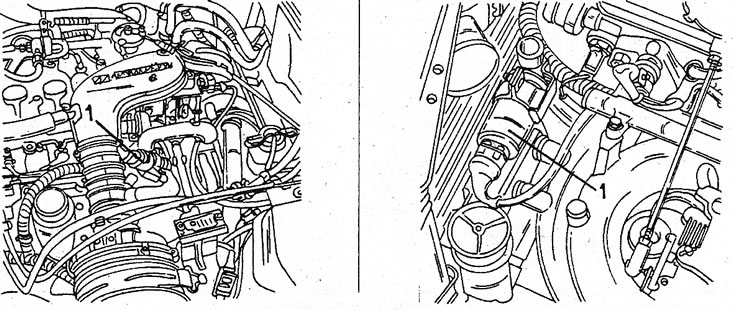


10.5 Idle speed control valve (1). Right - 4-cylinder engine (later model), left - V6 engine

10.5 Idle speed control valve (1). Right - 4-cylinder engine (later model), left - V6 engine
This article is available on: russian, bulgarian, belarusian, ukrainian, serbian, croatian, romanian, polish, slovak, hungarian
Article has been reviewed by editor: Fedoseev Denis
Share with friends:
Previous
Espace I and II: Injection fuel system
Next

Fuel injection system — general description
Fuel filter
Fuel pump
Air filter
Other articles on other Renault models

➽ Location of components of the exhaust gas recirculation system… Renault Duster 1 (2009-2017)
➽ Brake system components Renault Fluence 1 (2009-2020, petrol)
➽ List of electrical equipment components, connections, connectors… Renault Kangoo 1 (1997-2007)
➽ Replacement of anti-roll bar components Renault Logan 1 (2004-2012, petrol)
➽ Removal and installation of heater components Renault Megane 1 (1995-2002)
Link to this article in different formats
Reviews and comments of visitors
No comments yet


Add two numbers 27 + 44


Renault 19 (1988-1996) 
  • General information
  • Maintenance
  • Power unit
  • Engine repair
  • Exhaust system
  • Cooling system
  • Supply system
  • Single-point injection
  • Multi-point injection
  • Diesel injection system
  • Transmission
  • Clutch
  • Car gearbox
  • Chassis, running gear
  • Car suspension
  • Steering
  • Brake system
  • Wheels and tires
  • Body and interior
  • Exterior (external elements)
  • Interior (internal elements)
  • Heating and ventilation
  • Electrical equipment
  • Equipment and devices
  • Headlights and lighting
  • Ignition system
  • Power devices
  • Electrical circuits
Espace I and II (1984-1996) 
  • General information
  • Introduction to the guide
  • Troubleshooting
  • Power unit
  • Engine repair
  • Cooling system
  • Carburetor fuel system
  • Injection fuel system
  • Diesel fuel system
  • Ignition system
  • Transmission
  • Clutch
  • Car gearbox
  • Drive shafts
  • Chassis, running gear
  • Brake system
  • Steering
  • Front suspension
  • Rear suspension
  • Body and interior
  • Exterior (external elements)
  • Interior (internal elements)
  • Doors, locks and windows
  • Electrical equipment
  • Equipment and devices
  • Electrical circuits
Espace III (1996-2002) 
  • General information
  • Introduction to the manual
  • User manual
  • Power unit
  • Petrol engines F3R
  • Petrol engines Z7X
  • Diesel engines G8T
  • Diesel engines G9T
  • Transmission
  • Clutch
  • Mechanical gearbox
  • Automatic gearbox
  • Drive shafts
  • Chassis, running gear
  • Steering
  • Front suspension
  • Rear suspension
  • Brake system
  • Body and interior
  • Exterior (external elements)
  • Interior (internal elements)
  • Doors, locks and windows
  • Heating and ventilation
  • Electrical equipment
  • Equipment and instruments
  • Power devices
  • Electrical circuits
RenaultBook.ru © 2018–2026 | Mobile version | News and articles | Sitemap: EN BG BY UA RS HR RO PL SK HU | Administration | Site search | Bookmark
Duster 1 (2009-2017) | Fluence 1 (2009-2020, petrol) | Kangoo 1 (1997-2007) | Laguna 2 (2001-2007) | Logan 1 (2004-2012, petrol) | Logan 2 (2012-2020) | Megane 1 (1995-2002) | Megan 2 (2002-2009, petrol) | Sandero 1 (2007-2012, petrol) | Scenic 1 (1996-2003) | Symbol 1 (1999-2008, petrol) | Symbol 2 (2008-2013, petrol) | Renault 19 (1988-1996) | Espace I and II (1984-1996) | Espace III (1996-2002) | Clio 1 (1990-1998) |
We want your visit to be comfortable 😌 and use cookies 🍪 to do so.