
English Русский
Български
Беларускі
Український
Српски
Hrvatski
Română
Polski
Slovenský
Magyar
Bookmark Contacts Articles Sitemap
Company vehicles Peugeot Company vehicles Opel Company vehicles Skoda Company vehicles Land Rover Company vehicles Mitsubishi Company vehicles Volkswagen Company vehicles Honda
RenaultBook.ru


Duster   Fluence   Kangoo   Laguna   Logan   Megane   Sandero   Scenic   Symbol   Clio   Other
Symbol 1 (1999-2008, petrol) Symbol 2 (2008-2013, petrol)

Catalytic Converter — Removal and Installation (Renault Symbol 2)

  • Main
  • Symbol
  • Symbol 2 (2008-2013, petrol)
  • Power unit
  • Exhaust system
  • Catalytic Converter — Removal and Installation
0
Contents: Removal 🠛 Installation 🠛
The catalytic converter is a reliable and simple device that does not require maintenance, but the owner should pay attention to some points in order to extend the service life of the converter.

The catalytic converter operates at high temperatures and should therefore never be located in a location where it can come into contact with flammable materials (this may cause them to catch fire). In particular, you should not stop the car on dry leaves, hay, rags, brushwood, etc.

Do not use leaded gasoline - the lead contained in such gasoline coats the rare earth metals and disables the neutralizer.

Do not start the engine by towing - unburned fuel will get into the neutralizer, after starting it may overheat.

Do not turn off the ignition at high engine speed.

Do not use fuel or motor oil additives - they may contain components that are harmful to the neutralizer.

Do not operate a vehicle whose engine consumes a lot of oil, as the combustion products of the oil, getting into the catalytic converter, impair its operation.

The tightness in the section from the exhaust manifold gasket to the catalytic converter inclusive must be ideal.

Keep the fuel injection system and ignition system in good condition, as poor combustion of fuel is detrimental to the neutralizer.

In some cases, you can smell sulfur from the exhaust pipe. This is a common occurrence that occurs after several thousand kilometers. The catalytic converter on a serviceable car lasts up to 150,000 km. If the efficiency of the catalytic converter has decreased, it is replaced.


Tightening torque


  • Flange nuts - 20

Removal


1. Disconnect the battery.

2. Place the vehicle on a lift.

3. Remove the clamp securing the neutralizer without the muffler. Discard the clamp.

4. Remove the body protection heat shield.

5. Disconnect the exhaust pipe.

Discard the seal.

6. Remove the neutralizer.
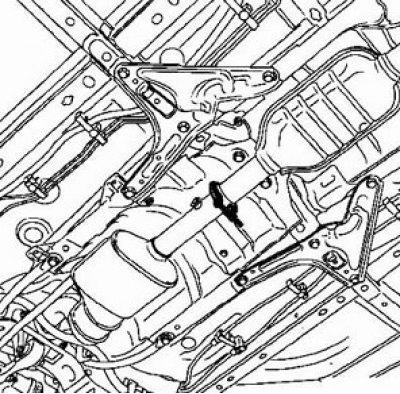
6. Remove the neutralizer.


Installation


Installation is carried out in the reverse order. Install a new gasket and clamp.

Note: If the body heat shield is damaged, replace it to avoid the risk of fire.
This article is available on: russian, bulgarian, belarusian, ukrainian, serbian, croatian, romanian, polish, slovak, hungarian
Article has been reviewed by editor: Kupriyanov Sergey
Share with friends:
Previous
Symbol 2: Exhaust system
 

Disassembling the exhaust system
Muffler repair
Exhaust system — general information
Repair of the exhaust gas toxicity reduction system
Exhaust gas toxicity reduction system
 
Other articles on other Renault models

➽ Catalytic converter (K9K engine) Renault Duster 1 (2009-2017)
➽ Diagnostics of the catalytic converter (K4M and F4P) Renault Laguna 2 (2001-2007)
➽ Catalytic converter for diesel engine K9K Renault Logan 2 (2012-2020)
➽ Catalytic Converter — Description and Precautions Renault Megane 1 (1995-2002)
➽ Servicing cars with a catalytic converter Renault Scenic 1 (1996-2003)
Link to this article in different formats
Reviews and comments of visitors
No comments yet


Add two numbers 44 + 45


Symbol 2 (2008-2013, petrol) 
  • General information
  • User manual
  • Maintenance
  • Power unit
  • Engine repair
  • Cooling system
  • Fuel system
  • Exhaust system
  • Ignition system
  • Transmission
  • Clutch
  • Mechanical gearbox
  • Automatic gearbox
  • Drive shafts
  • Chassis, running gear
  • Front suspension
  • Rear suspension
  • Steering
  • Brake system
  • Body and interior
  • Exterior (external elements)
  • Interior (internal elements)
  • Doors, locks and windows
  • Heating and ventilation
  • Electrical equipment
  • Equipment and devices
  • Headlights and lighting
  • Power devices
  • Electrical circuits
Symbol 1 (1999-2008, petrol) 
  • General information
  • User manual
  • Car care
  • Maintenance
  • Power unit
  • Engine repair
  • Cooling and lubrication system
  • Supply system
  • Exhaust system
  • Ignition system
  • Transmission
  • Clutch
  • Mechanical gearbox
  • Automatic gearbox
  • Drive shafts
  • Chassis, running gear
  • Car suspension
  • Steering
  • Brake system
  • Body and interior
  • Exterior (external elements)
  • Interior (internal elements)
  • Doors, locks and windows
  • Restoration and repair
  • Electrical equipment
  • Equipment and devices
  • Headlights and lighting
  • Power devices
  • Heating and ventilation
  • Electrical circuits
RenaultBook.ru © 2018–2026 | Mobile version | News and articles | Sitemap: EN BG BY UA RS HR RO PL SK HU | Administration | Site search | Bookmark
Duster 1 (2009-2017) | Fluence 1 (2009-2020, petrol) | Kangoo 1 (1997-2007) | Laguna 2 (2001-2007) | Logan 1 (2004-2012, petrol) | Logan 2 (2012-2020) | Megane 1 (1995-2002) | Megan 2 (2002-2009, petrol) | Sandero 1 (2007-2012, petrol) | Scenic 1 (1996-2003) | Symbol 1 (1999-2008, petrol) | Symbol 2 (2008-2013, petrol) | Renault 19 (1988-1996) | Espace I and II (1984-1996) | Espace III (1996-2002) | Clio 1 (1990-1998) |
We want your visit to be comfortable 😌 and use cookies 🍪 to do so.