English Русский
Български
Беларускі
Український
Српски
Hrvatski
Română
Polski
Slovenský
Magyar
Bookmark Contacts Articles Sitemap
Company vehicles Peugeot Company vehicles Opel Company vehicles Skoda Company vehicles Land Rover Company vehicles Mitsubishi Company vehicles Volkswagen Company vehicles Honda
RenaultBook.ru


Duster   Fluence   Kangoo   Laguna   Logan   Megane   Sandero   Scenic   Symbol   Clio   Other
Symbol 1 (1999-2008, petrol) Symbol 2 (2008-2013, petrol)

Checking the condition of tires and their pressure (400 km) (Renault Symbol 2)

  • Main
  • Symbol
  • Symbol 2 (2008-2013, petrol)
  • General information
  • Maintenance
  • Checking the condition of tires and their pressure (400 km)
0
Check your tyres regularly for damage such as cuts or bulges, especially on the sidewalls. Remove the wheels periodically and remove any dirt from the outside and inside surfaces. Inspect the rims for any signs of corrosion or other damage. Light alloy wheels are often damaged by hitting the curb, and steel wheels may become dented.

When installing new tires, they need to be balanced, but due to tire wear or loss of balancing weights attached to the wheel rim, a new balancing may be required. If tires are not balanced, they wear out faster, the same applies to steering and suspension components. Wheel imbalance is usually accompanied by vibration, especially at a certain speed (usually around 80 km/h). If such vibration is felt only through the steering, then probably only the front wheels need balancing. If the whole car vibrates, then the rear wheels may be unbalanced. Wheel balancing should be done in a car repair shop.

Check the tire pressure regularly, when the tires are cold. Do not adjust the tire pressure immediately after driving, as this will give an incorrect result. Control values for tire pressure, front/rear, bar:
  • partial load - 2.3/2.0
  • full load - 2.4/2.1

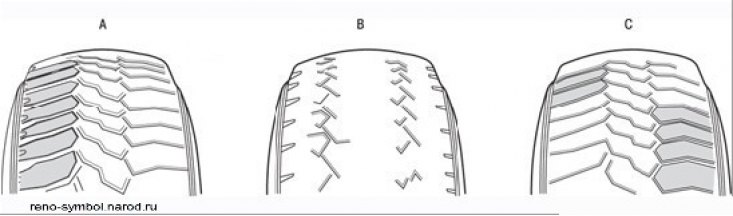
Figure 2.27. Types of tire wear: A – wear of the outer part of the tread; B – wear of the middle…

Figure 2.27. Types of tire wear: A – wear of the outer part of the tread; B – wear of the middle part of the tread; C – uneven tread wear


Tire wear is significantly affected by pressure deviation from control values. Low tire pressure causes outer parts of the tread to wear out, while high pressure causes wear in the middle part of the tread. Uneven tread wear is primarily determined by incorrect installation angles and wheel imbalance (Figure 2.27). Tyre wear can be affected by your driving style: sharp braking and acceleration or cornering at high speeds will cause them to wear out quickly.
This article is available on: russian, bulgarian, belarusian, ukrainian, serbian, croatian, romanian, polish, slovak, hungarian
Article has been reviewed by editor: Kupriyanov Sergey
Share with friends:
Previous
Symbol 2: Maintenance
Next

Checking the fluid level in the windshield washer reservoir (400 km)
Checking the coolant level (400 km)
Checking the brake fluid level (400 km)
Checking the engine oil level (400 km)
Maintenance periods
Checking windshield wipers (400 km)
Engine oil change (10,000 km)
Checking the fluid level in the power steering system (30,000 km)
Checking the condition of the front brake pads and discs (30,000 km)
Checking and adjusting the parking brake (30,000 km)
Other articles on other Renault models

➽ Checking the condition and pressure of tires Renault Megane 1 (1995-2002)
➽ Checking the condition of the tires Renault 19 (1988-1996)
➽ Checking oil pressure Renault Duster 1 (2009-2017)
➽ Checking oil pressure Renault Fluence 1 (2009-2020, petrol)
➽ Checking the fuel supply pressure (engines F4R, F4P, K4M) Renault Laguna 2 (2001-2007)
Link to this article in different formats
Reviews and comments of visitors
No comments yet


Add two numbers 30 + 28


Symbol 2 (2008-2013, petrol) 
  • General information
  • User manual
  • Maintenance
  • Power unit
  • Engine repair
  • Cooling system
  • Fuel system
  • Exhaust system
  • Ignition system
  • Transmission
  • Clutch
  • Mechanical gearbox
  • Automatic gearbox
  • Drive shafts
  • Chassis, running gear
  • Front suspension
  • Rear suspension
  • Steering
  • Brake system
  • Body and interior
  • Exterior (external elements)
  • Interior (internal elements)
  • Doors, locks and windows
  • Heating and ventilation
  • Electrical equipment
  • Equipment and devices
  • Headlights and lighting
  • Power devices
  • Electrical circuits
Symbol 1 (1999-2008, petrol) 
  • General information
  • User manual
  • Car care
  • Maintenance
  • Power unit
  • Engine repair
  • Cooling and lubrication system
  • Supply system
  • Exhaust system
  • Ignition system
  • Transmission
  • Clutch
  • Mechanical gearbox
  • Automatic gearbox
  • Drive shafts
  • Chassis, running gear
  • Car suspension
  • Steering
  • Brake system
  • Body and interior
  • Exterior (external elements)
  • Interior (internal elements)
  • Doors, locks and windows
  • Restoration and repair
  • Electrical equipment
  • Equipment and devices
  • Headlights and lighting
  • Power devices
  • Heating and ventilation
  • Electrical circuits
RenaultBook.ru © 2018–2026 | Mobile version | News and articles | Sitemap: EN BG BY UA RS HR RO PL SK HU | Administration | Site search | Bookmark
Duster 1 (2009-2017) | Fluence 1 (2009-2020, petrol) | Kangoo 1 (1997-2007) | Laguna 2 (2001-2007) | Logan 1 (2004-2012, petrol) | Logan 2 (2012-2020) | Megane 1 (1995-2002) | Megan 2 (2002-2009, petrol) | Sandero 1 (2007-2012, petrol) | Scenic 1 (1996-2003) | Symbol 1 (1999-2008, petrol) | Symbol 2 (2008-2013, petrol) | Renault 19 (1988-1996) | Espace I and II (1984-1996) | Espace III (1996-2002) | Clio 1 (1990-1998) |
We want your visit to be comfortable 😌 and use cookies 🍪 to do so.