



The frame is the base of the stand and is used to install and secure the damaged vehicle, power racks, tensioning devices and other devices that provide hydraulic straightening of damaged vehicles
bodies. The frame is made of a large channel and is an intersection of a box profile with 20 mm wide grooves located along and across the entire area of the frame. This frame design allows you to attach a car (body) to it, install the necessary devices at various points relative to the damaged areas of the body being repaired.
The power stand with a drive, various supports, extensions, extensions, chains and other devices are designed to transmit mechanical effects from the hydraulic cylinder to the deformed areas of the body.
Depending on the damage category and its location on the body, the car may arrive at the assembly stand assembled or partially disassembled (without front or rear suspension) or only in the form of a body.
Install and straighten the emergency body using the stretching method on the frame in the following order:
- place the car (body) in the center of the stand;
- hang the car (body) on stands using a jack and clamps installed on the power cross pipes, and secure the body by the sill stiffeners;
- attach the car body to the foundation frame using bracing devices at the support points of the power cross pipes;
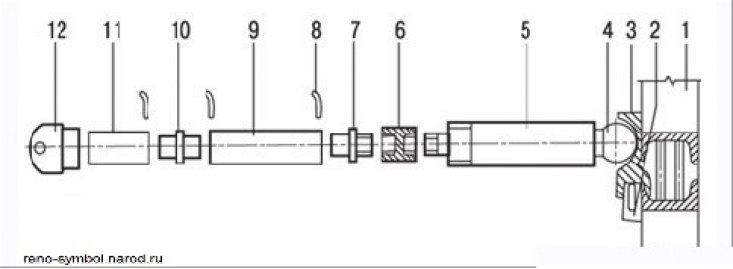
Figure 9.125. Elements of the power strut and its fastening to the frame: 1 – stand frame; 2 – wedge; 3 – spherical support; 4 – ball joint; 5 – hydraulic cylinder; 6 – coupling sleeve; 7, 10 – adapter; 8 – gate; 9, 11 – extension cords; 12 – support
- fix the spherical support 3 (Figure 9.125) on frame 1 with wedges 2. Having assembled the power stand, install it in the spherical support 3. The length of the stand is selected so that it allows the necessary tensile force to be applied. The direction of the force must coincide with the direction of the impact;
- attach a clamp or some other tool to the damaged area of the body;
- connect the damaged part of the body and the foundation frame with a chain through the support of the power strut;
- straighten the body by applying pressure to the power strut cylinder using a foot hydraulic pump.
To straighten the body, up to four power stands with chains and devices can be used simultaneously, which must have different combinations of length and be installed at different angles depending on the impacts received.
Device for straightening deformed elements of car bodies
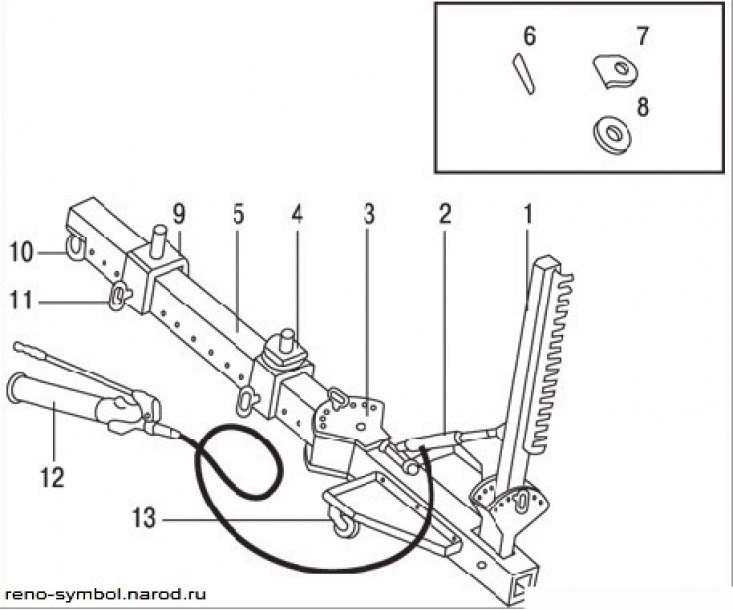
Figure 9.126. Device for straightening deformed elements of the body of passenger cars: 1 – power lever; 2 – hydraulic cylinder; 3 – rotary beam; 4 – clamping device; 5 – beam; 6, 7, 8, 9, 11 – clamping parts; 10, 13 – wheels; 12 – hydraulic pump
Device (Figure 9.126) it is fixed with clamping devices at any point on the lower shelves of the cross or longitudinal beams of the stand frame.
The straightening of emergency bodies is carried out as follows:
- install the emergency body on the frame, fix its undamaged part in the support brackets and additionally secure it to the sill stiffeners;
- determine the work area and the direction of application of tensile forces, roll the device under the frame;
- secure the device to the frame of the frame using the wedges of the clamping devices;
- install and fix the power lever and the rotary beam in the required position with a stopper;
- connect the lever to the deformed body parts using a set of chains, clamps and gripping devices;
- perform the working stroke of the lever using a hydraulic device.
Hydraulic and screw devices for body restoration
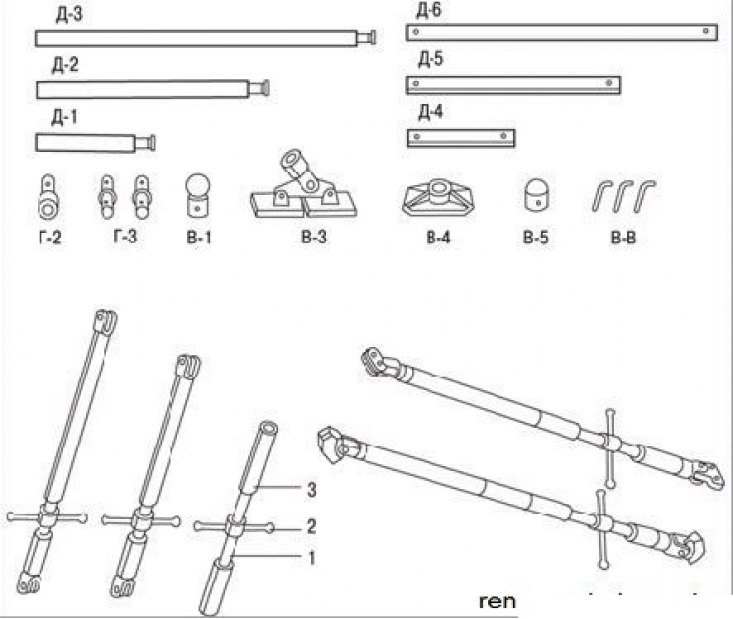
Figure 9.127. Screw device for restoring body geometry: 1 – screw; 2 – ratchet; 3 – bushing; B - clamps; G - adapters; D – extension cords
The screw device consists of a screw jack, screw 1 (Figure 9.127), a ratchet 2 and two bushings 3 with right and left threads, clamps B, adapters G, several extensions D, various stops and clamps. With the help of these elements, work is performed to correct distortions in the engine compartment, trunk, inside the body, door openings.
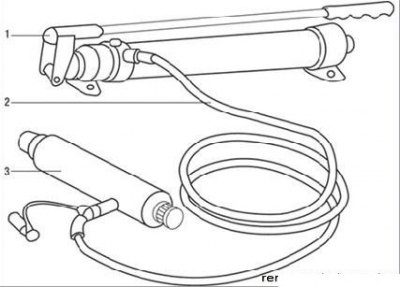
Figure 9.128. Hydraulic device for restoring body geometry: 1 – hydraulic pump; 2 – hose; 3 – hydraulic cylinder
Hydraulic device (Figure 9.128) consists of a set of equipment, which includes a hydraulic pump, a hose and a number of extensions. Various adapters or supports are attached to the ends of the extensions using clamps.