
English Русский
Български
Беларускі
Український
Српски
Hrvatski
Română
Polski
Slovenský
Magyar
Bookmark Contacts Articles Sitemap
Company vehicles Peugeot Company vehicles Opel Company vehicles Skoda Company vehicles Land Rover Company vehicles Mitsubishi Company vehicles Volkswagen Company vehicles Honda
RenaultBook.ru


Duster   Fluence   Kangoo   Laguna   Logan   Megane   Sandero   Scenic   Symbol   Clio   Other
Megane 1 (1995-2002) Megan 2 (2002-2009, petrol)

Jump starting the engine from another car's battery (Renault Megane 2)

  • Main
  • Megane
  • Megan 2 (2002-2009, petrol)
  • User manual
  • Maintenance and care
  • Jump starting the engine from another car's battery
0
To jump start an engine using a battery installed in another vehicle, follow the instructions below.

Purchase the appropriate large-section electrical wires from a Renault service station. If such wires are already available, make sure they are in good condition.

Both batteries must have the same nominal voltage of 12 V. The capacity (Ah) of the charged battery must not be less than that of the discharged one.

If the electrolyte in the battery is frozen, defrost it before charging the battery.

Also make sure that both vehicles do not have electrical contact with each other (due to the possibility of a short circuit when connecting the positive terminals) and the discharged battery is connected correctly. Turn off the ignition on the car.

Start the engine of the vehicle from which the battery is being charged and let it run at medium engine speed.
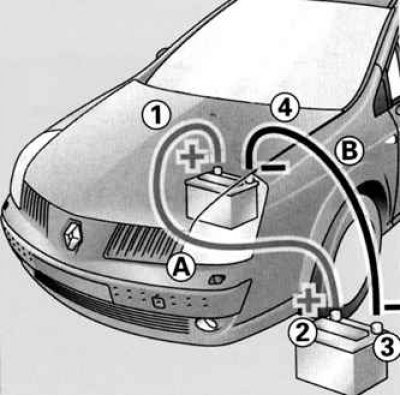
Fig. 1.113. Additional battery connection diagram: 1 – positive terminal of the discharged battery;…

Fig. 1.113. Additional battery connection diagram: 1 – positive terminal of the discharged battery; 2 – positive terminal of additional battery; 3 – negative terminal of additional battery; 5 – negative terminal of the discharged battery; A – positive wire; B – negative wire


Connect positive (+) wire A to terminal (+)1 of the discharged battery, then to terminal (+)2 of the charged battery (fig. 1.113).

Connect the negative (–) B cable to terminal (–) 3 of the charged battery, then to terminal (–) 4 of the discharged battery.

Make sure that the A and B jumper wires are not in contact and that the positive (+) A wire is not in contact with any metal parts of the vehicle with a charged battery.

Start your car's engine, then disconnect wires A and B in reverse order (4-3-2-1).
This article is available on: russian, bulgarian, belarusian, ukrainian, serbian, croatian, romanian, polish, slovak, hungarian
Article has been reviewed by editor: Kupriyanov Sergey
Share with friends:
Previous
Megan 2: Maintenance and care
Next

Fuse box
Replacing halogen headlight bulbs
Tires and traffic safety
Wheel replacement
Decorative cap and decorative plug
Replacing the power supply element of the Renault card
Replacing windshield wiper blades
Replacing the rear window wiper blade
Towing a car
Frequency of maintenance and name of works
Other articles on other Renault models

➽ Starting the engine with an additional battery Renault Fluence 1 (2009-2020, petrol)
➽ Starting the engine from an auxiliary battery Renault Kangoo 1 (1997-2007)
➽ Starting the engine — using a booster battery Renault Scenic 1 (1996-2003)
➽ Starting an engine with a discharged battery Renault 19 (1988-1996)
➽ Starting and stopping the engine Renault Duster 1 (2009-2017)
Link to this article in different formats
Reviews and comments of visitors
No comments yet


Add two numbers 39 + 19


Megan 2 (2002-2009, petrol) 
  • User manual
  • Introduction to manual
  • Controls and instruments
  • Salon equipment
  • Operation and driving
  • Maintenance and care
  • Power unit
  • Engine repair
  • Fuel system
  • Injection system
  • Intake and exhaust system
  • Starting and charging system
  • Cooling system
  • Decreased toxicity
  • Transmission
  • Clutch
  • Mechanical gearbox
  • Automatic gearbox
  • Wheel drive mechanism
  • Chassis, running gear
  • Suspension and wheels
  • Steering
  • Brake system
  • Body and interior
  • Exterior (external elements)
  • Interior (internal elements)
  • Doors, locks and windows
  • Heating and air conditioning
  • Electrical equipment
  • Equipment and devices
  • Headlights and lighting
  • Electrical circuits
Megane 1 (1995-2002) 
  • General information
  • User manual
  • Maintenance
  • Power unit
  • Petrol engines 1.4/1.6 l
  • Petrol engines 2.0 l
  • Diesel engines 1.9 l
  • Overhaul of engines
  • Cooling system
  • Fuel system (petrol)
  • Fuel system (diesel)
  • Decreased toxicity
  • Charge and launch systems
  • Ignition system (petrol)
  • Preheat system (diesel)
  • Transmission
  • Clutch
  • Mechanical gearbox
  • Automatic gearbox
  • Drive shafts
  • Chassis, running gear
  • Brake system
  • Car suspension
  • Steering
  • Body and interior
  • Exterior (external elements)
  • Interior (internal elements)
  • Doors, locks and windows
  • Electrical equipment
  • Equipment and devices
  • Electrical circuits
RenaultBook.ru © 2018–2026 | Mobile version | News and articles | Sitemap: EN BG BY UA RS HR RO PL SK HU | Administration | Site search | Bookmark
Duster 1 (2009-2017) | Fluence 1 (2009-2020, petrol) | Kangoo 1 (1997-2007) | Laguna 2 (2001-2007) | Logan 1 (2004-2012, petrol) | Logan 2 (2012-2020) | Megane 1 (1995-2002) | Megan 2 (2002-2009, petrol) | Sandero 1 (2007-2012, petrol) | Scenic 1 (1996-2003) | Symbol 1 (1999-2008, petrol) | Symbol 2 (2008-2013, petrol) | Renault 19 (1988-1996) | Espace I and II (1984-1996) | Espace III (1996-2002) | Clio 1 (1990-1998) |
We want your visit to be comfortable 😌 and use cookies 🍪 to do so.