



Contents: Operation of tires 🠛 Tire replacement 🠛
Tires are the only part of the car that is in constant contact with the road, so it is very important to monitor the condition of the car's tires.
It is necessary to strictly follow the requirements of the traffic regulations in force in the country where the vehicle is operated.
When replacing tires, use only the same brand, size, type and tread pattern as those originally installed on the vehicle.
Operation of tires
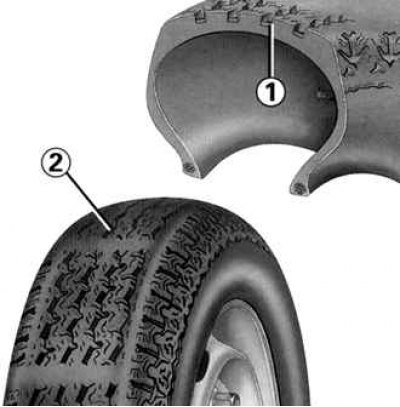
Fig. 1.107. Tire wear indication: 1 – wear indicators; 2 – indicator protrusions
The tyres must be in good condition and the tread pattern must be deep enough. The tyres recommended for use by Renault's technical departments have special wear indicators 1, which are moulded into the tread of the wheel in the form of protrusions (fig. 1.107).
When the tread pattern wears to the level where the indicator protrusions 2 become visible, the tires must be replaced, since the indicators show that the tread depth has decreased to 1.6 mm and the tire's grip on wet roads will be poor.
Driving errors such as crashing into obstacles (for example, on a curbstone), may cause damage to the tires and disruption of the correct geometry of the front suspension.
Overloading the vehicle, driving for long periods on highways, especially in hot weather, or constantly driving on roads with poor surfaces cause rapid wear of tires and reduce the safety of the vehicle.
Tire replacement
Installing different types of tires on a vehicle at the same time will result in the following:
- the car will not meet the requirements of the current traffic regulations;
- the car's behavior in turns will change;
- the effort on the steering wheel will increase;
- the noise level from the tires will increase;
- it will be difficult to install anti-skid chains.