



The serviceability of the battery is of great importance when operating a car in winter. If the "age" of the battery installed in the car is 2-3 years, then before winter it is enough to wash it from the outside, clean the terminals and fully charge it (if the car was constantly used in the city, the battery charge is far from nominal).
Note: If the battery does not charge to its rated capacity, it should be replaced.
According to experts, the average lifespan of a battery is about 3 years.
Buying a battery is not a problem at the moment: there are a large number of brands and models in stores. Which battery to choose is a personal matter. It should be noted that there are two price groups on the market now: batteries costing over $60 (usually up to $100), such as Bosch, Steco, American, Fiamm, and those priced below $60 (Mutlu, Inci, Centra, SAEM, etc.).
The higher prices of batteries of the first group are due to the more advanced technology of their production. These batteries, as a rule, belong to the category of maintenance-free. Special types of electrolytes and hermetically sealed design of such batteries increase their service life and provide high starting currents, guaranteeing the crankshaft rotation of the engine even in severe frosts. Leading manufacturers now necessarily use the technology of plate packaging, as a result of which it is possible to avoid a short circuit of the battery in case of their destruction.
Cheaper batteries require periodic maintenance, which consists of checking the density of the electrolyte and measuring its level.
When choosing a battery, pay attention to the following parameters:
- capacity, Ah. According to the operating instructions, it should be 70 Ah. It is permissible to use batteries with a capacity of 60–75 Ah. Too small a capacity will create problems with the "winter" start of the engine, if too large, the generator will not provide a full charge of the battery and its service life will be greatly reduced;
- starter discharge current, A (according to DIN 43 539 standard). The higher its value, the better, especially in winter operation. This is a guarantee that the starter will turn the crankshaft at a high enough speed, and if the engine does not start on the first try, you will have a chance to make a second and third.
Note: Do not buy batteries from southern manufacturing countries: there are no frosts there and their starter discharge current may be significantly lower than that of batteries adapted to Russian winter conditions.
When buying a battery that is different from the standard one, pay attention to its size and the location of the terminals: buy a battery with the same polarity as the old one, otherwise your car's wires may not reach the terminals.
The density of the electrolyte of a fully charged battery may differ from the nominal value by no more than 0.02 g/cm³ (table 15.1).
Table 15.1. Temperature correction to hydrometer readings when measuring electrolyte density
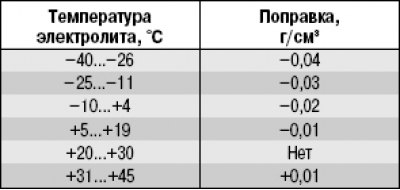
The most accurate way to determine the battery charge level by the density of the electrolyte is to measure it at a temperature of +25°C (table 15.2).
Table 15.2. Electrolyte density at 25°C, g/cm³
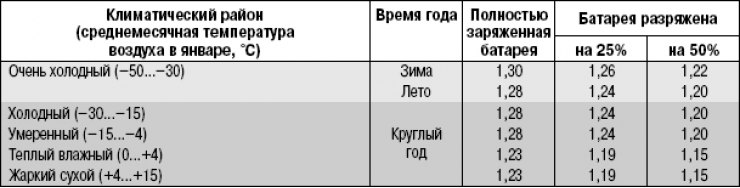
When checking the battery with a special load plug, the readings of the built-in voltmeter should be 12.5–12.9 V with the load disconnected and not fall below 11 V under load for 10 s. Such a battery will serve for a long time and reliably.
If the battery is still discharged due to unsuccessful engine starts, you can use jumper cables with crocodile-type contact clamps. When buying, it is better to choose cables designed for a large load (from 200 A).
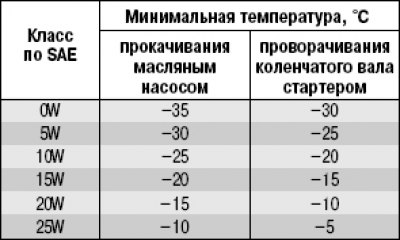
Using a less viscous winter motor oil makes starting a cold engine much easier. The international classification SAE J300 contains six classes of winter oils. The designation of "winter" classes includes the letter W (winter).
In moderate climates, it is permissible to use all-season tires in winter (universal) motor oils that are now widely used (table 15.3).
When buying oils, especially imported ones, you should be wary of counterfeits, so it is best to buy oils in specialized stores that provide certificates for the product.
Table 15.3. Characteristics of winter oils
Note: Remember that if you drive intensively in the city, change the oil (and, accordingly, the oil filter) must be carried out in strict accordance with the manufacturer's operating instructions for the vehicle, reducing the frequency of replacement by 20% every 50 thousand km, starting from 100 thousand km. Flush the lubrication system when switching to another brand of oil. Various "boilers" that supposedly heat up the thickened oil in the crankcase do not provide any practical effect, except for premature failure of the battery.
The cooling system of your car's engine uses a special low-freezing liquid - antifreeze (an aqueous solution of alcohol, glycol, glycerin and inorganic salts with the addition of special additives).
Attention! It is strictly forbidden to use water in the cooling system in winter. This is explained by the fact that when the heater fan is turned on at full power, the circulation of water through the radiator may completely stop and the water in the radiator will freeze right while driving. When the car stops, there will be no circulation through the radiator and the engine will "boil". In addition, when the cooling system operates on water for a long time, scale forms in places of strong heating, which does not conduct heat well. Scale formed in the cooling system in one place narrows the flow section of the channels, and in another place, due to corrosion, on the contrary, increases them - this disrupts the uniformity of heat transfer, causes local overheating and can lead to deformation of the cylinder head.
Often the fuel system is the cause of unsatisfactory engine performance in winter. And all because of the water condensate accumulated in the fuel tank. Almost all leading manufacturers of auto chemicals (STP, Loctite, Wynns, Aspokem) offer preparations poured into the fuel tank. They gradually clean the fuel system. It would not be superfluous to replace the fine fuel filter and make sure the engine injectors are clean and in good working order.
Before winter comes, don't forget about high-voltage wires. After a couple of years of driving on roads treated with anti-icing reagents, it is advisable to replace them, preferably with wires with a silicone sheath, which are less sensitive to temperature changes. In addition, frost does not form on them, which is often the reason for the lack of spark. A banal cause of problems in the ignition system can be corrosion or poor tightening of the battery terminals.
The operating instructions prescribe replacing the spark plugs every 15 thousand km. But, given the experience of carrying out repair work, it is better to do this after 7 thousand km or more often if the car is very intensively used in a large city or on gasoline of dubious quality. It is better to use spark plugs from imported manufacturers, such as Sagem, Champion and others, approved for use in the engine of your car.
During the winter period of car operation, the body is exposed to maximum corrosion, so its anti-corrosion treatment is highly desirable. However, according to the employees of some authorized service stations, for a number of new foreign cars, especially with a galvanized body, factory treatment is quite sufficient.
Anti-corrosion treatment requires strict adherence to technology, and although almost all manufacturers of protective materials produce them in packaging for household use, it is still preferable to carry out the treatment in a specialized service center. It is worth finding out in advance what technology it is carried out by. In any case, before applying a protective coating to the bottom and arches, the car must be cleaned of dirt, washed and thoroughly dried.
Winter operation, especially on the "salted" streets of large cities, greatly increases the corrosion of body parts. Regular washing in winter is necessary if the car is stored outside, and absolutely necessary daily if the car is stored in a warm garage. Water washes away salt well, and a layer of wet dirt dries for a very long time, increasing the harmful effect of salt on the paintwork of the body. As a last resort, wash the car more often during a thaw, and before the cold weather, wash and wipe dry, ideally - dry in a warm room. Before starting winter operation, be sure to carry out additional anti-corrosion treatment of the body. Such treatment is best carried out in a specialized car service using special protective equipment and technologies. There are two types of anti-corrosion treatment: treatment of the bottom and hidden cavities of the body and treatment of the paintwork of the body. The latter can be easily done yourself. It includes washing, drying and treatment with special protective compounds based, as a rule, on wax or silicone. If you find deep scratches when treating the body, treat the exposed metal with a rust converter (modifier).
Additional plastic mudguards reduce abrasive wear of the anti-corrosion coating on the inside of the wings, but if they are installed improperly, poorly ventilated cavities may form between the wing and the mudguard, in which additional foci of corrosion will appear due to penetrating moisture.
The correct choice of tires for use in winter allows you to improve road safety. Using a car in winter on summer tires is extremely dangerous and therefore unacceptable. Tires intended for use in winter, according to the tread pattern, can be divided into the European type (the tread pattern consists of individual blocks or blocks connected into a rib) and the Scandinavian type (the tire tread pattern has a large distance between small blocks, which allows the contact patch to be cleared of loose snow).
When operating a car in winter in urban conditions, where the roads are more often covered with snow and salt slush than compacted snow or ice, it is better to use winter tires without studs: they are lighter and have lower rolling resistance compared to studded tires.
Note: It is important to know that studless tires have worse grip on icy roads, but on wet asphalt they have undeniable advantages in terms of braking distance compared to studded tires.
Note: If you use studded tires, be sure to change them as a set, and do not limit yourself to just the front pair of wheels for the sake of economy, as this dramatically increases the likelihood of a front-wheel drive vehicle skidding.
Attention! Do not forget that in accordance with the requirements of traffic regulations, when using studded tires, you must place a triangular sign with the letter "W" on the rear window to warn other drivers.
Before winter, you should check the windshield wipers, blowers and heated glass - they must be in good working order.
Defective windshield wipers that leave matte stripes on the glass reduce not only the comfort of the ride, but also the safety of the driver. When purchasing windshield wipers, try to choose wipers recommended by the manufacturer and meeting the following requirements:
- efficiently and evenly cleans the entire surface of the windshield and rear door glass from various types of dirt;
- have sufficient wear resistance;
- when the brushes are in operation, there should be no scratches left on the glass surface.
For winter use of the car, you can purchase special brushes, the hinges and rocker arms of which are protected from icing by a rubber cover.
Attention! In order to prevent the windshield wiper blade joints from becoming loose in winter, it is not recommended to dilute the windshield wiper antifreeze with water, as the blades cool down much faster than the windshield, and any water that gets on them may freeze. Regularly wash away dirt and sand from the windshield wiper blade joints with water. In order to avoid excessive wear of the blade belts, do not turn on the windshield wiper in winter until the heater has warmed up the entire glass and melted the ice on it.
When preparing a car for operation in the winter, you should carefully inspect the windshield. In the first frost after the autumn rain, even a small chip on the windshield will turn into a full-fledged crack. Existing repair technologies allow you to eliminate such a defect without removing the glass. This is easier and cheaper than replacing the glass.
Another "winter" problem is fogging of the glass. If the ventilation system is in good working order, it rarely occurs, but we recommend that you purchase special anti-fogging liquids, which are enough to apply to the glass once a week.