



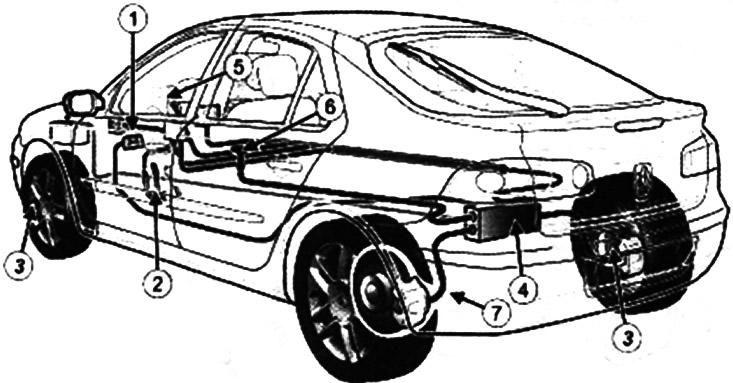
List and arrangement of system elements
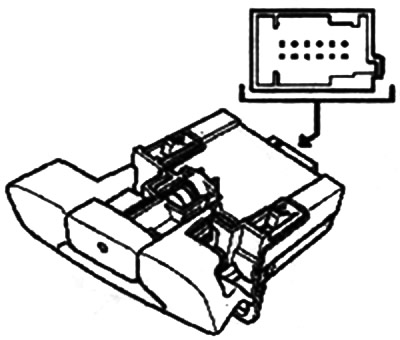
The automatic parking brake system includes:
- handle 1, which replaces the parking brake lever. The handle is located on the dashboard, next to the steering wheel;
- clutch Pedal Position Sensor 2;
- wheel speed sensors 3;
- drive and control unit 4;
- instrument cluster warning lights 5;
- emergency parking brake cable actuator 6 (manual), located between the two seats in the center console, under the bottom of the small item compartment;
- cables 7.
The handle consists of two main elements:
Original publication on the portal [Renaultbook.ru]
- an element for braking the brake discs of the rear brake mechanisms, called a control handle,
- a switch designed to release the brake discs, which has a built-in red signal lamp indicating the state of the parking brake.
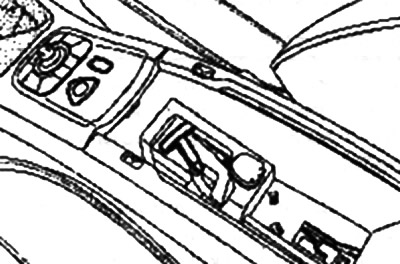
To engage the parking brake, pull the handle towards you.
To release the automatic parking brake, pull the handle towards you and press the switch.
In the event of a battery failure, the emergency parking brake release handle allows the parking brake to be released manually. It is located between the two front seats in the center console. To access the emergency release handle, remove the bottom of the storage compartment for small items.
After each use of the emergency release handle, be sure to clear the fault from the automatic parking brake ECU memory using the Diagnostic Tool.
The automatic parking brake is automatically applied whenever the engine is stopped. The brake is released automatically when the vehicle starts moving.
When starting the engine on an incline, it is enough to pull the control handle slightly towards you to brake the car on the slope. The parking brake is released automatically when the torque required to start the car is applied to the drive wheels. However, this function cannot prevent the engine from stopping in the event of incorrect driver actions.
If the main brake system fails while driving, emergency braking is performed by the automatic parking brake, for this you need to continuously pull the handle. For safety reasons, in addition to the automatic parking brake, the car is equipped with a special system to prevent spontaneous locking of the rear wheels.
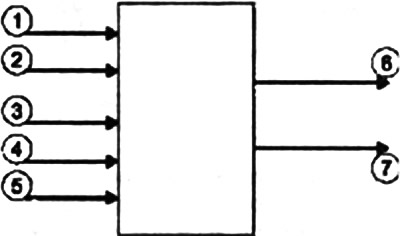
The control handle is a mechanical control element 1.
The inclination angle sensor 2 is used to change the contact force of the brake pads depending on the inclination angle.
Brake shoe contact force sensor 3 is used to check and adjust the amount of contact force of the brake shoes.
Clutch pedal travel sensor 4 transmits the slip point to the ECU to plot a reference curve.
The ABS wheel speed sensors are used as rear wheel speed sensors 5. The signal from the sensors informs the ECU about the spontaneous movement of the stopped vehicle.
The drive and control unit includes an electric motor, rear brake drive cables, inclination angle sensors and brake shoe contact force sensors 6.
The indicator lights and the display on the instrument panel indicate the activation, deactivation and malfunction of the automatic parking brake 7.
If the battery fails, the emergency parking brake handle allows you to manually release the parking brake.
The selection of the parking brake cable slack is performed automatically by the drive and control unit.
Precautions during repair
On vehicles with an automatic parking brake, you must always remove the Renault card from the reader to prevent the battery from discharging too quickly and the parking brake from being released unintentionally.
The automatic parking brake can only be released after the steering column is unlocked.
If the vehicle's weight exceeds the maximum permissible weight, then to apply additional pressure to the brake pads, pull the parking brake control handle towards you and hold it in this position for three seconds.
When parking the car at low negative ambient temperatures, it is recommended to release the parking brake after stopping the engine and before removing the Renault card to avoid freezing of the brake pads. It is possible to configure the ECU for low temperature mode. This mode prohibits automatic tightening of the brake.
On vehicles with automatic transmission, the parking brake cannot be released after five seconds:
- if the engine is running;
- if the automatic parking brake is engaged;
- if the transmission is engaged;
- if the driver's door is open. System:
- turns on the sound signal;
- displays a message on the instrument panel about the automatic parking brake disengagement lock and the need to move the selector lever to position P or N.