English Русский
Български
Беларускі
Український
Српски
Hrvatski
Română
Polski
Slovenský
Magyar
Bookmark Contacts Articles Sitemap
Company vehicles Peugeot Company vehicles Opel Company vehicles Skoda Company vehicles Land Rover Company vehicles Mitsubishi Company vehicles Volkswagen Company vehicles Honda
RenaultBook.ru


Duster   Fluence   Kangoo   Laguna   Logan   Megane   Sandero   Scenic   Symbol   Clio   Other
Renault 19 (1988-1996) Espace I and II (1984-1996) Espace III (1996-2002)

Cooling liquid (Renault Espace III)

  • Main
  • Renault
  • Espace III (1996-2002)
  • General information
  • User manual
  • Cooling liquid
0

Checking the level


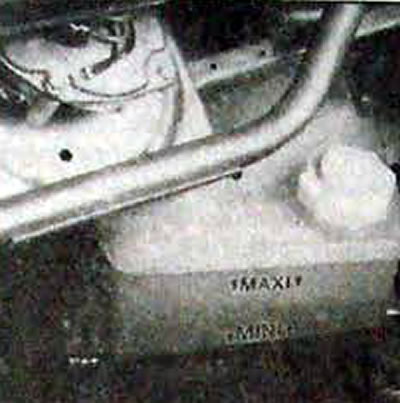
Checking the coolant level in the expansion tank

Checking the coolant level in the expansion tank


The coolant level must be checked in the expansion tank with the engine off every 1,000 km of the vehicle's mileage. The coolant level must be between the "MINI" and "MAXI" marks on the wall of the expansion tank and must never fall below the "MINI" mark. The fluid level changes depending on the engine temperature.

Use only coolant made from a mixture of ethylene glycol concentrate and distilled water that provides engine protection down to -27°C.

When checking the coolant level, note its condition. The liquid should be clean and clear. If the coolant is brown or rusty, drain the liquid, flush the cooling system and fill with fresh coolant

If the cylinder head, head gaskets, radiator or oil heat exchanger were replaced during repairs, fresh coolant must be added to the cooling system. This is due to the fact that the anti-corrosion additive in the coolant precipitates during engine operation and creates anti-corrosion protection. In coolant that has been in use, the anti-corrosion additives are less active in order to form a protective layer on newly installed parts.

Caution. When opening the expansion tank cap on a hot engine, be careful, as the escaping vapors can cause severe burns. To do this, cover the cap with a thick layer of cloth and slowly unscrew it until a hissing sound is heard. After the hissing stops, slowly unscrew and remove the cap from the expansion tank.
This article is available on: russian, bulgarian, belarusian, ukrainian, serbian, croatian, romanian, polish, slovak, hungarian
Article has been reviewed by editor: Trofimova Anastasia
Share with friends:
Previous
Espace III: User manual
Next

Motor oil
Tires — Check
Wheel replacement
Removal the seat
Armrest — adjustment, removal and installation
Air filter
Power steering system
Brake system
Rechargeable battery
Other articles on other Renault models

➽ Cooling liquid Renault Duster 1 (2009-2017)
➽ Cooling liquid Renault Fluence 1 (2009-2020, petrol)
➽ Cooling liquid Renault Logan 2 (2012-2020)
➽ Filling the cooling system Renault Kangoo 1 (1997-2007)
➽ Description of the design of the cooling system Renault Laguna 2 (2001-2007)
Link to this article in different formats
Reviews and comments of visitors
No comments yet


Add two numbers 31 + 42


Renault 19 (1988-1996) 
  • General information
  • Maintenance
  • Power unit
  • Engine repair
  • Exhaust system
  • Cooling system
  • Supply system
  • Single-point injection
  • Multi-point injection
  • Diesel injection system
  • Transmission
  • Clutch
  • Car gearbox
  • Chassis, running gear
  • Car suspension
  • Steering
  • Brake system
  • Wheels and tires
  • Body and interior
  • Exterior (external elements)
  • Interior (internal elements)
  • Heating and ventilation
  • Electrical equipment
  • Equipment and devices
  • Headlights and lighting
  • Ignition system
  • Power devices
  • Electrical circuits
Espace I and II (1984-1996) 
  • General information
  • Introduction to the guide
  • Troubleshooting
  • Power unit
  • Engine repair
  • Cooling system
  • Carburetor fuel system
  • Injection fuel system
  • Diesel fuel system
  • Ignition system
  • Transmission
  • Clutch
  • Car gearbox
  • Drive shafts
  • Chassis, running gear
  • Brake system
  • Steering
  • Front suspension
  • Rear suspension
  • Body and interior
  • Exterior (external elements)
  • Interior (internal elements)
  • Doors, locks and windows
  • Electrical equipment
  • Equipment and devices
  • Electrical circuits
Espace III (1996-2002) 
  • General information
  • Introduction to the manual
  • User manual
  • Power unit
  • Petrol engines F3R
  • Petrol engines Z7X
  • Diesel engines G8T
  • Diesel engines G9T
  • Transmission
  • Clutch
  • Mechanical gearbox
  • Automatic gearbox
  • Drive shafts
  • Chassis, running gear
  • Steering
  • Front suspension
  • Rear suspension
  • Brake system
  • Body and interior
  • Exterior (external elements)
  • Interior (internal elements)
  • Doors, locks and windows
  • Heating and ventilation
  • Electrical equipment
  • Equipment and instruments
  • Power devices
  • Electrical circuits
RenaultBook.ru © 2018–2026 | Mobile version | News and articles | Sitemap: EN BG BY UA RS HR RO PL SK HU | Administration | Site search | Bookmark
Duster 1 (2009-2017) | Fluence 1 (2009-2020, petrol) | Kangoo 1 (1997-2007) | Laguna 2 (2001-2007) | Logan 1 (2004-2012, petrol) | Logan 2 (2012-2020) | Megane 1 (1995-2002) | Megan 2 (2002-2009, petrol) | Sandero 1 (2007-2012, petrol) | Scenic 1 (1996-2003) | Symbol 1 (1999-2008, petrol) | Symbol 2 (2008-2013, petrol) | Renault 19 (1988-1996) | Espace I and II (1984-1996) | Espace III (1996-2002) | Clio 1 (1990-1998) |
We want your visit to be comfortable 😌 and use cookies 🍪 to do so.