English Русский
Български
Беларускі
Український
Српски
Hrvatski
Română
Polski
Slovenský
Magyar
Bookmark Contacts Articles Sitemap
Company vehicles Peugeot Company vehicles Opel Company vehicles Skoda Company vehicles Land Rover Company vehicles Mitsubishi Company vehicles Volkswagen Company vehicles Honda
RenaultBook.ru


Duster   Fluence   Kangoo   Laguna   Logan   Megane   Sandero   Scenic   Symbol   Clio   Other
Renault 19 (1988-1996) Espace I and II (1984-1996) Espace III (1996-2002)

Oil level indicator (Renault 19)

  • Main
  • Renault
  • Renault 19 (1988-1996)
  • Electrical equipment
  • Equipment and devices
  • Oil level indicator
0
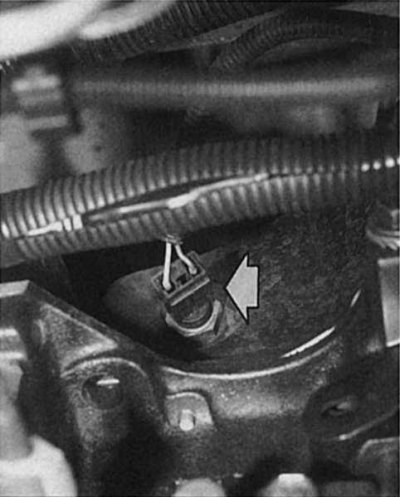
Left: Sensor (shown by arrow) oil level indicator (in the figure, a 1.4-liter engine of type "C") and, accordingly, a combined oil level and pressure sensor (16-valve engine) give incorrect information if the connector is not connected correctly.

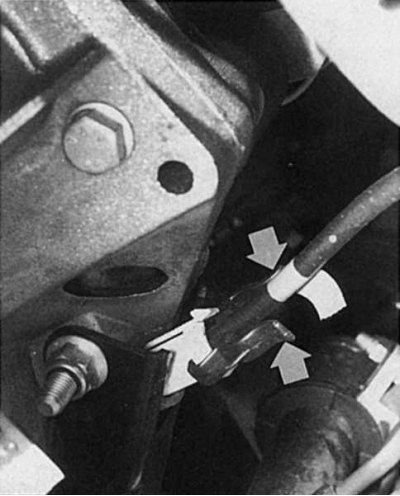
Right: The speedometer cable in the gearbox is easily accessible from above only with the basic configuration. The safety clip (arrow) must be released by pressing. When replacing the speedometer cable, check the rubber tip for damage.
Some Renault 19 variants also have an oil level indicator in the combined instrument panel.

Some Renault 19 variants also have an oil level indicator in the combined instrument panel.
  • The oil level is monitored (thermally conductive) with a measuring rod screwed into the engine housing in such a way that its sensor is immersed in the oil pan.
  • When the ignition is turned on, an electric current flows through the wire in the dipstick, which is measured by a small electronic device located behind the indicator. Depending on how deeply the dipstick is immersed in the oil, the control unit processes a certain amount of voltage and displays a corresponding oil level value on the indicator.
  • When the engine is running, the oil pressure sensor interrupts the flow of "measuring" electrical current to the control unit and the oil level is no longer registered.

Troubleshooting


1. Check the oil level sensor: disconnect the contact connection from the sensor and measure the resistance between the sensor contacts. If the sensor is working properly, the resistance should be between 5 and 30 ohms.


2. Check the oil level indicator: remove the combination instrument and disconnect the contact.

3. Connect the plus and minus (they are marked) to the battery - if the arrow does not move, then the indicator is faulty.
This article is available on: russian, bulgarian, belarusian, ukrainian, serbian, croatian, romanian, polish, slovak, hungarian
Article has been reviewed by editor: Trofimova Anastasia
Share with friends:
Previous
19: Equipment and devices
Next

Oil pressure indicator
Charging indicator
High beam indicator
Tachometer — General Information
Brake system indicators
Speedometer and speedometer cable
On-board computer
Watches — description and inspection
Switches on the combination lever
Ignition switch and anti-theft device
Other articles on other Renault models

➽ Fuel level indicator and fuel pump Renault Duster 1 (2009-2017)
➽ Replacing the oil level indicator guide seal Renault Logan 1 (2004-2012, petrol)
➽ Replacing the oil level indicator guide seal Renault Sandero 1 (2007-2012, petrol)
➽ Fuel pump — fuel level sensor — fuel filter assembly (all… Renault Fluence 1 (2009-2020, petrol)
➽ Checking the engine oil level Renault Kangoo 1 (1997-2007)
Link to this article in different formats
Reviews and comments of visitors
No comments yet


Add two numbers 20 + 48


Renault 19 (1988-1996) 
  • General information
  • Maintenance
  • Power unit
  • Engine repair
  • Exhaust system
  • Cooling system
  • Supply system
  • Single-point injection
  • Multi-point injection
  • Diesel injection system
  • Transmission
  • Clutch
  • Car gearbox
  • Chassis, running gear
  • Car suspension
  • Steering
  • Brake system
  • Wheels and tires
  • Body and interior
  • Exterior (external elements)
  • Interior (internal elements)
  • Heating and ventilation
  • Electrical equipment
  • Equipment and devices
  • Headlights and lighting
  • Ignition system
  • Power devices
  • Electrical circuits
Espace I and II (1984-1996) 
  • General information
  • Introduction to the guide
  • Troubleshooting
  • Power unit
  • Engine repair
  • Cooling system
  • Carburetor fuel system
  • Injection fuel system
  • Diesel fuel system
  • Ignition system
  • Transmission
  • Clutch
  • Car gearbox
  • Drive shafts
  • Chassis, running gear
  • Brake system
  • Steering
  • Front suspension
  • Rear suspension
  • Body and interior
  • Exterior (external elements)
  • Interior (internal elements)
  • Doors, locks and windows
  • Electrical equipment
  • Equipment and devices
  • Electrical circuits
Espace III (1996-2002) 
  • General information
  • Introduction to the manual
  • User manual
  • Power unit
  • Petrol engines F3R
  • Petrol engines Z7X
  • Diesel engines G8T
  • Diesel engines G9T
  • Transmission
  • Clutch
  • Mechanical gearbox
  • Automatic gearbox
  • Drive shafts
  • Chassis, running gear
  • Steering
  • Front suspension
  • Rear suspension
  • Brake system
  • Body and interior
  • Exterior (external elements)
  • Interior (internal elements)
  • Doors, locks and windows
  • Heating and ventilation
  • Electrical equipment
  • Equipment and instruments
  • Power devices
  • Electrical circuits
RenaultBook.ru © 2018–2026 | Mobile version | News and articles | Sitemap: EN BG BY UA RS HR RO PL SK HU | Administration | Site search | Bookmark
Duster 1 (2009-2017) | Fluence 1 (2009-2020, petrol) | Kangoo 1 (1997-2007) | Laguna 2 (2001-2007) | Logan 1 (2004-2012, petrol) | Logan 2 (2012-2020) | Megane 1 (1995-2002) | Megan 2 (2002-2009, petrol) | Sandero 1 (2007-2012, petrol) | Scenic 1 (1996-2003) | Symbol 1 (1999-2008, petrol) | Symbol 2 (2008-2013, petrol) | Renault 19 (1988-1996) | Espace I and II (1984-1996) | Espace III (1996-2002) | Clio 1 (1990-1998) |
We want your visit to be comfortable 😌 and use cookies 🍪 to do so.