
English Русский
Български
Беларускі
Український
Српски
Hrvatski
Română
Polski
Slovenský
Magyar
Bookmark Contacts Articles Sitemap
Company vehicles Peugeot Company vehicles Opel Company vehicles Skoda Company vehicles Land Rover Company vehicles Mitsubishi Company vehicles Volkswagen Company vehicles Honda
RenaultBook.ru


Duster   Fluence   Kangoo   Laguna   Logan   Megane   Sandero   Scenic   Symbol   Clio   Other
Logan 1 (2004-2012, petrol) Logan 2 (2012-2020)

Vernier Caliper tool (Renault Logan 2)

  • Main
  • Logan
  • Logan 2 (2012-2020)
  • General information
  • Maintenance
  • Vernier Caliper tool
0
1. Rod. 2. Sliding frame. 3. Rod scale. 4. Jaws for internal measurements. 5. Jaws for external…

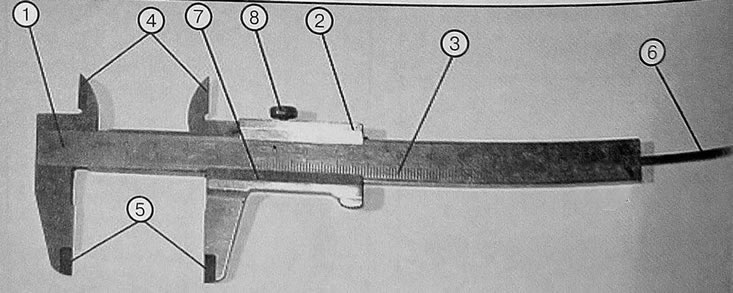
1. Rod. 2. Sliding frame. 3. Rod scale. 4. Jaws for internal measurements. 5. Jaws for external measurements. 6. Depth gauge ruler. 7. Vernier. 8. Screw for clamping the frame


A caliper is a universal tool designed for high-precision measurements of external and internal dimensions. In addition, a caliper can be used to determine the depth of holes and protrusions

The measuring jaws of the caliper can also be used to measure the parallelism of the sides of workpieces.

Calipers have measurement limits of 0-125 mm (SHC-1), 0-160 mm (SHC-2) and 0-400 mm (SHC-3).

The most commonly used caliper is ShTs-1.

To measure external dimensions and check parallelism, the main measuring jaws of the tool are used, and to measure internal dimensions and mark out, auxiliary pointed jaws are used.

Using a depth gauge, determine the depth of holes and protrusions.

The basis of the caliper device is a ruler with divisions (rod) and an auxiliary scale-vernier, which moves along the main ruler-rod. With the help of this auxiliary scale, it is possible to count off the division fractions of the main scale.

The operating principle of the vernier is based on the difference in the division intervals of the main scale and the vernier scale. This difference is equal to the division value of the vernier, and the number of divisions depends on the division value.


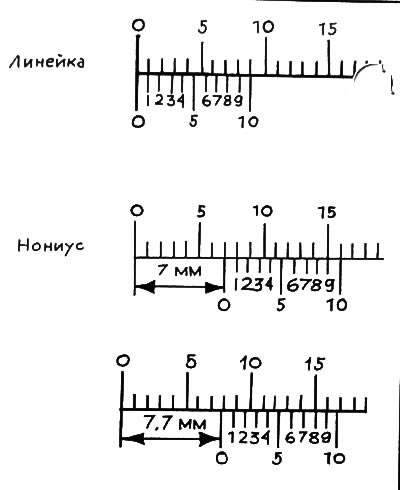
If the scale division interval is 1 mm, and the vernier division interval is 0.9 mm, then the vernier division value is 0.1 mm.

Thus, if you combine the zero division of the vernier with the zero division of the main scale of the caliper, then the first division of the vernier will "lag" behind the first division of the main scale by the amount of the difference in the scale intervals, i.e. by 0.1 mm, the second division - by 0.2 mm, etc.

The tenth division of the vernier, having shifted by 1 mm, coincides with the ninth division of the main scale of the rod, that is, if the division value of 1 mm is divided by the number of divisions of the vernier (by 10), we get 0.1 mm (see picture)

Example:
  • If the zero mark of the vernier coincides with any mark on the ruler, then this division indicates the size in whole millimeters.
  • If the zero mark of the vernier does not coincide with the mark on the main scale, then the division on the ruler closest to the left shows a whole number of millimeters, and tenths are counted according to the vernier.
  • To the whole number of millimetres are added as many tenths of a millimetre as there are vernier strokes until any vernier stroke completely coincides with one of the ruler strokes. The figure shows an example of reading 7 mm, and 7.7 mm.
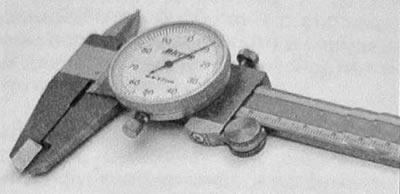
  • Some calipers are equipped with a dial indicator. The dial indicator allows you to adjust the zero setting and control tolerances.
  • During and after work, wipe the caliper with a napkin soaked in an aqueous alkaline solution, then dry with a clean napkin. After work, cover the surfaces of the caliper with a thin layer of any technical oil and put it in a case. Avoid rough impacts or falls during operation to avoid bending the rod and other damage, scratches on the measuring surfaces, friction of the measuring surfaces against the controlled part.
During and after work, wipe the caliper with a napkin soaked in an aqueous alkaline solution, then…


During and after work, wipe the caliper with a napkin soaked in an aqueous alkaline solution, then…
This article is available on: russian, bulgarian, belarusian, ukrainian, serbian, croatian, romanian, polish, slovak, hungarian
Article has been reviewed by editor: Petrovsky Roman
Share with friends:
Previous
Logan 2: Maintenance
Next

Car Micrometers
Flat feeler gauges
Basic set of necessary tools
Environmental protection
Precautions when working with Supplemental Restraint System (SRS)…
Dial type indicator
Bore gauge tool
Other articles on other Renault models

➽ Checking the cooling system using the Mot. 1700 tool Renault Duster 1 (2009-2017)
➽ Tool kit and mobile jack Renault Fluence 1 (2009-2020, petrol)
➽ Installation and removal of the Mot. 1760 tool Renault Laguna 2 (2001-2007)
➽ Car tool kit Renault Megan 2 (2002-2009, petrol)
➽ Replacing the front wheel brake caliper Renault Sandero 1 (2007-2012, petrol)
Link to this article in different formats
Reviews and comments of visitors
No comments yet


Add two numbers 47 + 19


Logan 2 (2012-2020) 
  • General information
  • Faults en route
  • Daily checks
  • Governing bodies
  • Maintenance
  • Power unit
  • Petrol engines 1.2 l
  • Petrol engines 1.6 l
  • Diesel engines 1.5 l
  • Cooling system
  • Lubrication system
  • Power and control system
  • Intake and exhaust system
  • Engine electrical equipment
  • Transmission
  • Clutch
  • Car gearbox
  • Drive shafts
  • Chassis, running gear
  • Suspension and wheels
  • Brake system
  • Steering
  • Body and interior
  • Exterior (external elements)
  • Interior (internal elements)
  • Safety system
  • Heating and air conditioning
  • Electrical equipment
  • Equipment and devices
  • Wiring diagrams (sedan)
  • Wiring diagrams (wagon)
Logan 1 (2004-2012, petrol) 
  • General information
  • Vehicle device
  • User manual
  • Faults en route
  • Daily maintenance
  • First maintenance
  • Second maintenance
  • Driver tips
  • Power unit
  • Engine repair
  • Lubrication system
  • Cooling system
  • Power and exhaust system
  • Transmission
  • Clutch
  • Car gearbox
  • Drive shafts
  • Chassis, running gear
  • Front suspension
  • Rear suspension
  • Steering
  • Brake system
  • Wheels and tires
  • Body and interior
  • Exterior (external elements)
  • Interior (internal elements)
  • Doors, locks and windows
  • Body Care
  • Electrical equipment
  • Equipment and devices
  • Headlights and lighting
  • Power devices
  • Electrical circuits
RenaultBook.ru © 2018–2026 | Mobile version | News and articles | Sitemap: EN BG BY UA RS HR RO PL SK HU | Administration | Site search | Bookmark
Duster 1 (2009-2017) | Fluence 1 (2009-2020, petrol) | Kangoo 1 (1997-2007) | Laguna 2 (2001-2007) | Logan 1 (2004-2012, petrol) | Logan 2 (2012-2020) | Megane 1 (1995-2002) | Megan 2 (2002-2009, petrol) | Sandero 1 (2007-2012, petrol) | Scenic 1 (1996-2003) | Symbol 1 (1999-2008, petrol) | Symbol 2 (2008-2013, petrol) | Renault 19 (1988-1996) | Espace I and II (1984-1996) | Espace III (1996-2002) | Clio 1 (1990-1998) |
We want your visit to be comfortable 😌 and use cookies 🍪 to do so.