
The solenoid valves are controlled by signals from the ECU, which in turn is controlled by signals from four wheel speed sensors. Magnetic wheel speed sensors receive signals from a toothed ring mounted on the wheel hub. By comparing these signals, the ECU can calculate the wheel speed of the vehicle. When the speed of rotation of any wheel deviates from the speed of the car, the system, processing the received signals, predicts the moment of blocking the wheel that slows down its rotation.
If the system expects a wheel to lock up, it instructs the appropriate valve to isolate the fluid supply to that wheel's brake cylinder from the brake master cylinder.
If the rotational speed continues to decrease relative to the speeds of the other wheels, the ABS system pushes the brake fluid back into the master cylinder, reducing braking. If all four wheels slow down equally, the return pump will stop and all solenoid valves will open again, allowing the brake master cylinder to pressurize the slave cylinders as usual. This cycle can repeat up to ten times per second.
The activation of the solenoid valves and the return pump creates pulsations in the brake system, which are transmitted to the brake pedal, thus indicating to the driver that the ABS is engaged.
Solenoid valves in the front circuit act on the brake calipers of the front wheels independently, while the solenoid valve on the rear wheels acts on both wheels simultaneously. Because the braking system is diagonally split, a separate mechanical plunger valve in the hydraulic unit separates the rear solenoid valve's hydraulic output into two separate circuits. To prevent false signals from affecting the system, the built-in safety loop monitors all signals entering the ECU. If a false signal is received or there is not enough voltage in the network, the system will automatically turn off, a warning signal will light up on the panel to turn off the ABS system. At the same time, the normal mode of operation of the brake system is maintained.
However, when driving on a slippery road, you need to be extremely careful, as the distribution function of the system will be impaired (pressure equalization function in the front and rear brakes) and there is a possibility of skidding the car when braking.
If there is a malfunction in the system, you should present the car to specialists for diagnostics and repair.
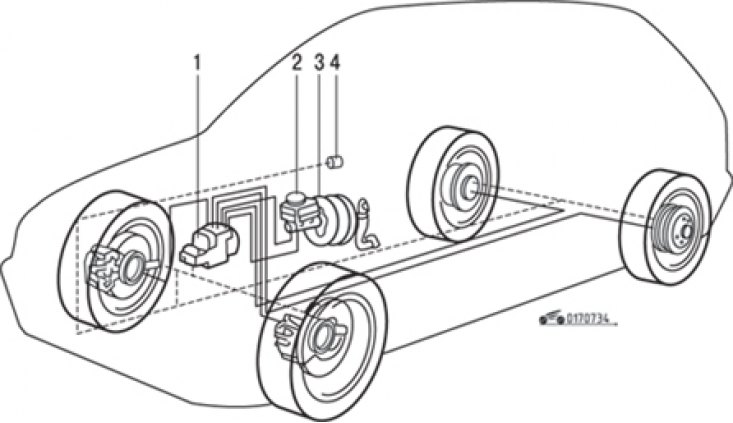
Pic. 7.34. Location on the vehicle of Bosch ABS units and parts: 1 - hydraulic block; 2 – the main brake cylinder; 3 - brake booster; 4 – a control lamp of switching off of ABS in a combination of devices
The location of the ABS units is shown in fig. 7.34.