



Contents: General information 🠛 Driver and front passenger airbag 🠛 Operating principle 🠛 Front airbag feature 🠛 Malfunctions 🠛 Additional safety devices for rear…🠛 Seat belt force limiter 🠛 Side airbags 🠛 Side curtains 🠛
General information
In a severe frontal impact, seat belts keep the driver and passengers in place
The front shoulder belt pretensioners and the rear pyrotechnic retractors tighten the seat belts so that they fit snugly against the body.
The programmable restraint system limits the force with which the belt is pressed against the body.
Front airbags deploy:
- from the center of the steering wheel to protect the driver's head;
- from the dashboard for the front passenger.
Lumbar pretensioners or anti-slide airbags tighten the seat belts to protect the lower body
Note: The inflation level of the driver's airbag can be adjusted by the ECU depending on:
- seat positions;
- impact force.
In the event of a sufficiently severe side impact, the front side chest airbag, located in the front seat (from the side of the blow), when deployed, protects the chest of the person sitting in the front seat on the door side. Rear side airbag. if the car is equipped with one, located in the side of the body on the corresponding side (from the side of the blow), protects the chest of the person sitting in the back seat from the door side. Curtain airbag (from the side of the blow) protects the head of the person sitting in the front or back seat from the door side.
Depending on the force and location of the impact, pretensioners, seat belt retractors, anti-skid airbags, frontal and side airbags may deploy in various combinations.
When the pyrotechnic gas generator is triggered, a pop is heard and light smoke comes out
Note: Power to the ECU and igniters is supplied from the vehicle battery under normal operating conditions. However, the airbag ECU has a built-in backup power source in case of battery failure during the initial stages of an impact.
When the seat belt pretensioners or airbags are triggered, the ECU is completely blocked and a warning light comes on on the instrument panel. In this case, the ECU must be replaced (under the influence of ignition energy, some elements lose their nominal characteristics).
After installing all components, check the system using a diagnostic tool.
After the hit:
- if the pretensioners are triggered, replace the seat belts if they were fastened, as well as the seat frame (power is supplied to the shoulder belt pretensioners in series);
- if the rear pyrotechnic safety reels are triggered, replace the seat belt together with the pyrotechnic reel (power is supplied to the pyrotechnic coils in series);
- if the driver's front airbag is deployed, the steering wheel and its mounting bolt must be replaced;
- after the front passenger central airbag has deployed, replace the instrument panel;
- if the side airbag of the seat is deployed, replace the seat frame;
- if the anti-slip airbag is deployed, also replace the seat frame;
- if the curtain airbag is deployed, install the plate and replace the deflector.
Driver and front passenger airbag
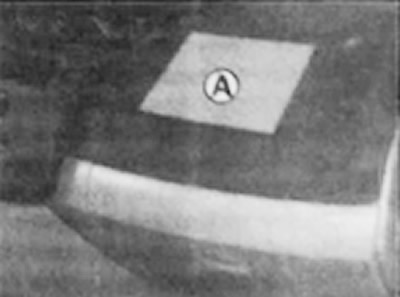
The driver and front passenger seats are equipped with airbags.
"Airbag" inscriptions on the steering wheel and on the instrument panel (airbag coverage area A), as well as the corresponding sticker on the lower part of the windshield indicate that this equipment is installed on the vehicle.
Each airbag system includes:
- airbag and gas generator mounted in the central panel of the steering wheel (for the driver) or in the dashboard (for the front passenger);
- a common electronic unit consisting of a shock sensor and a tracking system for turning on the gas generator igniter:
- a single control lamp located on the instrument panel;
- additional forward-mounted frontal impact sensor.
Note: The airbag is operated by a gas generator system that emits smoke and some heat when the airbag inflates (don't be scared - this doesn't mean a fire has started), and a popping sound is also heard. When the airbag is deployed, the driver may receive minor and quickly passing skin damage.
Operating principle
The system is activated only when the ignition is on.
In the event of a severe frontal impact, the airbags instantly inflate with gas, thus reducing the impact of the driver's head and chest on the steering wheel, and the head and chest of the front passenger on the dashboard; after the impact, the airbags immediately deflate, allowing you to freely leave the car.
Front airbag feature
Each pillow has two levels of opening depending on the force of the impact and a system of valves to prevent burns from the gases filling the pillow:
- "small volume" is the first level of filling of the pillow;
- "large volume" (second degree of filling of the pillow) - the safety seams of the airbag are torn and it becomes larger (under very strong blows).
Malfunctions
When the ignition is turned on, the control lamp located on the instrument panel lights up for a few seconds.
If the indicator lamp does not light when the ignition is turned on, or lights up when the engine is running, this indicates a malfunction in the airbag system.
Contact a service station as soon as possible. Failure to do so may result in reduced safety.
Additional safety devices for rear seat passengers
Depending on the vehicle's configuration, additional safety devices include:
- seat belt pretensioners built into inertia reels;
- seat belt tension limiters.
In the event of a frontal impact, these devices can be activated either separately or simultaneously.
Depending on the force of the frontal impact, two options are possible:
- protection is provided only by seat belts;
- the pretensioner is activated, pressing the seat belt tightly against the body.
The rear seat belt pretensioners only operate when the ignition is on.
In the event of a strong frontal impact, the device instantly retracts the belt, pressing it against the body and thereby increasing the effectiveness of the belt.
Seat belt force limiter
This device is activated at a certain impact force and limits the force of the belt pressing on the torso.
Side airbags
Side airbags are installed in the front seats and, depending on the vehicle's configuration, in the rear side seats and deploy at the side of the seat (from the door side) in a severe side impact, protecting the driver and passengers.
Side curtains
These airbags are mounted on top of the vehicle and deploy along the front and rear side windows to protect the driver and passengers in severe side impacts.