



Cylinder head height, mm: H = 159.5 ±0.2.
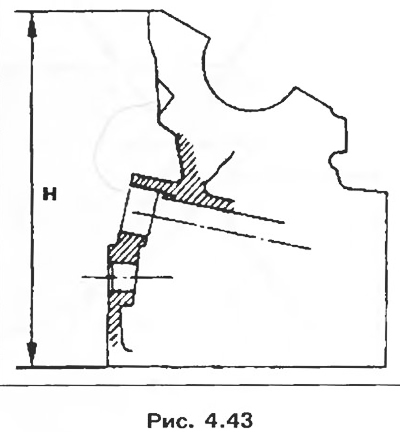
Maximum permissible deformation of the mating surface, mm: 0.05.
2. Valve guide bushings.
Inner diameter, mm: 8.
Outer diameter of guide bushing, mm:
- nominal: 13;
- repair: 13.30.
Caution! The intake and exhaust valve guides have valve stem oil seals that must be replaced each time the valve drive mechanism is disassembled.
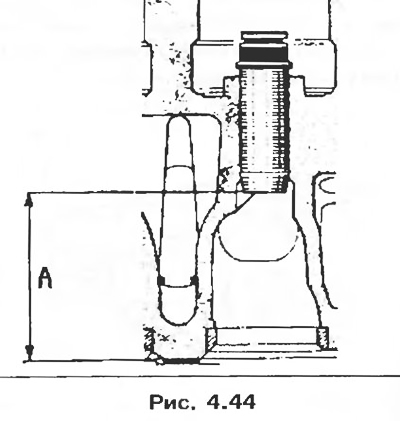
Position of the guide bushings of the intake and exhaust valves relative to the lower mating surface of the cylinder head, mm: A = 43.25.
3. Valve springs.
Length in free state, mm: 43.41
Length under load:
- 230 ±20 N = 37.9 mm;
- 705 ±35 N = 28.4 mm.
Length of the spring with fully compressed coils, mm: 25.77.
Wire diameter, mm: 4.25.
Inner diameter, mm: 21.5 ±0.1.
4. Valves.
Rod diameter, mm: 8
Working chamfer angle:
- inlet valve: 120°;
- outlet valve: 90°.
Head diameter, mm:
- inlet valve: 36.1;
- exhaust valve: 31.5.
Caution: When replacing valves, the new valves installed must have the same part number as the previous valves to prevent damage to the valves and seats.
The same part number may have several markings, in which case all valves are completely interchangeable.
Make sure that new valves with markings different from those of the removed valves have the same part number.
5. Valve seats.
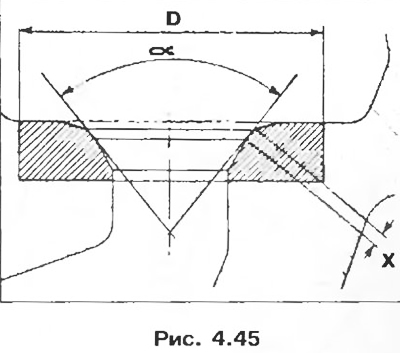
Outer diameter of seat D, mm:
- intake valves. 37 (37.3);
- exhaust valves. 32.6 (32.89).
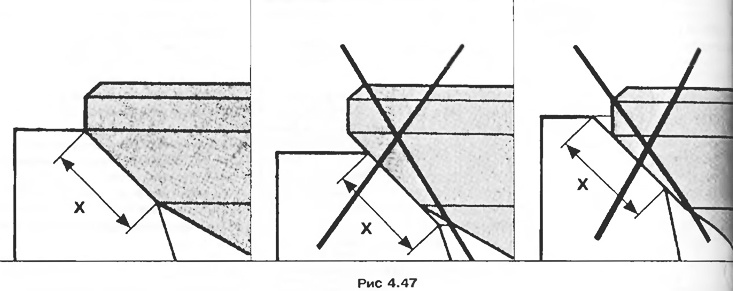
Inlet valves X = 1.8; α= 120°.
Grind the working chamfer of seat 1 using a cutter with an angle of 30°, reduce the width of the working chamfer by processing chamfer 2 with a cutter with an angle of 60° until width X is obtained.
Exhaust valves X = 1.8; α= 90°.
Grind the working chamfer of seat 1 using a cutter with an angle of 45°, reduce the width of the chamfer by processing chamfer 2 with a cutter with an angle of 75° until a width of X is obtained.
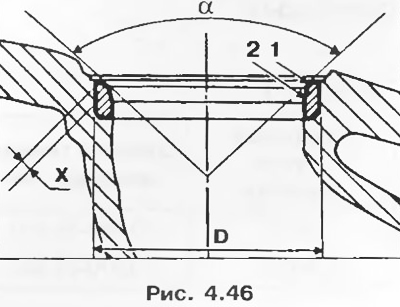
Attention! Check the valve fits correctly to its seat (figure 4.47).
6. Camshaft:
- axial clearance, mm: 0.05-0.13;
- number of bearings: 5.
7. Pistons.
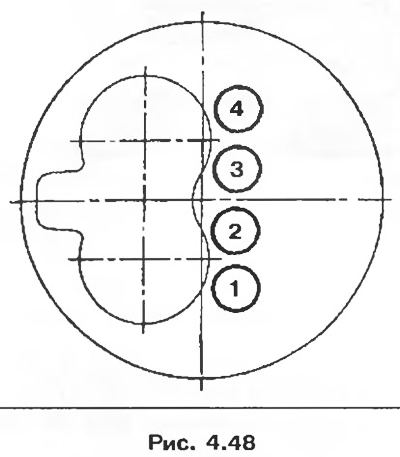
Mark 1 indicates the depth of the recess in the piston crown.
Mark 2 indicates the engine type 8Q piston A-B-C.
Mark 3 indicates the piston size group.
Label 4 is for the supplier.
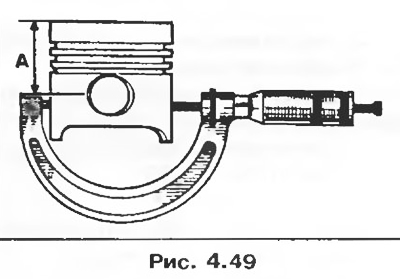
Selection of pistons for cylinder liners
Table 4.2
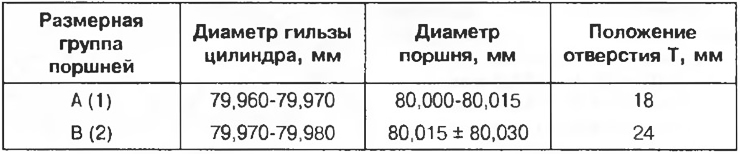
The piston diameter should be measured at a distance A = 60 mm.
8. Cylinder liners.
Attention! It is imperative to observe the selection of piston and cylinder liner diameters. The selection is determined by the position of the holes T in relation to the mating surface of the cylinder head. The position of these holes makes it possible to select the tolerances of the cylinder liners in their nominal size group and, consequently, the piston diameters corresponding to these tolerances (table 4.2).
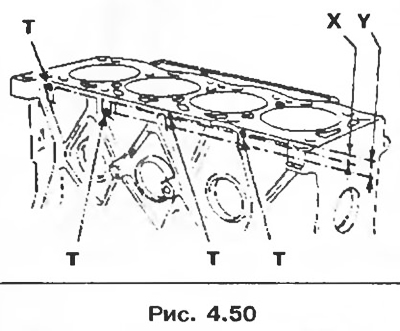
Note: The markings contain: 1 and 2 - designation of the sizes of piston groups A or B; T - the position of the holes indicates the size group for the cylinder: X = 18 mm, Y = 24 mm.
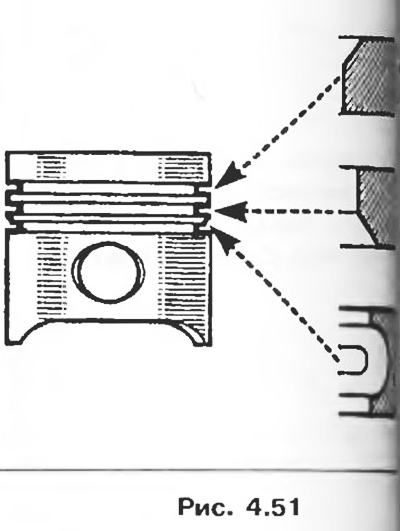
9. Piston rings.
Thickness, mm:
- upper compression ring.
- lower compression ring.
- oil scraper ring 3.
Piston ring locks are installed at 120° intervals. Compression rings are installed with the Top mark facing upwards.
10. Connecting rods.
Axial clearance of the lower connecting rod head, mm: 0.22-0.40.
11. Crankshaft.
Number of main bearings 5.
Axial clearance, mm: 0.07-0.23.
Table 4.3
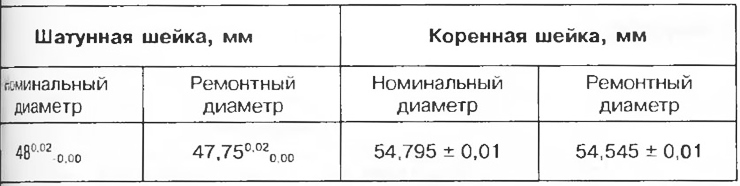
There are thrust half rings of different thicknesses, mm: 2.30-2.35-2.40-2.45.
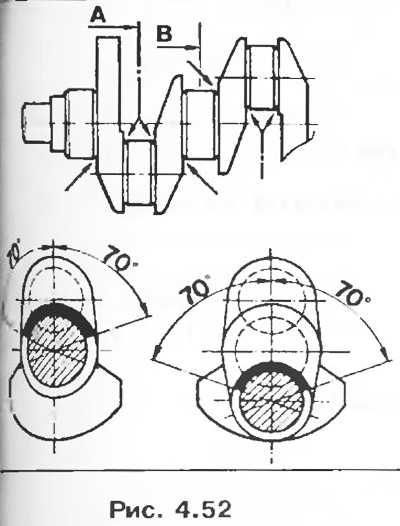
When grinding, the fillets on the plane must remain intact in the areas that form the corner (figure 4.52, arrows).
12. Intermediate shaft.
Axial clearance, mm: 0.07-0.15.
The intermediate shaft is installed in two bushings with a diameter of, mm:
- inner sleeve 39.95,
- outer sleeve 40.5.
Parts that must be replaced when removed
- All sealing cuffs and gaskets.
- Flywheel mounting bolts.
- Connecting rod cap mounting bolts.
- Crankshaft support mounting bolts.
- Valve guide bushings.
- Fireproof washers for injectors.
- Cylinder head mounting bolt.
- Cooling system hose.