



The offsetting of the intake valve closing moment optimizes cylinder filling depending on the crankshaft speed. As a result, torque is increased in the medium-load mode and power at high crankshaft speed.
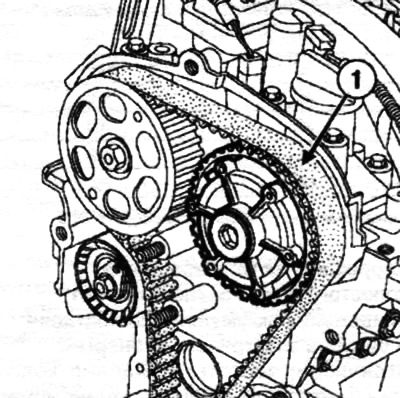
Camshaft phase regulator:
1 — phase regulator
Under these conditions, later closing of the intake valves ensures the supply of an additional portion of the fuel mixture due to its high speed of movement.
On the contrary, at low rotation speeds the charge inertia is small. Earlier closing of the exhaust valves allows to avoid poor filling of the cylinders and loss of torque due to displacement of part of the fresh charge of the mixture.
The higher the crankshaft speed, the later the intake valves should close.
Phase regulator operating modes (k4M engine)
Oil is supplied to the phase regulator via an electromagnetic valve installed on the cylinder head.
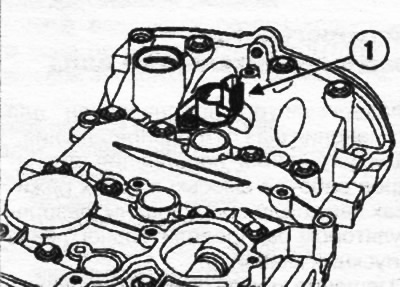
Phase regulator electromagnetic valve:
1 — valve
The valve is supplied with electrical power in the form of an alternating signal of the degree of cyclic opening (amplitude 12 V and frequency 250 Hz), which allows oil to be supplied to the mechanism and thus change the phase shift angle.
The ECU supplies the electromagnetic valve with a variable signal of the degree of cyclic opening, the value of which is proportional to the required phase shift.
The phases change smoothly from 0 to 43° according to the crankshaft rotation angle.
The electromagnetic valve of the camshaft phase regulator is controlled under the following conditions:
- no fault with crankshaft speed sensor;
- no faults in camshaft position sensors;
- absence of faults in the injection system;
- after starting the engine;
- when the engine is not idling and the accelerator pedal is released;
- the threshold value of the injection profile, set taking into account the load and crankshaft speed, was obtained;
- coolant temperature within 10-120°C;
- increased engine oil temperature.
Backup modes:
- return of the phase regulator to its original position;
- zero phase shift.
Attention: When the electromagnetic valve is locked in the open position, the engine runs unsteadily at idle, the pressure in the intake manifold is increased, and increased engine noise is also noted.
Operation and control of the phase regulator (m4R, H4J engines)
The phase regulator is disabled or controlled by the injection system ECU via an electromagnetic valve installed on the cylinder head cover.
When the crankshaft speed is within 1500-4300 rpm, the ECU supplies supply voltage to the electromagnetic valve.
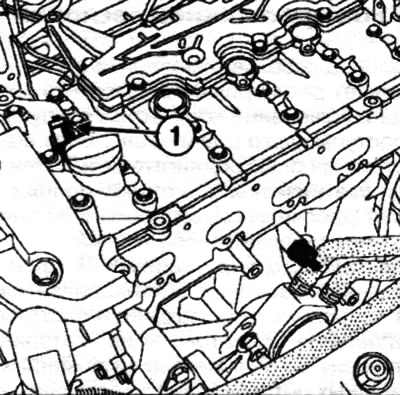
Phase regulator electromagnetic valve:
1 — valve
When 4300 rpm is exceeded, the electromagnetic valve power supply is cut off. In this case, the position of the phase regulator mechanism facilitates filling of the cylinders at high crankshaft speed. In this position, the locking plunger blocks the mechanism.
Note: At rotation speeds up to 1500 rpm, the supply voltage is not supplied to the electromagnetic valve. The mechanism is locked by the plunger. From the moment the electromagnetic valve is supplied with power, at crankshaft rotation speeds above 1500 rpm, under the action of oil pressure, the locking plunger moves away and releases the mechanism.
In the initial position, the electromagnetic valve is closed. The valve opens the oil passage to control the phase regulator when the following conditions are met:
- no fault with crankshaft speed sensor;
- no faults in camshaft position sensors;
- absence of faults in the injection system;
- after starting the engine;
- the engine is not idling;
- battery voltage is above 11.4 V;
- coolant temperature above 30°C;
- engine speed is 1500 - 4300 rpm;
- load more than 87% (approximately 900 mbar).
Caution: When the electromagnetic valve is locked in the open position, the engine will run unsteadily at idle speed and the pressure in the intake manifold will be increased.