English Русский
Български
Беларускі
Український
Српски
Hrvatski
Română
Polski
Slovenský
Magyar
Bookmark Contacts Articles Sitemap
Company vehicles Peugeot Company vehicles Opel Company vehicles Skoda Company vehicles Land Rover Company vehicles Mitsubishi Company vehicles Volkswagen Company vehicles Honda
RenaultBook.ru


Duster   Fluence   Kangoo   Laguna   Logan   Megane   Sandero   Scenic   Symbol   Clio   Other
Clio 1 (1990-1998)

Fuel system — filling and bleeding (Renault Clio 1)

  • Main
  • Clio
  • Clio 1 (1990-1998)
  • Power unit
  • Fuel system (diesel)
  • Fuel system — filling and bleeding
0
1. After disconnecting part of the fuel supply system or after the fuel in the tank has been completely used up, the fuel system must be filled and bled.

2. Most models are equipped with a manual filler bulb, installed in the right corner of the engine compartment, in the supply line to the fuel filter. If there is no such bulb, as well as on later models with a Bosch injection system, it must be installed (they are available for sale as spare parts from Renault dealers), or use an alternative procedure.

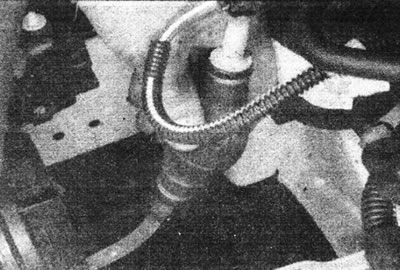
3. On models equipped with a primer bulb, loosen the bleeder screw located on the top of the fuel pump near the inlet connector, then squeeze the bulb several times until fuel flows out of the screw without air bubbles (see illustrations).
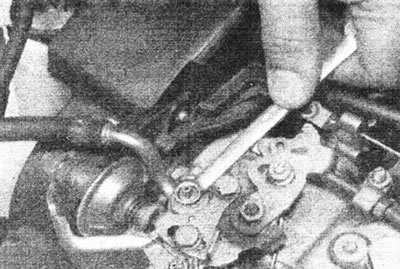
7.3a. Loosen the fuel system bleeder nipple located on the fuel pump inlet coupling...
7.3a. Loosen the fuel system bleeder nipple located on the fuel pump inlet coupling...


7.3b....and squeeze the dressing bulb (where available).

7.3b....and squeeze the dressing bulb (where available).


Tighten the bleed screw and continue pumping the bulb until you feel a steady resistance. Try to start the engine at this stage by pressing the gas pedal all the way down and turning on the starter. Do not turn on the glow plugs. If the engine does not start within 15 seconds, turn on the glow plugs and then try starting the engine again.

4. On models not equipped with a filling bulb, the engine will be difficult to start. To avoid damaging the spark plugs and battery, turn the engine starter for 4-5 seconds, and then pause for 8-10 seconds. As soon as the engine starts, allow it to operate at an elevated idle speed until the idle speed stabilizes. Turn off the engine and start it again.

5. For all models, if a large amount of air has entered the system, wrap a rag around the fuel return coupling on the top of the pump and loosen the coupling. Squeeze the filler bulb until fuel flows from the connector without air bubbles - on models without a bulb, inject fuel into the pump with a syringe. Tighten the coupling and wipe away any spilled fuel.

6. If air has entered the injector tubes, wrap the injector couplings with a rag, then loosen the couplings. Crank the engine with the starter until fuel flows out of the coupling without air bubbles, then tighten the coupling. Wipe up any spilled fuel.

Warning: Be prepared to turn off the engine if it starts.


7. Try to start the engine by pressing the gas pedal all the way down and turning on the starter. Do not turn on the glow plugs at first, but if the engine does not start within 15 seconds, turn on the glow plugs and then try to start the engine again.
This article is available on: russian, bulgarian, belarusian, ukrainian, serbian, croatian, romanian, polish, slovak, hungarian
Article has been reviewed by editor: Fedoseev Denis
Share with friends:
Previous
Clio 1: Fuel system (diesel)
Next

Gas pedal — removal and installation
Throttle cable — removal, installation and adjustment
Fuel level sensor — removal and installation
Air filter housing — removal and installation
General description and precautions
Maximum engine speed — checking and adjustment
Thermal actuator and fast idle cable — removal, installation,…
Fast Idle Control System Components — removal, installation,…
Cold Start Injection Timing Correction Device — checking, removing…
Fuel Shut-Off Valve — description, removal, and installation
Other articles on other Renault models

➽ Filling and bleeding the fuel system Renault Megane 1 (1995-2002)
➽ Filling and bleeding the steering system Renault Espace I and II (1984-1996)
➽ Functional diagram of the fuel supply system Renault Duster 1 (2009-2017)
➽ Technical characteristics of engines for diagnostic procedures… Renault Fluence 1 (2009-2020, petrol)
➽ Filling the cooling system Renault Kangoo 1 (1997-2007)
Link to this article in different formats
Reviews and comments of visitors
No comments yet


Add two numbers 41 + 25


Clio 1 (1990-1998) 
  • General information
  • Maintenance
  • Troubleshooting
  • Power unit
  • Petrol engines 1.1 l (C)
  • Petrol engines 1.2 l (D)
  • Petrol engines 1.2/1.4 l (E)
  • Petrol engines 1.8 l (F)
  • Diesel engines
  • Overhaul of engines
  • Cooling and heating
  • Fuel system (carburetor)
  • Central fuel injection
  • Distributed fuel injection
  • Fuel system (diesel)
  • Starting and charging system
  • Ignition system (transistor)
  • Ignition system (electronic)
  • Pre-heating of diesel engines
  • Transmission
  • Clutch
  • Manual gearbox
  • Automatic gearbox
  • Drive shafts
  • Chassis, running gear
  • Brake system
  • Car suspension
  • Steering system
  • Body and interior
  • Exterior (external elements)
  • Doors, locks and windows
  • Electrical equipment
  • Equipment and devices
  • Electrical circuits
RenaultBook.ru © 2018–2026 | Mobile version | News and articles | Sitemap: EN BG BY UA RS HR RO PL SK HU | Administration | Site search | Bookmark
Duster 1 (2009-2017) | Fluence 1 (2009-2020, petrol) | Kangoo 1 (1997-2007) | Laguna 2 (2001-2007) | Logan 1 (2004-2012, petrol) | Logan 2 (2012-2020) | Megane 1 (1995-2002) | Megan 2 (2002-2009, petrol) | Sandero 1 (2007-2012, petrol) | Scenic 1 (1996-2003) | Symbol 1 (1999-2008, petrol) | Symbol 2 (2008-2013, petrol) | Renault 19 (1988-1996) | Espace I and II (1984-1996) | Espace III (1996-2002) | Clio 1 (1990-1998) |
We want your visit to be comfortable 😌 and use cookies 🍪 to do so.