



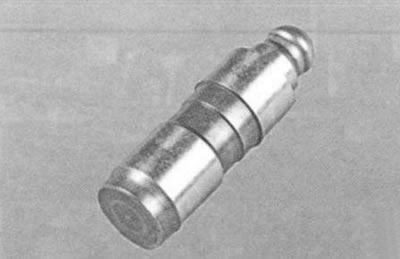
Hydraulic compensators of clearances in the valve drive mechanism serve to eliminate clearances in the drive. The operation of the hydraulic compensator is based on the principle of incompressibility of engine oil, constantly filling the internal cavity of the hydraulic compensator during engine operation and moving its plunger when a clearance appears in the valve drive, ensuring constant contact of the roller of the valve drive pressure lever with the camshaft cam without clearance. Due to this, there is no need to adjust the valves during maintenance.
Hydraulic compensators are non-separable compact devices inserted into the cylinder head sockets.
Knocking of valves of a running engine can be caused by:
- air entering the above-plunger cavities of hydraulic compensators when the oil level in the crankcase is too low or too high, as well as when the vehicle is parked on a slope for a long time;
- contamination of precision surfaces of hydraulic valve clearance compensators in the valve drive mechanism with sludge from low-quality motor oil (or if it is not replaced in a timely manner, or if the oil filter is damaged);
- wear of hydraulic compensators.
If bleeding or flushing fails to restore the functionality of the hydraulic compensators, replace them, as they are of a non-separable design.
First, make sure that the extraneous noise during engine operation is caused by a malfunction of the hydraulic compensators:
- start the engine. If the hydraulic compensators are faulty, extraneous noise in the cylinder head cover area appears immediately after the engine is started and changes in accordance with the change in the engine crankshaft speed. If the noise does not appear immediately after the engine is started or does not change with a change in the crankshaft speed, the malfunction is not caused by a malfunction of the hydraulic compensators. Moreover, if the noise does not change with a change in the crankshaft speed, the cause of the extraneous noise is probably not in the engine;
- when the engine is idling, make sure that the noise level does not change with changes in load (for example, when disengaging the clutch or when turning on electrical consumers and the air conditioner). If the noise level changes, the cause may be the collision of parts due to wear of the connecting rod and main bearing liners of the crankshaft, and not a malfunction of the hydraulic compensators;
- warm up the engine to operating temperature. If the noise has decreased or disappeared, the knocking of the hydraulic compensators may be caused by oil contamination. In this case, it is necessary to flush the hydraulic compensators;
- if the noise does not disappear, air may have entered the hydraulic lifters and should be removed.
If the oil level in the crankcase is too low, the oil pump takes in air along with the oil; if it is too high, the oil is shaken and foamed by the crankshaft counterweights. When the car is parked on a slope for a long time, oil flows out of the cavities of the hydraulic compensators and oil channels, and the supply of oil to the hydraulic compensators after starting the engine requires some time, during which air has time to enter the cavity of the hydraulic compensator. In all these cases, when oil enters the above-plunger cavity of the hydraulic compensator together with air, the air inside this cavity will be compressed when the valve opens and the hydraulic compensator will not be pressed enough, which will lead to the characteristic knock of the valve mechanism with increased clearances.
To remove air from the hydraulic lifters, do the following:
- check the oil level in the engine crankcase and top it up to normal if necessary (see "Checking the level and adding oil to the lubrication system");
- start the engine and warm it up at idle speed for 1-3 minutes;
- increase the crankshaft speed to 3000 rpm, then reduce it sharply to idle speed and let the engine idle;
- repeat the cycle and check if the valve drive mechanism noise has disappeared. If the hydraulic compensators are in good condition, the noise will disappear after 10-30 cycles;
- after the noise disappears, repeat the air removal cycle 5 more times;
- let the engine idle for 1-3 minutes and check that the valve train noise has disappeared.
If the noise from the valve drive mechanism does not disappear after bleeding the air and warming up the engine to operating temperature, identify faulty hydraulic lifters.
1. Turn off the engine and immediately after it stops, remove the cylinder head cover and change the gasket "Cylinder head covers".
2. Set the piston of the 1st cylinder to TDC of the compression stroke (see "Setting the piston of the first cylinder to the TDC position of the compression stroke").
3. To check the functionality of the DOHC engine hydraulic compensators, press the shoulder of the pressure lever resting on the hydraulic compensator. If the lever can be moved with almost no effort, the hydraulic compensator is faulty.
4. Similarly, check the condition of the hydraulic compensators of the remaining cylinders.
After identifying faulty hydraulic lifters, you should first try to flush them.
You will need: the same tools as for replacing valve stem seals, except for those needed directly for replacing them (tools are used only for preparatory operations) (cm. "Replacing valve stem seals"), as well as three containers for flushing diesel fuel with a capacity of approximately 5 dm³ each, a piece of hardened wire with a diameter of 0.5 mm and a length of approximately 10 cm.
1. Remove the air filter (see "Removal and installation the air filter").
2. Remove the cylinder head cover (see "Replacing the cylinder head cover gasket").
[Original article is on the portal: RENAULTBOOK]
3. Remove the camshaft from the side of the hydraulic compensator being replaced (see "Replacing the camshaft")...
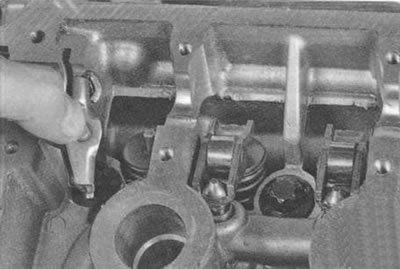
4. ...and the valve push lever.
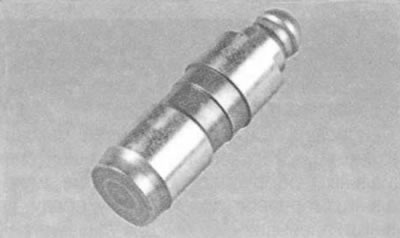
5. Remove the faulty hydraulic compensator.
6. Prepare three identical containers with a capacity of approximately 5 dm³ for flushing the hydraulic compensators. The dimensions of each container should be sufficient for the hydraulic compensator, lowered to the bottom of the container in a vertical position, to be completely immersed in liquid. Fill the containers with clean diesel fuel.
Note: Label the containers in any way you like (for example, numbers 1, 2, 3), to use each of them for its own purpose. Use the first container only for preliminary flushing of hydraulic compensators, the second - for final flushing, and the third - for filling hydraulic compensators.
7. Place the hydraulic compensator in the first container and clean its outer surface.
Note: Use only a polymer brush to clean the outside of the hydraulic compensator. A metal brush can scratch the precision-machined surface of the plunger.
8. Having immersed the hydraulic compensator halfway into the first container, with the plunger down, lightly press the wire through the hole to push the valve ball and, holding the ball pushed, move the hydraulic compensator plunger 5-10 times until the plunger movement becomes completely free. If you cannot achieve easy plunger movement, replace the hydraulic compensator.
Warning: The hydraulic compensator valve spring is very weak and can be damaged by pressing hard on the valve ball.
9. Remove the hydraulic compensator from the container and, pressing the valve ball, move the plunger until all diesel fuel flows out of the hydraulic compensator.
10. Place the hydraulic compensator in the second container and repeat step 7.
11. Remove the hydraulic compensator from the container and drain the diesel fuel from it as described in operation 8.
12. Place the hydraulic compensator on the bottom of the third container vertically with the plunger facing up and press the ball of its valve with a wire.
Warning: Use the third container of diesel fuel only for filling the hydraulic compensators. Do not use it for flushing.
13. While holding the valve ball depressed, move the plunger down and then slowly move it up so that the above-plunger cavity of the hydraulic compensator is filled with diesel fuel.
14. Remove the hydraulic compensator from the container; holding it with the plunger facing up, press down on the plunger with a little force and make sure that it remains motionless.
At the same time, check the overall height of the hydraulic compensator by comparing it with a new hydraulic compensator.
Warnings:
- If the hydraulic compensator plunger was moved during the check, repeat steps 12 and 13 until the hydraulic compensator cavity is completely filled with diesel fuel. If the hydraulic compensator still does not reach the working condition or its overall height is less than the height of the new hydraulic compensator, replace it.
- Before assembling the valve drive mechanism, store the filled hydraulic compensators only in the vertical position with the plungers facing up. Avoid getting dirt into the hydraulic compensators.
- Install hydraulic lifters on the engine as soon as possible after refueling to prevent possible loss of diesel fuel.
15. Install the hydraulic compensator and all removed parts in the reverse order of removal.
16. Start the engine and let it idle for 1-3 minutes. If necessary, bleed the hydraulic lifters as described above in this subsection.