



2. Disconnect both cables from the battery (always disconnect the negative first).
3. Apply the handbrake, then jack up the front right side of the car and support it on axle stands. Remove the right wheel.
4. Remove the plastic cover from inside the right wheel arch to gain access to the crankshaft pulley bolt.
5. Remove the spark plugs as described in Section 1.
6. Place your finger over the #1 spark plug hole in the cylinder head (closest to the flywheel). Turn the crankshaft clockwise until you feel pressure in cylinder #1. This indicates that the piston is rising in the cylinder.
7. Looking through the opening at the flywheel end of the engine, continue to turn the crankshaft until the TDC timing mark on the flywheel aligns with the TDC mark on the clutch housing (see Illustration 3.7 in Part A of this Section).
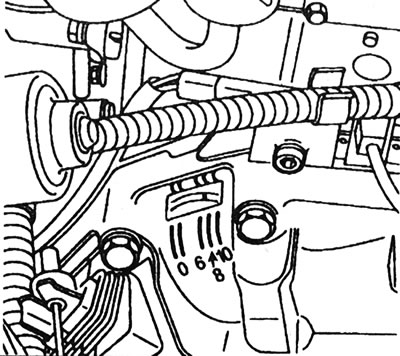
3.7. Timing marks on the flywheel and clutch housing. 0 = TDC
8. If you now remove the distributor cap, the rotor will be aligned with the toothed segment of the high tension wire of cylinder #1.
9. To view the timing mark on the camshaft sprocket, remove the drive cover bracket and the right engine mount.
10. When piston No. 1 is set to the TDC position, the timing mark on the camshaft sprocket should be aligned with the mark on the end of the valve cover (see illustration 5.10).
Article reprinted from the website: renaultbook
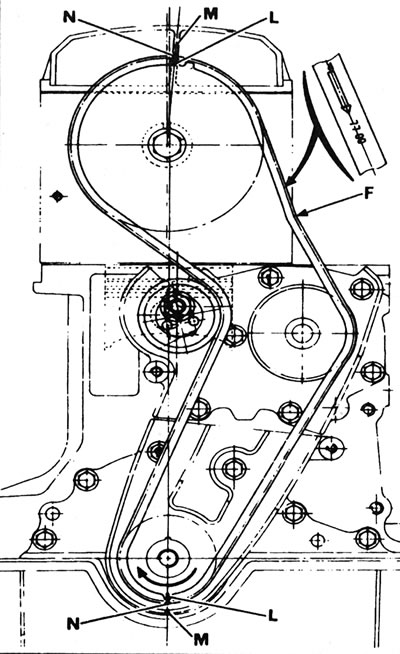
5.10. Toothed drive belt and timing marks: F - Belt tension check point; L - Timing marks on the camshaft and crankshaft sprockets; M - Fixed installation marks; N - Mounting strips on the belt.