



2. Most of the actions included in this Part are based on the condition that the engine is installed in the vehicle. Therefore, if this information is used when rebuilding an already removed engine, many of the procedures described here can be skipped.
Engine - general description
3. The engine has a 4-cylinder, in-line design with an overhead camshaft, mounted transversely in the front of the car.
4. The cylinder block is cast from cast iron and has replaceable liners. The crankshaft is supported in the cylinder block on five main bearings. The central main bearing is equipped with thrust washers that regulate the axial clearance of the crankshaft.
5. The connecting rods are secured to the crankshaft by means of connecting rod bearings with liners, and to the pistons by means of piston pins, which are fixedly seated in the connecting rods. The pistons are made of aluminum alloy and are equipped with three rings, two compression rings and one oil scraper ring.
6. The camshaft rotates in five bearings drilled directly into the cylinder head and is driven from the crankshaft by a toothed belt, which also drives the water pump. The camshaft controls the valves via rocker arms mounted on a shaft attached to the top of the cylinder head.
7. The engine uses a semi-closed crankcase ventilation system.
8. Lubrication is supplied under pressure from an oil pump, which is driven by a chain from the crankshaft (see illustration).
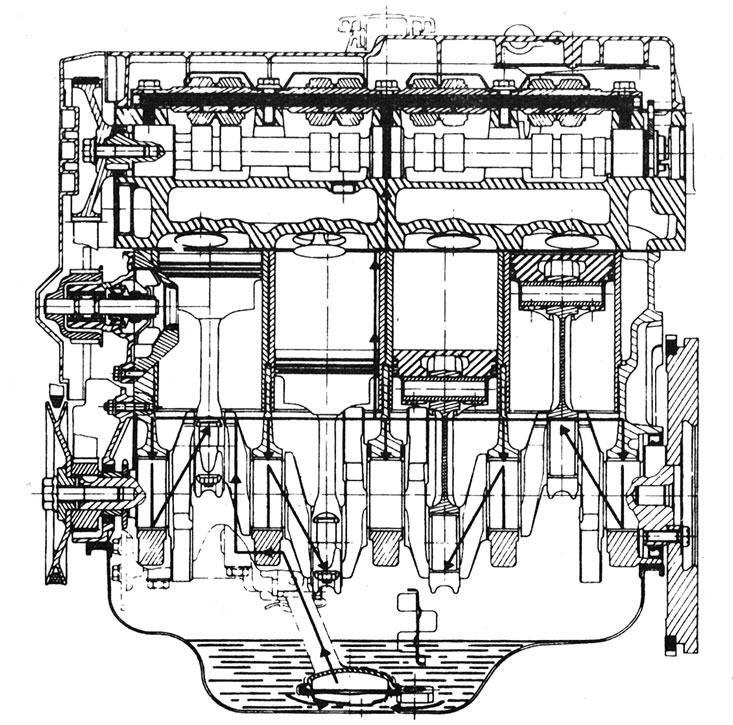
1.8. Lubrication chain of the E series engine.
9. The distributor rotor is driven directly from the rear end of the camshaft.
Repair operations performed without removing the engine from the vehicle:
- Removal and installation the cylinder head.
- Removal and installation the toothed drive belt and sprockets.
- Replacing the camshaft oil seal.
- Removal and installation the camshaft.
- Removal and installation the pallet.
- Removal and installation of connecting rods, pistons and liners*.
- Removal and installation the oil pump.
- Replacing crankshaft seals (on models with automatic transmission - only the right one).
- Replacing engine mounts.
- Removal and installation the flywheel (models with manual transmission).
Original publication on the website: RENAULTBOOK.ru
*Note: Although the steps marked with an asterisk can be performed on the engine in a vehicle (after removing the pallet), it is still better to do this with the engine removed. For this reason, these procedures are described in Part F of this Section.