



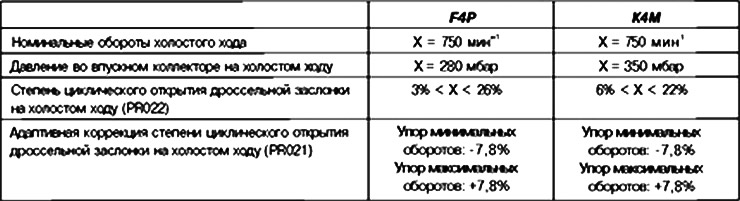
Under normal operating conditions of a warm engine, the value of the cyclic opening ratio at idle speed changes from the upper to the lower value to achieve the nominal idle speed.
It may happen that due to the spread of operating indicators (running-in, engine contamination.), the value of the cyclic opening ratio is close to the upper or lower limit.
Adaptive idle speed cyclic adjustment compensates for slow changes in engine air demand to set the idle speed cyclic adjustment to the average nominal value.
This correction is only effective if the coolant temperature is above 75°C, 60 seconds have passed since the engine was started and it is in the idle speed control phase.
Interpretation of parameters
In case of excess air (due to air leakage, improper adjustment of the throttle valve stop, etc), the engine idle speed increases, the idle cyclic opening ratio value decreases to return to the nominal idle speed, the idle cyclic opening ratio adaptive correction value decreases to return to the average idle cyclic opening ratio value.
When there is a lack of air (pollution, etc.) the opposite situation occurs: the degree of cyclic opening at idle speed increases, as does the value of adaptive correction, in order for the engine to switch to idle mode.
Attention! After deleting data from the ECU memory, it is necessary to start, stop and then let the engine idle. This is necessary so that the adaptive correction can be restored correctly.
The value of the idle speed cyclic opening degree and its adaptive correction
Original publication on the portal www.RenaultBook.ru