



Contents: Lifting by lift 🠛 Lifting with a mobile jack 🠛 Installing belts 🠛 Forward tipping 🠛 Backward tipping 🠛 Permitted lifting points 🠛
Caution: Never attach the towing cable to the drive shafts of the wheels.
Towing eyes may only be used to tow a vehicle on the road. The eyes may not be used to pull a vehicle out of a ditch or to lift it directly or indirectly.
Tow with a rigid hitch. When towing with a rope or cable (if this is permitted by current legislation) the braking system of the towed vehicle must be in good condition.
Do not tow a vehicle with a faulty chassis.
Avoid jerking when accelerating and braking, as this may cause the vehicle to malfunction. In all cases, it is recommended to tow at a speed of no more than 50 km/h.
Before towing, screw in and lock the towing eye. Vehicles with automatic transmission: transport the vehicle on a flatbed or tow with the front wheels raised. In exceptional cases, towing at a speed of no more than 20 km/h and for a distance of no more than 30 km is possible (the selector lever must be in neutral position).
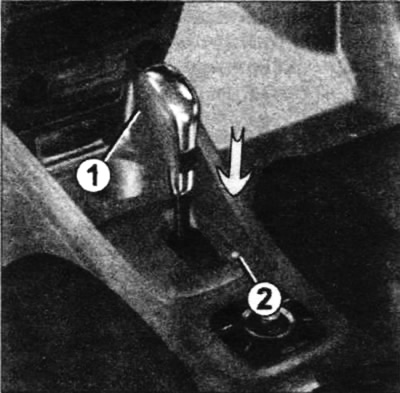
If the selector lever is locked in the "P" position when the brake pedal is pressed, it can be moved out of this position manually.
To do this, insert a rigid rod into hole 2 and simultaneously press the rod and the release button 1 located on the selector lever handle.
Original of this article on the website: renaultbook.ru
Vehicles with Renault card: In case of battery failure, the steering column remains locked. In this case, connect a working battery or power source to lock the airbag ECU using the diagnostic tool, which will unlock the steering column.
If the airbag control unit cannot be locked, tactilely raise the front of the vehicle.
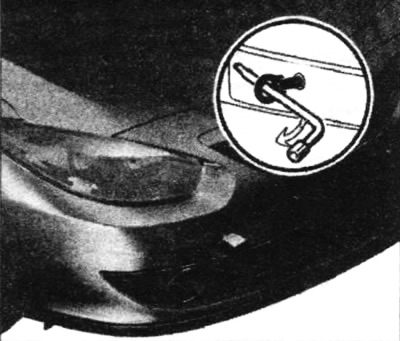
Front towing eye position
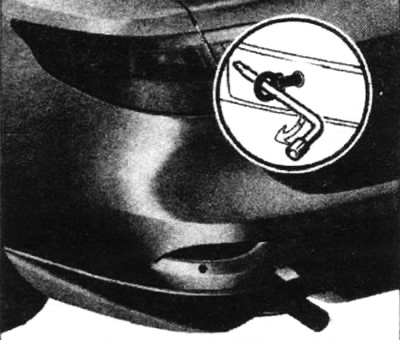
Rear towing eye position
Fully tighten the eyelet provided in the driver's tool kit located in the trunk inside the spare tire.
Lifting by lift
To remove heavy units from a vehicle, it is preferable to use a four-post lift.
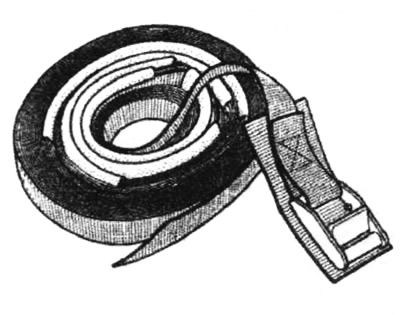
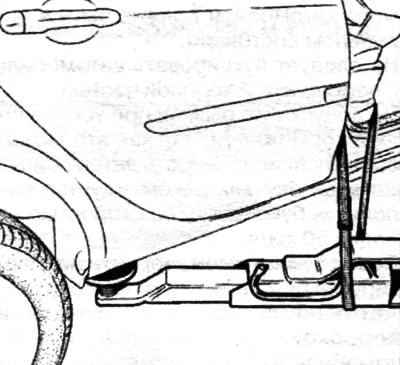
If the vehicle is on a two-post lift, it may tip over after the powertrain, rear suspension, or transmission is removed. Install the safety strap(s) as described below.
Lifting with a mobile jack
Warning: To avoid accidents, the trolley jack must only be used to lift and/or move the vehicle. The vehicle must then be placed on supports capable of supporting its weight.
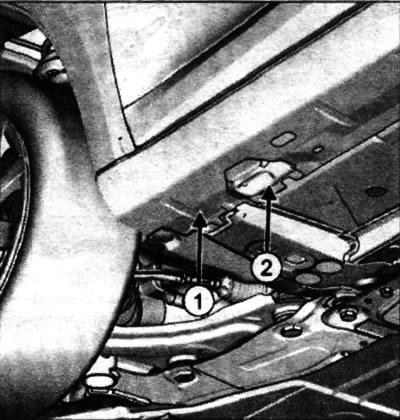
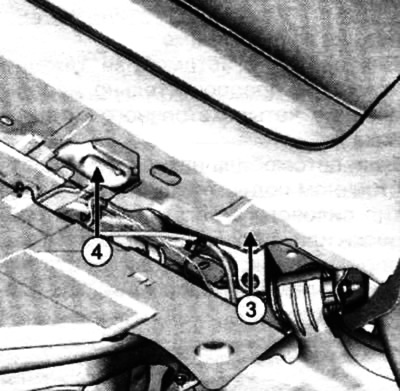
To install the vehicle on stands, lift it on one side in zones (3) and (1) and install stands under the amplifiers provided for installing the standard jack in zones (4) and (2).
 |
 |
Installing belts
For safety reasons, these belts should always be in good condition. Replace the belts at the first sign of damage.
When installing the belts, make sure that the protective elements are correctly installed on the seats and decorative areas of the vehicle.
Forward tipping
Route the strap under the right rear suspension arm.
Pass the belt through the interior of the vehicle.
Route the strap under the left rear suspension arm.
Pass the belt through the interior of the vehicle again.
Tighten the belt.
Backward tipping
Route the strap under the right front suspension arm.
Pass the belt through the interior of the vehicle.
Route the strap under the left front suspension arm.
Pass the belt through the interior of the vehicle again.
Tighten the belt.
Permitted lifting points
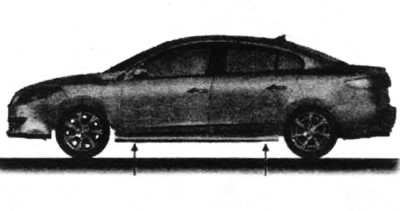
To raise the vehicle, position the lift arm stops as shown below, being careful not to damage the lower portion of the rocker panel.
Attention.
- Do not lift the vehicle using the front panel as support.
- Do not rest the jack on points not intended for lifting the vehicle.
- Do not place supports under the jack rest points.
Place the lift arms under the side crossbars (1).
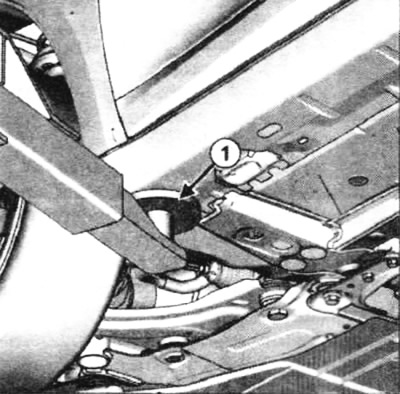
Lifting points at the front of the body
Place the lift levers under the edge of the ribs under the body sill (3).
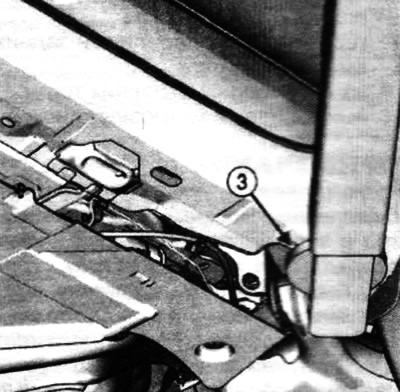
Lifting points at the rear of the body