



Contents: Roller jack and car stands 🠛 Roller jack for side lifting 🠛 Car jack stands 🠛 Underbody lift 🠛
Roller jack and car stands
Note: When using a roller jack, it is essential to place supports under the vehicle.
Warning! Do not lift the vehicle by placing a jack under the front or rear suspension arm.
Depending on the type of roller jack, use bushings Cha. 408-01 or Cha. 408-02 to install insert Cha. 280-02.
To raise the front or rear of the vehicle, use the jacking points provided with the vehicle's jack.
Roller jack for side lifting
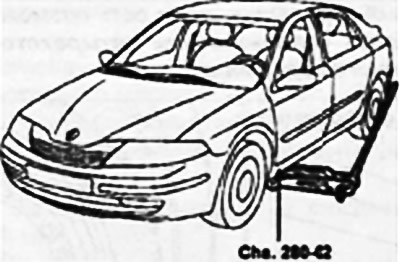
Use spacer Cha. 280-02.
Place a jack under the sill panel below the front door.
Properly install the spacer groove under the rib under the body sill.
Car jack stands
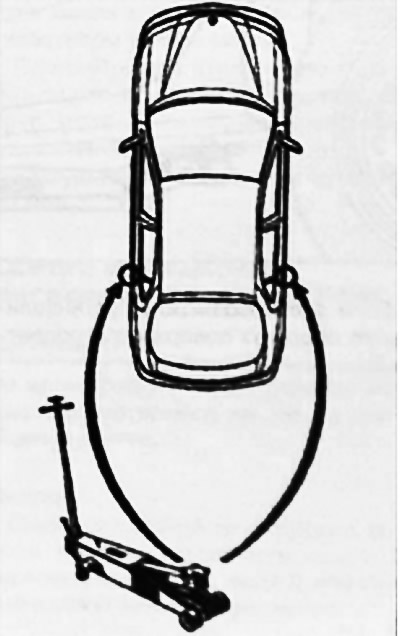
When installing supports under a vehicle, the latter must be installed:
- or under the projections provided for lifting the car using a standard jack;
- or under the pin fasteners located behind the protrusions.
The installation of supports under the rear part is carried out by lifting the car from the side.
Underbody lift
Note. Never use a two-post lift if there is a possibility of using a four-post lift.
 |
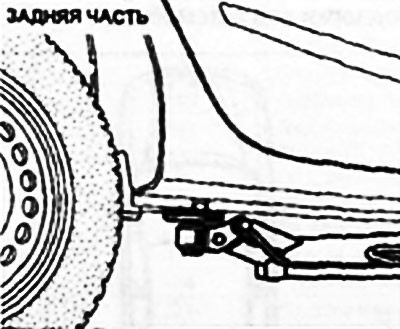 |
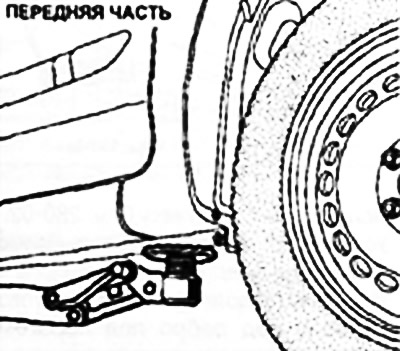
If this is not possible, install the support surface of the lift paw heel under the edge under the body threshold at the level of the stop points of the standard jack.
The heel pads of the lift legs must be installed under the support points for the jack being transported.
When a vehicle is placed on a two-post lift, it is necessary to ensure that the vehicle is balanced for safety reasons.
When removing heavy knots (such as powertrain, rear axle or fuel tank, etc.) and depending on the vehicle load, its length and the position of the lift foot, the vehicle may lose its balance.
To avoid this, be sure to secure the straps around and inside the body and connect them to the lift legs between the heel pads.
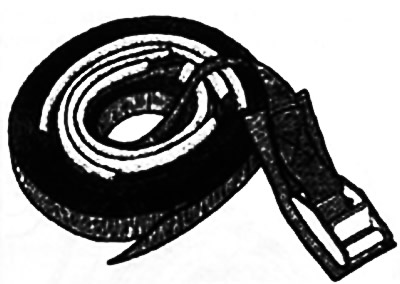
This type of belt is intended only to ensure a stationary position of the vehicle on a two-post lift (it is strictly forbidden to use them for other purposes (for security reasons)).
Use only belts in good condition and clean (to avoid contamination of the interior or body). Do not tighten the belts too much to avoid damaging the vehicle (the lower sections of the body side must be protected in places with a belt).