



Contents: Draining the fluid 🠛 Flushing the cooling system 🠛 Filling the cooling system 🠛 Antifreeze mixture 🠛
Draining the fluid
Warning: Wait until the engine cools down. Avoid contact of antifreeze with your skin or painted surfaces of your vehicle. Wash away spilled drops immediately with plenty of water.
1. With the engine completely cooled, place a rag over the expansion tank cap and slowly turn the cap counterclockwise to relieve pressure in the cooling system. Then unscrew the cap completely and remove it.
2. Place a suitable container under the lower hose connection to the radiator or water pump.
3. Loosen the clamp, then disconnect the lower hose and drain the liquid into a container.
4. Move the container under the drain plug in the cylinder block. On the C-series engine, the drain plug is located on the crankshaft pulley end of the engine, below the water pump. On other engines, the plug is located on the rear right side of the cylinder block (see illustrations).
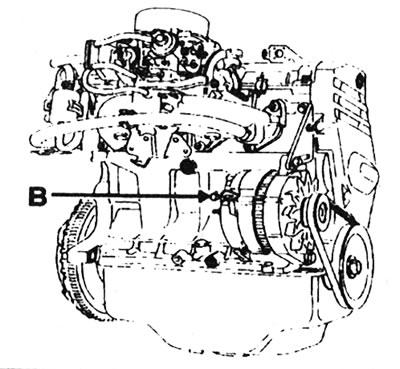
36.4a. Drain plug (B) on the cylinder block - E-series engine.
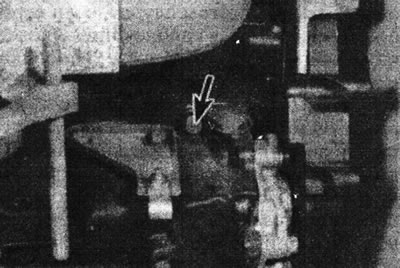
36.4b. Drain plug (marked with an arrow) on the cylinder block - E-series engines.
5. Unscrew the plug and drain the coolant into a container.
6. If necessary, flush the system as described in the following steps, then install the drain plug and secure the lower hose. Use a new clamp if necessary. Fill the system as described later in this Chapter.
Flushing the cooling system
7. If coolant changes have been neglected or the antifreeze mixture has become diluted, the cooling system may gradually lose efficiency as the radiator passages become restricted by rust and other deposits. The efficiency of the cooling system can be restored by flushing the system.
8. Loosen the clamp and disconnect the upper hose from the radiator. Insert a garden hose into the outlet and run water through the radiator until it runs clear out of the bottom outlet of the radiator.
9. To flush the engine water jacket and the rest of the system, on a C-series engine, disconnect the upper hose from the water pump, and on other engines, remove the thermostat as described in Section 3. Insert a garden hose and run water through the engine until it runs clear from the lower hose.
10. In case of severe contamination, the radiator must be flushed in the reverse direction. To do this, first remove it from the car and turn it upside down, insert a garden hose into the lower outlet and run water until it flows out clean from the upper hose.
11. If you are unable to flush the radiator thoroughly, use a special cleaning system.
12. To prevent severe contamination of the system, change the antifreeze regularly.
Filling the cooling system
13. Reinstall the engine block drain plug, lower radiator hose, and any other hoses removed if the system was just flushed.
14. Open the bleed nipples. On the C-series engine there are three of them - one each on the heater supply and return hoses, and one in the top hose next to the thermostat. On other engines there is only one fitting located on the side of the radiator, at the top.
15. Pour the antifreeze mixture into the expansion tank and close the bleed nipples one by one as soon as a continuous stream of coolant without air bubbles begins to flow out of them. Continue filling the expansion tank up to the maximum level mark.
16. Start the engine and let it run at 1500 rpm (i.e. at increased idle speed) for approximately 4 minutes. During this period, maintain the fluid level in the expansion tank at the maximum level.
17. Install the cap with the pressure relief valve on the expansion tank, start the engine and let it run at 1500 rpm for approximately 10 minutes until the fan comes on. During this time, the coolant will circulate around the engine and any remaining air will be removed into the expansion tank.
18. Turn off the engine and let it cool, then check the fluid level as described earlier and top it up to the correct level.
Antifreeze mixture
19. The antifreeze mixture must be changed at the specified intervals. This is necessary not only to preserve its properties, but also to prevent the development of corrosion.
20. Always use an ethylene glycol based antifreeze that is suitable for use in cooling systems made of various metals. The proportions of antifreeze and the levels of protection provided are specified in the Specifications.
21. Before adding antifreeze, completely drain the liquid, flush the system, and check the condition and secure fastening of all hoses.
22. After filling the system, attach a label to the radiator or expansion tank indicating the type and concentration of antifreeze used and the date of filling.
23. Do not use engine coolant in the windshield washer system.