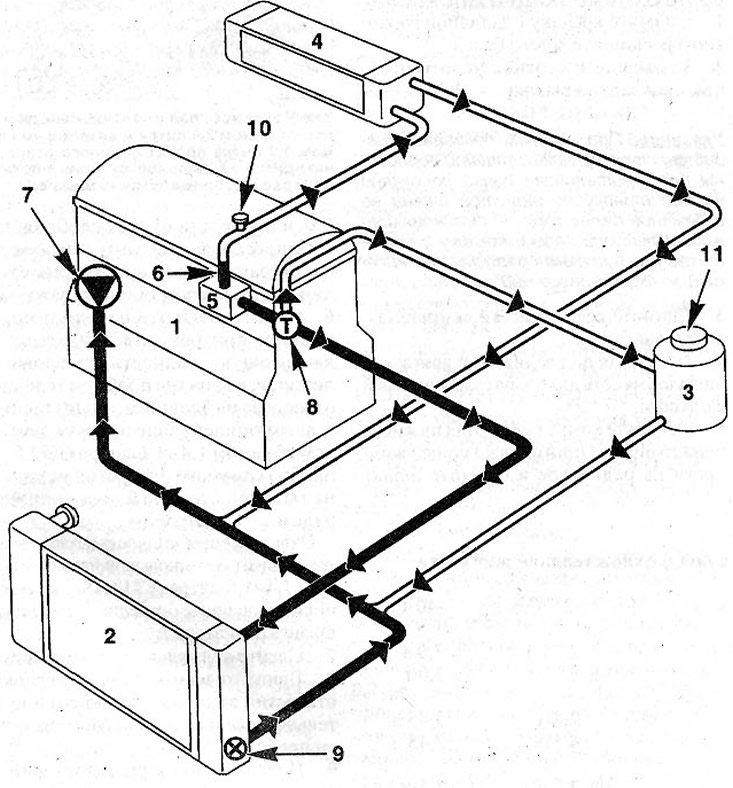
1 - engine; 2 - radiator; 3 - expansion tank; 4 - heater radiator; 5 - thermostat housing; 6 - branch pipe 3 mm; 7 - water pump; 8 - thermostat; 9 - thermal switch for the radiator fan; 10 - air vent plug; 11 - expansion tank cap
For vehicles with a 1.6 liter petrol engine (K7M) and a volume of 2.0 liters, the opening pressure of the exhaust valve cover (of blue color) - 1.6 bar.
For vehicles with a 1.6 liter petrol engine (K4M), 1.4 liter diesel and 1.9 liter diesel valve cap opening pressure (Brown) - 1.2 bar.
Refueling volumes:
- Vehicles with a 1.4 liter petrol engine (K7J) - 6.0 l
- Vehicles with a 1.4 liter petrol engine (K4J) - 6.9 l
- Vehicles with a 1.6 liter petrol engine (K7M) - 6.0 l
- Vehicles with a 1.6 liter petrol engine (K4M) - 6.9 l
- Vehicles with a diesel engine of 1.9 liters - 7.5 liters
- Vehicles with 2.0 liter petrol engine - 7.0 liter
Coolant circulation is controlled by a thermostat. While the engine is not warmed up, the coolant circulates only in the cooling jacket of the cylinder block and in the heater radiator. As the coolant temperature rises, the thermostat in the liquid cooling system opens and directs coolant flow to the radiator. The coolant is supplied by a water pump and driven by a V-belt. The coolant flows through the radiator from the bottom up and is cooled by the air passing next to the cooling fins.
Additional cooling of the radiator is carried out by an electric fan. As soon as the temperature of the coolant rises to about +92 C, the thermal switch turns on the radiator fan through the relay. As soon as the coolant temperature drops below 82°C, the fan is switched off.
The expansion tank acts as a coolant reservoir. It accumulates the coolant that increases in volume when heated and gives it back to the circulation circuit after the engine has cooled. Refueling of a cooling liquid is carried out through a mouth of a broad tank..
Attention! The electric fan under the influence of heat accumulated in the engine compartment, and even when the ignition is off, can automatically turn on. Risk of injury or injury! Carry out work near the electric fan only when the engine is cold.
Attention! When working on the cooling system, make sure that no coolant gets on the toothed belt. Ethylene glycol, which is part of the coolant, damages the base of the belt and after a while it can break, which is fraught with serious engine damage.
At the factory, an aqueous solution of antifreeze is poured into the cooling system. Antifreeze is concentrated ethylene glycol with protective anti-corrosion additives that prevent freezing of the coolant and corrosion of the cooling system, and also increase the boiling point of the coolant. Therefore, the cooling system must be filled with said aqueous solution all year round.
Attention! Only fill the system with coolants approved by RENAULT, e.g. CLACEOL RX (type D). Antifreeze must be suitable for use on units made of aluminum.
Due to the fact that over time there is a decrease in the content of anti-corrosion additives in the coolant, it must be changed periodically as part of maintenance.
Antifreeze should be mixed with clean or distilled water.
In our latitudes, frost protection must be provided down to -25°C (see table).
Attention! The proportion of antifreeze in the coolant should not exceed 60%. With a higher content, the freezing point of the coolant decreases. In addition, in this case, the cooling effect of the liquid is also reduced.
Table of the ratio of antifreeze and water in the coolant
| Engine | Coolant | -25°C | -40°C |
| 1.4-/1.6L E7J/K7M | concentrate water | 2.25 l 3.75 l | 3.0 l 3.0 l |
| 1.4-/1.6L E4J/K4M | concentrate water | 2.4 l 4.5 l | 3.45 l 3.45 l |
| 2.0 l | concentrate water | 2.5 l 4.5 l | 3.5 l 3.5 l |
| 1.9 l diesel | concentrate water | 2.75 l 4.75 l | 3.75 l 3.75 l |