



Front suspension and steering gear
1. Jack up the front of the vehicle and place it on axle stands.
2. Visually inspect the ball joint dust caps and steering gear rubber boots for cracks, abrasions, or contamination (see illustration).
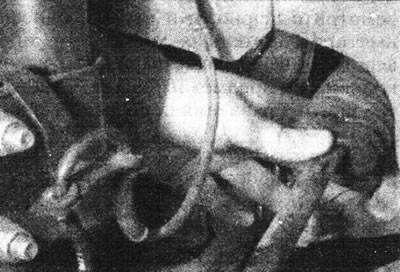
17.2 Check the condition of the rubber protective boot of the steering gear.
3. On vehicles with power steering, check the condition of the hoses, tubes and couplings. Also check the rubber steering gear boots for any pressure leaks, which indicate bad seals in the steering gear.
4. Grasp the wheel from the top and bottom and try to pump it (see illustration).
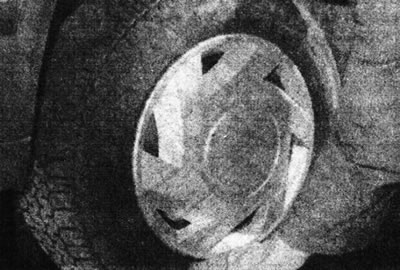
17.4 Check the condition of the front suspension components and wheel bearings.
There may be some play, but if it is large, further investigation is necessary. Continue pumping the wheel while the assistant presses the brake pedal. If the play is now eliminated or reduced, then the hub bearings are faulty. If there is still play, then there is wear in the suspension joints.
5. Now take the wheel by the sides and try to pump it as before. Any movement can be caused by wear in the wheel hub bearings or steering tie rod ball joints. If the inner or outer ball joint is worn, visual movement will be evident.
6. Using a large screwdriver or flat bar, check the suspension upper bushings for wear by lifting the suspension components. There should be some movement since the bushings are made of rubber, but excessive wear should be obvious. Also check the condition of all visible rubber bushings.
7. With the vehicle standing on its wheels, ask an assistant to turn the steering wheel forward and backward by one eighth of a turn. There should be a slight play between the steering wheel and the wheels. If this is not the case, inspect the joints and bushings described previously, in addition, check the steering column universal joints for wear and the rack and pinion mechanism itself.
Rear suspension
8. Block the front wheels, then jack up the rear of the car and place it on axle stands.
9. Proceeding as described above, check the rear wheel hub bearings, suspension bushings and shock absorber mounts for signs of wear.
Checking the shock absorber
10. Check for fluid leaks around the shock absorber body. If a leak is detected, the shock absorber should be replaced.
Note: Shock absorbers should always be replaced in pairs on the same axle.
11. The effectiveness of the shock absorber can be tested by rocking the car from each side. The car should return to its normal position. If the car continues to rock, the shock absorber is probably faulty. Also inspect the upper and lower shock mounts for wear.