


The brake system consists of two circuits acting diagonally. One brake drive circuit acts on the front right and rear left wheels, and the other on the front left and right rear. This ensures that the vehicle stops with sufficient efficiency in the event of failure of one of the circuits of the service brake system, for example, due to a leak. The pressure for both circuits is provided by the main brake cylinder when the brake pedal is pressed.
The expansion tank, which supplies brake fluid to the entire system, is located at the front of the engine compartment above the master cylinder.
The brake booster vacuum in cars with a gasoline engine uses the vacuum in the intake manifold and, through valves, makes it possible to reduce the force on the brake pedal. Due to the fact that the diesel engine does not have enough vacuum in the intake manifold, cars with a diesel engine are equipped with a brake booster vacuum pump driven by the engine.
The front and rear brake pads do not need to be adjusted.
The parking brake acts via a cable drive on the rear wheel brake mechanisms.
The rear axle brake force regulator regulates the braking force applied to the rear wheels and i te prevents the rear wheels of an unloaded vehicle from locking during sudden braking.
When cleaning the brake system, dust is generated. This dust is harmful to human health. Therefore, when cleaning the brake system, make sure that brake dust does not get into the respiratory tract.
Brake linings are a category of materials that require an operating permit and are listed in the General Operating Permit Register (ABE). In addition, they are selected by the manufacturer for specific vehicle models. Therefore, it is recommended to use only linings offered by the RENAULT plant or approved by the Federal Automobile Authority. Such linings have a number assigned to them by the Federal Automobile Authority.
Work on the brake system requires careful observance of cleanliness and precision. If the necessary experience is not available, it is better to entrust such work to a specialized workshop.
Anti-lock braking system (ABS)
Depending on the model and configuration, RENAULT MEGANE and SCENIC vehicles are equipped with the TEVES MARK IV or BOSCH 5.3 electronic anti-lock braking system (see illustration 1.0).
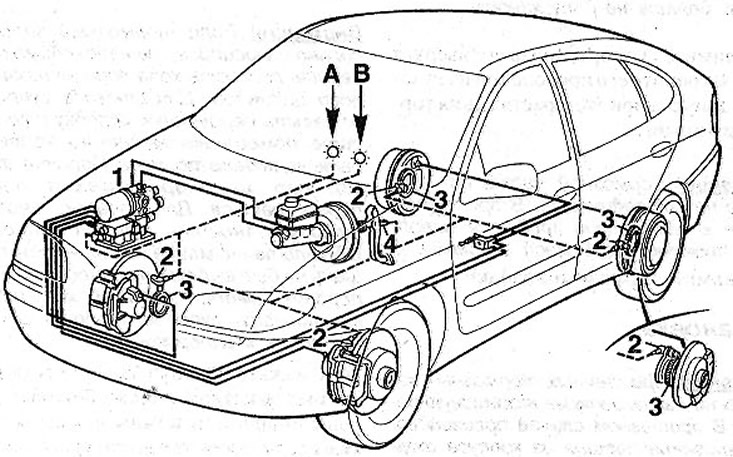
1.0 ABS diagram:
—— hydraulic pipelines
- - - electrical wiring
A - ABS warning light
B - brake fluid level indicator light
1 - hydraulic block
2 - wheel speed sensor
3 - gear that generates pulses when the wheels rotate for the wheel speed sensor
4 - brake light switch sensor
The anti-lock braking system (ABS) consists of an electronic control unit and hydraulics, an ABS indicator light on the instrument panel, wheel speed sensors and gears that generate pulses when the wheels rotate for the wheel speed sensor.
The anti-lock braking system prevents the wheels from locking during heavy braking. Thanks to this, the car remains controllable even under full braking. The driver feels the operation of the anti-lock braking system by the pulsation of the brake pedal and the noise of the ABS hydraulic unit in the engine compartment.
The shutdown function in the electronic ABS control unit ensures automatic shutdown of the system if a defect occurs, for example, if the power supply wire breaks or if the voltage in the on-board network drops below 10.5 V. The shutdown of ABS is signaled by the lighting of the light on the instrument panel. At the same time, the normal braking system continues to function and the car behaves like a car without ABS.
After the ignition is turned on, the ABS system performs a self-test. After about 3 seconds, the indicator light on the instrument panel should go out. If the indicator light remains on or lights up while driving, do the following.
1. Stop, turn off the engine and check the battery voltage. If it is less than 10.5 volts, charge the battery.
2. Check that the power cable terminals are securely fastened to the battery terminals.
3. Raise the vehicle on jack stands and remove the wheels. Check the wires of all four wheel speed sensors for external damage (grinding).
4. Disconnect the wheel speed sensor plugs and clean them with AUTOLUBE (see illustration). After this, connect the plugs.
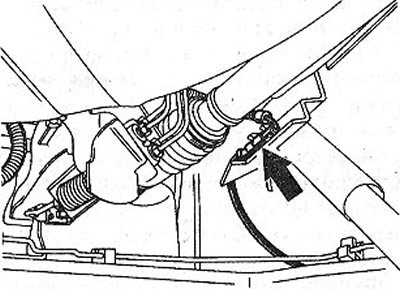
1.4 Disconnect the wheel speed sensor plugs and clean them with AUTOLUBE. The illustration shows the rear wheel plug. It is located next to the shock absorber
Further ABS testing should be performed in a workshop. The ABS control unit performs a self-diagnostic program and all faults are recorded. These faults can be read in a workshop using a special tester and then eliminated.
Attention! When working with electric welding, disconnect the plug of the electronic ABS control unit. Disconnect the plug only when the ignition is off. When painting, the control unit may be exposed to temperatures no higher than +85°C.