



The R spring constantly pulls the S segment of the regulator, ensuring constant tension of the clutch cable (see illustration 4.0). At the same time, the clutch release fork is also pulled up, which ensures constant contact between the release bearing and the diaphragm spring of the pressure plate. The clutch release fork spring is not activated.
When the clutch pedal is pressed, the toothed cam C enters the regulator segment S, locking it and preventing it from turning. As a result, the clutch cable transmits the pedal stroke to the clutch release fork.
Automatic adjustment when the friction lining wears out is performed by slightly stretching the spring R. In this case, the segment S rotates in the direction of the cable and when the pedal is pressed again, the toothed cam C catches and fixes the next tooth of the segment (see illustration 4.0).
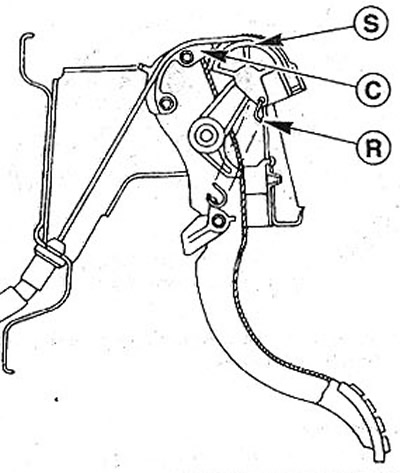
4.0 Spring R constantly pulls the regulator segment, ensuring constant tension of the clutch cable
1. Pull the clutch cable in the direction of the arrow as shown in the illustration, holding it with your hand near the clutch lever. The cable should be pulled out at least 2 cm (see illustration).
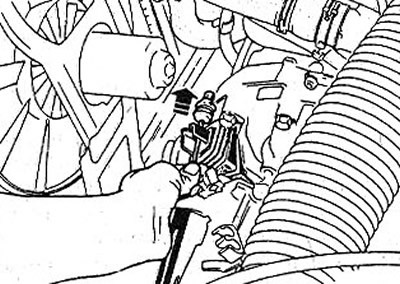
4.1 Pull the clutch cable in the direction of the arrow as shown in the illustration, holding it with your hand near the clutch lever
[Source link is located on Renaultbook.ru]
2. Ask an assistant to depress the clutch pedal. At this point, you should monitor the travel of the clutch release fork. The nominal value of the travel X is:
- all cars except K4J/K4M - 27.4-30.7 mm
- cars with K4J/K4M engine - 27-30.5 mm (see illustration)
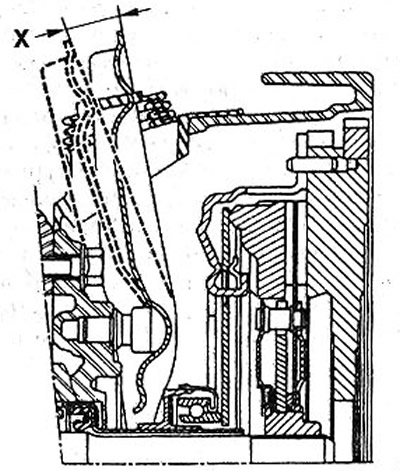
4.2 Clutch release fork stroke X