
English Русский
Български
Беларускі
Український
Српски
Hrvatski
Română
Polski
Slovenský
Magyar
Bookmark Contacts Articles Sitemap
Company vehicles Peugeot Company vehicles Opel Company vehicles Skoda Company vehicles Land Rover Company vehicles Mitsubishi Company vehicles Volkswagen Company vehicles Honda
RenaultBook.ru


Duster   Fluence   Kangoo   Laguna   Logan   Megane   Sandero   Scenic   Symbol   Clio   Other
Clio 1 (1990-1998)

Compression and leak testing of component connections — description (Renault Clio 1)

  • Main
  • Clio
  • Clio 1 (1990-1998)
  • Power unit
  • Diesel engines
  • Compression and leak testing of component connections — description
0
Contents: Compression check 🠛 Checking the tightness of component…🠛

Compression check


Note: Use a compression tester designed for diesel engines.


1. If the engine is not developing full power or is running rough, and if it is not related to the fuel system, a compression test can provide you with information regarding the condition of the engine. By performing this check regularly, you can detect a developing fault early.

2. Use a compression tester designed for diesel engines, as these engines develop higher pressures than gasoline engines. The compression tester is screwed into the glow plug or injector hole via an adapter (see illustration).
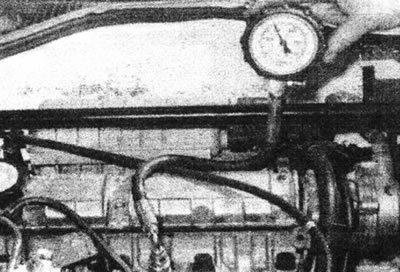
2.2. Compression check.

2.2. Compression check.


3. If not inconsistent with the compression tester manufacturer's instructions, perform the following preparation:
  • The battery must be charged, the air filter must be clean, and the engine must be warmed up to normal operating temperature.
  • Remove any injectors or glow plugs. When removing the injectors, also remove the sealing fireproof washers (which must be replaced - see Section 4D).
  • It is also recommended to disconnect the fuel shut-off valve on the pump to prevent fuel from entering the engine when cranking.

Source link is located on RENAULTBOOK


4. There is no need to press the gas pedal during testing.

5. What is important is not so much the actual measured compression, but the balance between the cylinders. The data are given in Specifications.

6. The cause of insufficient compression in a diesel engine is more difficult to determine than in a gasoline engine. It is not possible to determine the location of the fault by adding oil to the cylinders (a "wet" test), since there is a possibility that the oil will get into the swirl chamber or into the recess on the piston head, and will not reach the rings. However, the following information will help you identify the possible cause of the problem.

7. There should be approximately equal pressure in all cylinders; any difference greater than that specified in Specifications, indicates damage. Please note that compression in a healthy engine should increase quickly; low compression on the first stroke, followed by a gradual increase on subsequent strokes, indicates wear of the piston rings. Low compression on the first stroke, which does not increase on subsequent strokes, indicates leaky valves or a burnt-out cylinder head gasket (a crack in the head could also be the cause).

8. Low compression in two adjacent cylinders is most likely due to a burnt-out cylinder head gasket between them.

9. If the compression is unusually high, it is likely that the cylinder head surface, valves and pistons are covered with carbon deposits. In this case, the cylinder head must be removed and cleaned of carbon deposits (see Section 2F).


Checking the tightness of component connections


10. The leak test determines the rate of compressed air leakage from the cylinder. This is an alternative to checking compression and in many cases is a better method of checking the condition of the engine, as escaping air easily indicates the location where compression is being lost (piston rings, valves, or cylinder head gasket).

11. The equipment required to test the tightness of component connections is unlikely to be available to the car enthusiast. If insufficient compression is suspected, contact a specialist with the appropriate equipment.
This article is available on: russian, bulgarian, belarusian, ukrainian, serbian, croatian, romanian, polish, slovak, hungarian
Article has been reviewed by editor: Fedoseev Denis
Share with friends:
Previous
Clio 1: Diesel engines
Next

General description — diesel engine repair in the engine compartment
Diesel engine specifications
Top dead center (TDC) for piston #1 — location
Valve clearances — checking and adjusting
Toothed drive belt — removal, inspection and installation
Drive Belt Sprockets and Tensioner Mechanism — removal and…
Camshaft seals — replacement
Other articles on other Renault models

➽ Description of the compression and tightness test of component… Renault Megane 1 (1995-2002)
➽ Compression Stroke End Pressure — Check Renault Duster 1 (2009-2017)
➽ Checking for a cylinder leak Renault Fluence 1 (2009-2020, petrol)
➽ List of electrical equipment components, connections, connectors… Renault Kangoo 1 (1997-2007)
➽ Generator — Design Description and Testing Renault Laguna 2 (2001-2007)
Link to this article in different formats
Reviews and comments of visitors
No comments yet


Add two numbers 16 + 41


Clio 1 (1990-1998) 
  • General information
  • Maintenance
  • Troubleshooting
  • Power unit
  • Petrol engines 1.1 l (C)
  • Petrol engines 1.2 l (D)
  • Petrol engines 1.2/1.4 l (E)
  • Petrol engines 1.8 l (F)
  • Diesel engines
  • Overhaul of engines
  • Cooling and heating
  • Fuel system (carburetor)
  • Central fuel injection
  • Distributed fuel injection
  • Fuel system (diesel)
  • Starting and charging system
  • Ignition system (transistor)
  • Ignition system (electronic)
  • Pre-heating of diesel engines
  • Transmission
  • Clutch
  • Manual gearbox
  • Automatic gearbox
  • Drive shafts
  • Chassis, running gear
  • Brake system
  • Car suspension
  • Steering system
  • Body and interior
  • Exterior (external elements)
  • Doors, locks and windows
  • Electrical equipment
  • Equipment and devices
  • Electrical circuits
RenaultBook.ru © 2018–2026 | Mobile version | News and articles | Sitemap: EN BG BY UA RS HR RO PL SK HU | Administration | Site search | Bookmark
Duster 1 (2009-2017) | Fluence 1 (2009-2020, petrol) | Kangoo 1 (1997-2007) | Laguna 2 (2001-2007) | Logan 1 (2004-2012, petrol) | Logan 2 (2012-2020) | Megane 1 (1995-2002) | Megan 2 (2002-2009, petrol) | Sandero 1 (2007-2012, petrol) | Scenic 1 (1996-2003) | Symbol 1 (1999-2008, petrol) | Symbol 2 (2008-2013, petrol) | Renault 19 (1988-1996) | Espace I and II (1984-1996) | Espace III (1996-2002) | Clio 1 (1990-1998) |
We want your visit to be comfortable 😌 and use cookies 🍪 to do so.