



Contents: Fuses and fuses 🠛 Relay 🠛
Fuses and fuses
1. Fuses are designed to break a circuit when the current flowing through it exceeds a certain value, protecting components and wiring from damage.
2. The main fuses are located in the block under the dashboard on the passenger side.
3. To access the fuses, squeeze the two plastic tabs, then lower the cover. The circuits protected by the fuses are indicated on the plate at the bottom of the panel (see illustration).
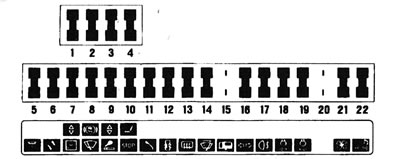
4.3. Location of fuses in the main unit - early models Protected circuits can be found on the plate in the block.
4. Additional fuses are installed in the block in the engine compartment, on the left side of the windshield fairing. To access them, lift the decorative grille, then separate the cover from the fuse box. The circuits protected by the fuses are indicated on the inside of the cover. The fuse for the car radio is located on the back of the unit (see illustrations).
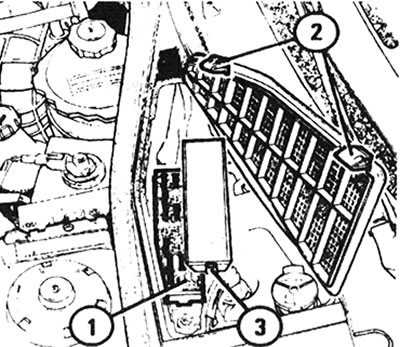
4.4a. Location of the additional fuse box in the engine compartment: 1 - Fuse box; 2 - Decorative grille fasteners; 3 - Lid lock.
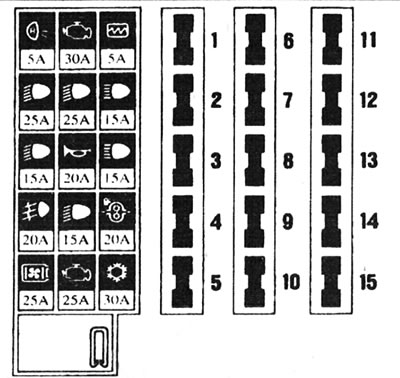
4.4b. Location of fuses in the additional block - early models Protected circuits can be found on the plate in the block.
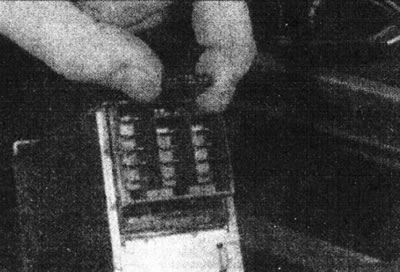
4.4s. Remove the fuses from the back of the car radio.
[This article is taken from the website www.RENAULTBOOK.ru]
5. A blown fuse can be identified by the melted conductor.
6. Before removing a fuse, check that the corresponding circuit is switched off.
7. Using a plastic tool, remove the fuse from its socket.
8. Spare fuses are located at the bottom left in the main block, and on the left in the additional block.
9. Before replacing a blown fuse, find and eliminate the cause of its blown fuse, and always use a new one with identical characteristics. Never replace a fuse more than once without identifying and correcting the cause of the fault. The fuse rating is printed on the back of the fuse and is additionally indicated by color.
10. The color coding of the fuses is as follows:
| Color | Current |
| Orange | 5A |
| Red | 10A |
| Blue | 15A |
| Yellow | 20A |
| Transparent or white | 25A |
| Green | Z0A |
Relay
11. A relay is an electrically controlled switch that is used for the following reasons.
- The relay can switch large currents remotely, so it is possible to use thinner wiring in the switch contacts.
- A relay can receive multiple input control signals, unlike mechanical switches.
- The relay may also have a "timer" function - for example, a windshield wiper relay.
12. Most relays are installed in the fuse box. But on some models, the rear window wiper/washer relay is located behind the panel to the left of the fuse box (see illustrations).
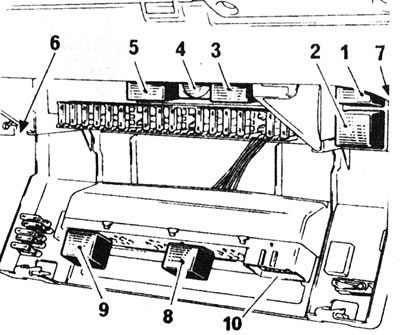
4.12a. Designation of relay in the main fuse box: 1 - Rear fog light relay; 2 - Rear window defroster relay; 3 - Light on warning buzzer; 4 - Direction indicator/hazard warning relay; 5 - Central lock timer relay; 6 - Windshield wiper/washer relay; 7 - Rear window wiper/washer relay; 8 - Front fog light relay; 9 - Outside temperature display relay; 10 - Diagnostic connector.
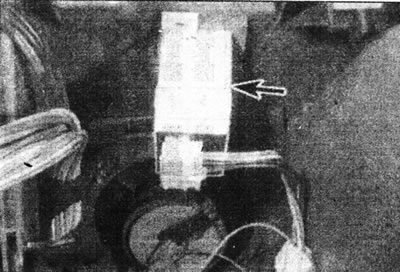
4.12b. Rear window wiper relay (marked with an arrow).
13. Some models have a separate relay unit for the fuel injection system and/or power steering pump in the engine compartment. For more details see. Sections 4 and 10 respectively.
14. If the relay-controlled circuit stops working, proceed as follows. Turn on the circuit. If the relay is functioning, you will hear a click when it is triggered. In this case, the components or wiring of the system are faulty. If the relay does not operate, then either the relay is not receiving switching voltage, or it is defective. The test is carried out by replacing the relay with a known good one; but be careful, some relays, despite being similar in appearance, can perform different functions.