English Русский
Български
Беларускі
Український
Српски
Hrvatski
Română
Polski
Slovenský
Magyar
Bookmark Contacts Articles Sitemap
Company vehicles Peugeot Company vehicles Opel Company vehicles Skoda Company vehicles Land Rover Company vehicles Mitsubishi Company vehicles Volkswagen Company vehicles Honda
RenaultBook.ru


Duster   Fluence   Kangoo   Laguna   Logan   Megane   Sandero   Scenic   Symbol   Clio   Other
Sandero 1 (2007-2012, petrol)

Replacing the fuel pump (Renault Sandero 1)

  • Main
  • Sandero
  • Sandero 1 (2007-2012, petrol)
  • Power unit
  • Fuel and exhaust system
  • Replacing the fuel pump
0
The main symptoms of a faulty fuel pump are a decrease in the power and dynamics of the car, dips in acceleration mode, and unstable engine operation in idle mode. A clear sign of deterioration in the operation of the fuel pump is also its howling or constant unpleasant hum, characteristic of excessive wear of the pump part due to the use of low-quality (poorly cleaned) fuel. Recently, there have been more frequent cases of fuel pump failures in the summer in hot weather. This is explained by the fact that when the pressure in the system is insufficient, the fuel boils, air locks form in the turbine part of the fuel pump and, as a result, the fuel supply stops completely.

Fuel pump malfunctions are divided into electrical and mechanical. Electrical problems are rare. Over time, the brushes or the collector of the electric motor anchor may wear out, but this happens when the mileage exceeds 150-200 thousand km. By this time, as a rule, the pumping part of the pump fails. In our operating conditions, the biggest problem for fuel pumps of injection engines is dirty fuel. The smallest mechanical impurities contained in such fuel contribute to the wear of the rubbing surfaces of the pump part and, therefore, sharply reduce the service life of the pump as a whole. In addition, the reason for the reduction in the resource of this unit can be driving with a low fuel level in the tank with the reserve fuel indicator light on.

Warning. Fuel pumps are cooled by gasoline passing through them, and with its help the pump parts are lubricated. Do not drive with less than 5 liters of fuel remaining in the tank.


Pre-check the fuel pressure in the fuel supply system as follows.

1. Check the serviceability of the fuel pressure regulator (see "Checking and replacing the fuel pressure regulator").

2. Remove the pump and wash the mesh fuel inlet filter. If the pressure does not increase in this case, the fuel pump must be replaced.

You will need: a flat-blade screwdriver, a container for draining gasoline from the fuel pump module.

1. Reduce the pressure in the fuel system (see "Decreased pressure in the engine fuel system").

2. Disconnect the wire from the negative terminal of the battery.
2. Disconnect the wire from the negative terminal of the battery.


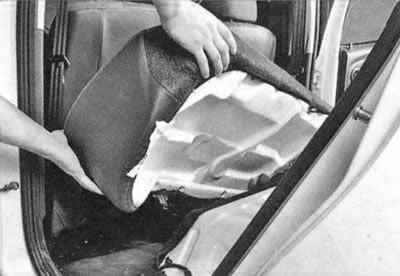
3. Remove the rear seat cushion (see "Removal and installation the rear seat").
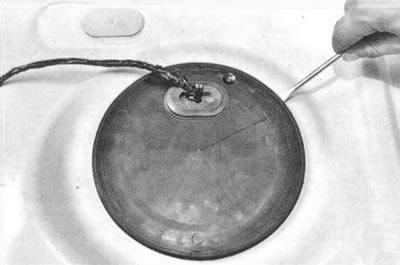
3. Remove the rear seat cushion (see «Removal and installation the rear seat»).


4. Use a screwdriver to pry...

4. Use a screwdriver to pry...


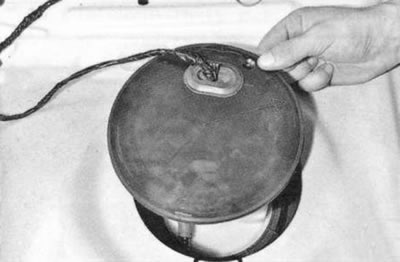
5. ...and remove the plastic hatch cover.
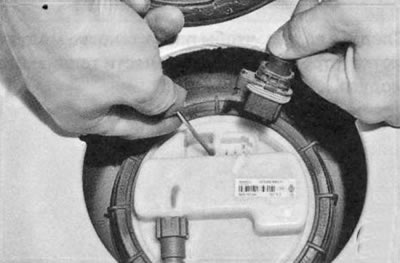


5. ...and remove the plastic hatch cover.


6. Release the retainer and disconnect the wiring harness connector from the fuel pump module.
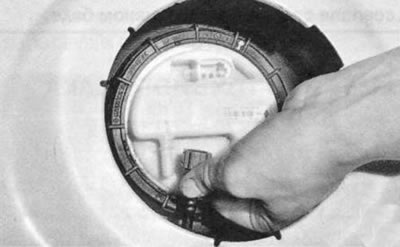
6. Release the retainer and disconnect the wiring harness connector from the fuel pump module.


7. Disconnect the fuel line tip from the pump fitting.
7. Disconnect the fuel line tip from the pump fitting.


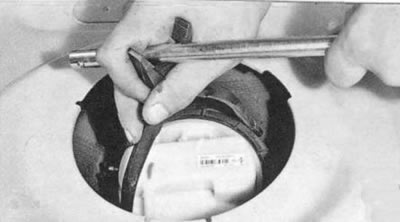
8. Unscrew the fuel pump module retaining ring by installing the pliers handles and lever as shown in the photo...
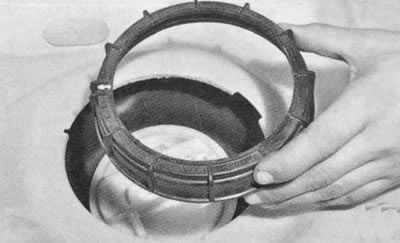
8. Unscrew the fuel pump module retaining ring by installing the pliers handles and lever as shown…


9. ...and remove the ring.


9. ...and remove the ring.


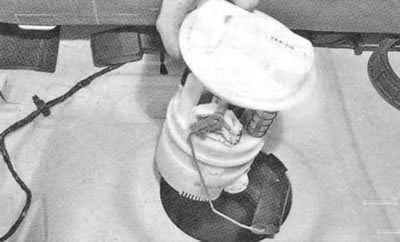
10. Carefully remove the fuel pump module and drain the fuel from it into a previously prepared container.
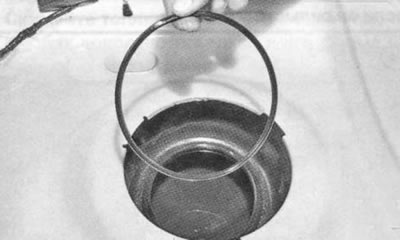
10. Carefully remove the fuel pump module and drain the fuel from it into a previously prepared…


11. Remove the sealing gasket.

Note: Be sure to replace the gasket if it is torn or severely compressed.
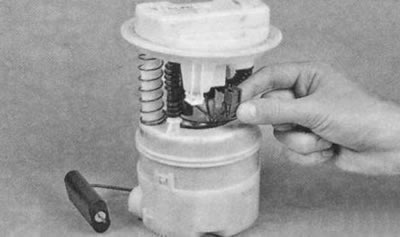

Note: Be sure to replace the gasket if it is torn or severely compressed.


12. Disconnect the fuel level sensor connector.
12. Disconnect the fuel level sensor connector.


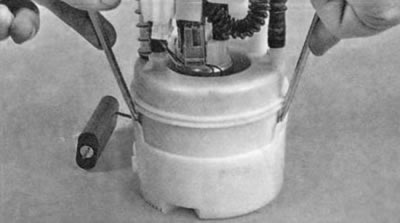
13. Squeeze the plastic clips and remove the fuel pump assembly from the collection cup.
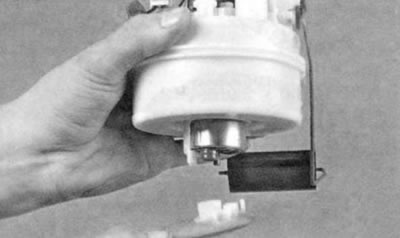


13. Squeeze the plastic clips and remove the fuel pump assembly from the collection cup.


14. Overcoming the force of the clamps, remove the mesh filter from the fuel receiver.

Note.

Note.

  • Wash or replace the mesh filter if it is heavily soiled.
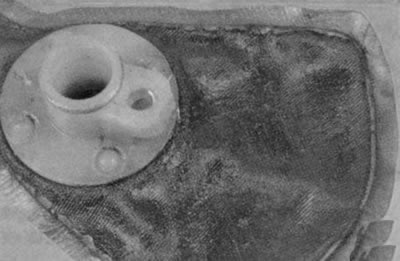

Wash or replace the mesh filter if it is heavily soiled.
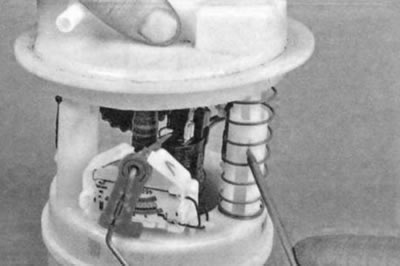

15. Use a screwdriver to press the fasteners and remove the upper part of the fuel pump assembly...
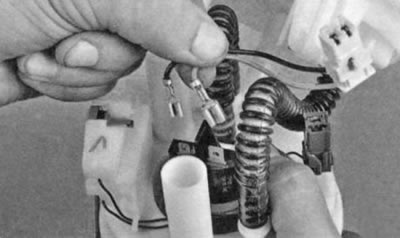
15. Use a screwdriver to press the fasteners and remove the upper part of the fuel pump assembly...


16. ... having disconnected the wiring blocks from the pump.
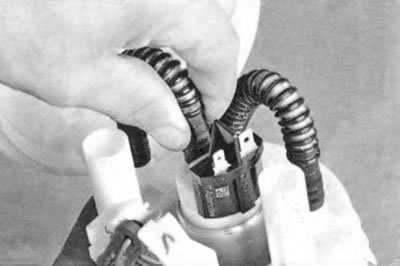


16. ... having disconnected the wiring blocks from the pump.


17. Remove the pump from the module housing.
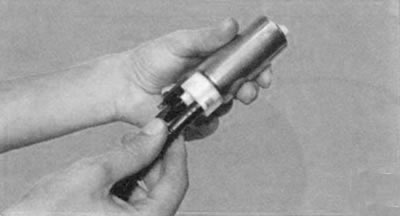
17. Remove the pump from the module housing.


18. Disconnect the fuel hose from the pump.

19. Assemble the fuel pump module in the reverse order of disassembly.

20. Install the parts in the reverse order of removal.

Note.
  • Note.
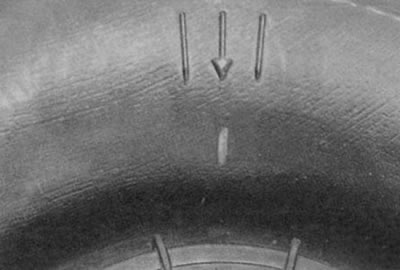
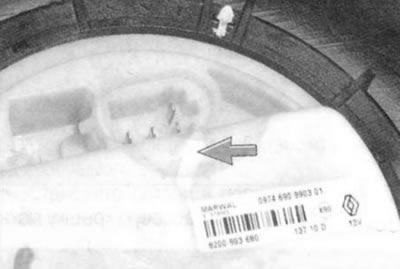
  • When installing the module, make sure that the mark (arrow) on the top of the fuel module...
  • When installing the module, make sure that the mark (arrow) on the top of the fuel module...
  • ...coincided with the mark on the fuel tank.
This article is available on: russian, bulgarian, belarusian, ukrainian, serbian, croatian, romanian, polish, slovak, hungarian
Article has been reviewed by editor: Podkrepilov Maxim
Share with friends:
Previous
Sandero 1: Fuel and exhaust system
Next

Removal and installation the air filter
Replacing the air filter element
Reducing pressure in the fuel system
Checking the pressure in the engine fuel system
Checking the tightness of fuel lines
Replacing the fuel tank
Checking and replacing the fuel pressure regulator
Checking, removing and installing fuel injectors
Removal and installation the fuel rail
Removal and installation the throttle assembly
Other articles on other Renault models

➽ Replacing the fuel pump Renault Logan 1 (2004-2012, petrol)
➽ Fuel level indicator and fuel pump Renault Duster 1 (2009-2017)
➽ Replacing the power steering pump pulley Renault Fluence 1 (2009-2020, petrol)
➽ Fuel pump assembly with fuel level sensor Renault Kangoo 1 (1997-2007)
➽ Checking fuel pump performance (all engines) Renault Laguna 2 (2001-2007)
Link to this article in different formats
Reviews and comments of visitors
No comments yet


Add two numbers 37 + 46


Sandero 1 (2007-2012, petrol) 
  • General information
  • Structure of car
  • User manual
  • Troubleshooting
  • Maintenance
  • Practical advice
  • Power unit
  • Engine repair
  • Lubrication system
  • Cooling system
  • Fuel and exhaust system
  • Transmission
  • Clutch
  • Manual gearbox
  • Automatic gearbox
  • Drive shafts
  • Chassis, running gear
  • Front suspension
  • Rear suspension
  • Steering
  • Brake system
  • Wheels and tires
  • Body and interior
  • Exterior (external elements)
  • Interior (internal elements)
  • Doors, locks and windows
  • Car body care
  • Heater and air conditioner
  • Security system
  • Electrical equipment
  • Equipment and devices
  • Headlights and lighting
  • Power devices
  • Ignition system
  • Electrical diagrams
RenaultBook.ru © 2018–2026 | Mobile version | News and articles | Sitemap: EN BG BY UA RS HR RO PL SK HU | Administration | Site search | Bookmark
Duster 1 (2009-2017) | Fluence 1 (2009-2020, petrol) | Kangoo 1 (1997-2007) | Laguna 2 (2001-2007) | Logan 1 (2004-2012, petrol) | Logan 2 (2012-2020) | Megane 1 (1995-2002) | Megan 2 (2002-2009, petrol) | Sandero 1 (2007-2012, petrol) | Scenic 1 (1996-2003) | Symbol 1 (1999-2008, petrol) | Symbol 2 (2008-2013, petrol) | Renault 19 (1988-1996) | Espace I and II (1984-1996) | Espace III (1996-2002) | Clio 1 (1990-1998) |
We want your visit to be comfortable 😌 and use cookies 🍪 to do so.