



In Russia, Renault Sandero cars are equipped with petrol engines: 8-valve 1.4 l (75 hp) and 1.6 l - 8-valve (87 hp) and 16-valve (102 hp).
The hatchback body is a load-bearing, all-metal, welded structure with hinged front fenders, side doors, hood and tailgate.
The transmission is made according to the front-wheel drive scheme with front wheel drives equipped with tripod-type constant velocity joints.
The cars are equipped with a five-speed manual or four-speed automatic transmission. Manual transmissions installed on cars with engines with a working volume of 1.4 and 1.6 liters are almost identical in design, have the same gear ratios and differ only in the size of the clutch housing, which is caused by the use of clutches of different diameters on these engines.
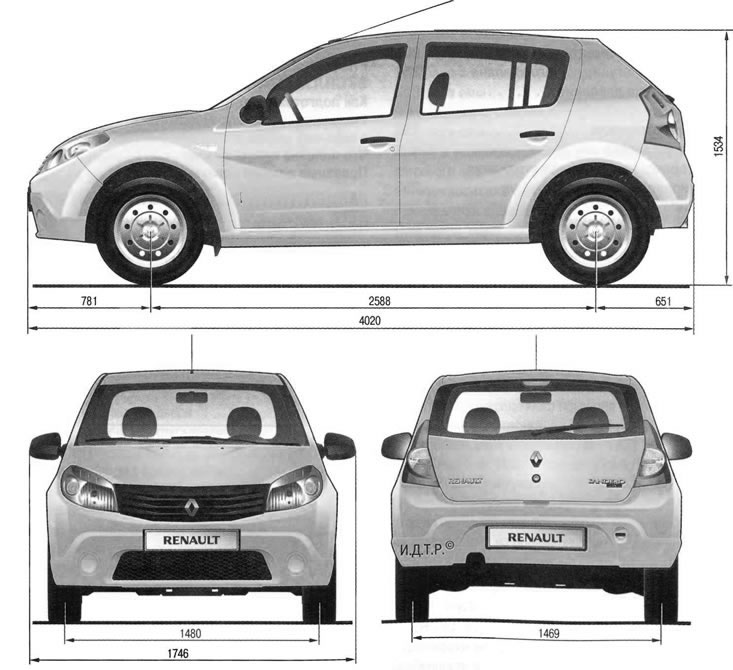
Fig. 1.1. Overall dimensions of the car
[Original article is on the portal www.RenaultBook.ru]
Technical characteristics of the car
Table 1.1
| Parameter | Automobile | ||
| with K7J engine | with K7M engine | with K4M engine | |
| General information | |||
| Number of seats, including driver's seat | 5 | ||
| Curb weight, kg | 975-1048 | 1048-1071 | 1082-1105 |
| Permitted maximum weight, kg | 1470 | 1470 | 1600 |
| Overall dimensions, mm | See Fig. 1.1 | ||
| Wheelbase, mm | Same | ||
| Minimum turning radius, m: | |||
| overall | 5,5 | ||
| on the outer front wheel | 5,25 | ||
| Number of steering wheel turns from lock to lock without/with hydraulic booster | 4,5/3,2 | ||
| Maximum speed of a car on a horizontal section of the highway, km/h | 162 | 175 | 180 |
| Acceleration time of a car from a standstill with gear shifting to a speed of 100 km/h, s | 13 | 11,5 | 10,5 |
| Fuel consumption, l/100 km: | |||
| urban cycle | 9,2 | 10,0 | 9,4 |
| suburban cycle | 5,5 | 5,8 | 5,8 |
| mixed cycle | 6,8 | 7,2 | 7,1 |
| Engine | |||
| Model | K7J | K7M | K4M |
| Engine type | Four-stroke, petrol, single overhead camshaft | Four-stroke, petrol, with two camshafts | |
| Number, arrangement of cylinders | Four, vertically in a row | ||
| Cylinder firing order | 1-3-4-2 | ||
| Cylinder diameter x piston stroke, mm | 79.5 x 70.0 | 79.5 x 80.5 | |
| Working volume, cm³ | 1390 | 1598 | |
| Compression ratio | 9,5 | 9,8 | |
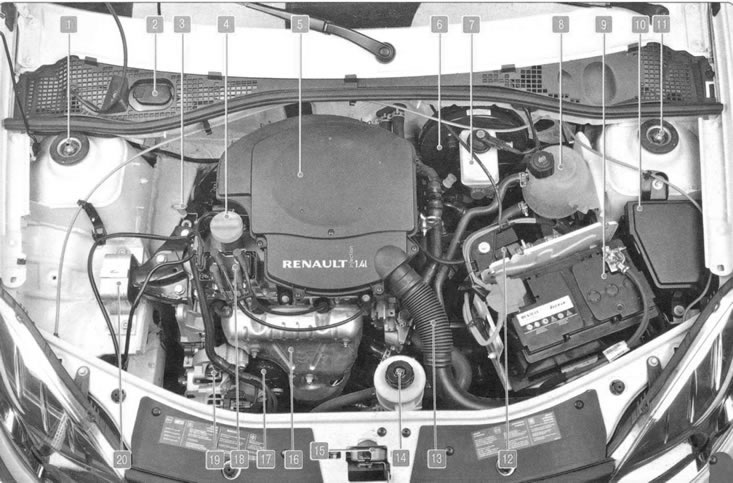
Fig. 1.2. Underhood space (top view) cars with K7J or K7M engine: 1, 11 - upper supports of the front suspension struts; 2 - washer reservoir; 3 - oil level indicator (dipstick); 4 - oil filler plug; 5 - air filter; 6 - brake booster; 7 - master brake cylinder reservoir; 8 - expansion tank of the engine cooling system; 9 - battery; 10 - cover of the relay and fuse mounting block; 12 - Electronic engine control unit; 13 - air supply hose; 14 - Power steering fluid reservoir; 15 - hood lock safety hook; 16 - exhaust manifold heat shield; 17 - oil filter; 18 - ignition module; 19 - generator; 20 - right support of the power unit suspension.
Continuation of table 1.1
| Parameter | Automobile | ||
| with K7J engine | with K7M engine | with K4M engine | |
| Maximum power, kW (hp), not less than | 55 (75) | 64(87) | 75(102) |
| Crankshaft speed corresponding to maximum power, min⁻¹ | 5500 | 5750 | |
| Maximum torque, Nm | 112 | 128 | 145 |
| Crankshaft speed corresponding to maximum torque, min⁻¹ | 3000 | 3750 | |
| Transmission | |||
| Clutch | Single-disc, dry, with diaphragm pressure spring and torsional vibration damper, permanently closed type | ||
| Clutch release drive | Cable | ||
| Manual transmission | JH1, five-speed, with synchronizers on all forward gears | JH3, five-speed, with synchronizers on all forward gears | |
| Automatic transmission | — | Four-speed, DP2 | |
| Gear ratios of a manual transmission: | |||
| I | 3,727 | ||
| II | 2,048 | ||
| III | 1,393 | ||
| IV | 1,029 | ||
| V | 0,795 | ||
| reverse | 3,545 | ||
| Main gear | Single, cylindrical, helical | ||
| Final drive ratio | 4,214 | ||
| Chassis | |||
| Front suspension | Independent, spring, with hydraulic shock absorbers | ||
| Rear suspension | Semi-independent, with coil springs, telescopic hydraulic shock absorbers | ||
| Wheels | Steel, disc, stamped | ||
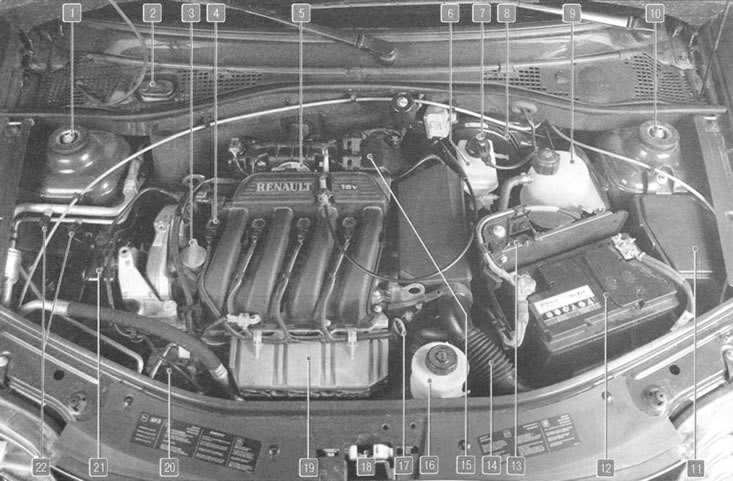
Fig. 1.3. Underhood space (top view) car with K4M engine: 1.10 - upper supports of the front suspension struts; 2 - windshield washer reservoir; 3 - oil filler plug; 4 - ignition coil; 5 - throttle assembly; 6 - master brake cylinder reservoir; 7 - master brake cylinder reservoir cap with level sensor; 8 - brake booster; 9 - expansion tank of the engine cooling system; 11 - cover of the relay and fuse mounting block; 12 - battery; 13 - Electronic engine control unit; 14 - air supply hose; 15 - air filter; 16 - Power steering fluid reservoir; 17 - oil level indicator (dipstick); 18 - hood lock safety hook; 19 - fuel rail protection; 20 - Power steering pump; 21 - right support of the power unit suspension; 22 - Air conditioning system service valves.
End of table. 1.1
| Parameter | Automobile | ||
| with K7J engine | with K7M engine | with K4M engine | |
| Rim size | 5.5J-14 | 5.5J-14 or 6J-15 | |
| Tires | Radial, tubeless | ||
| Tire size | 165/80 R14 or 185/70 R14 | 165/80 R14, 185/70 R14 or 185/65 R15 | |
| Steering | |||
| Steering | Trauma-safe, with hydraulic booster | ||
| Steering gear | Rack and pinion | ||
| Brake system | |||
| Service brake system: | |||
| front wheel brakes | Disc, with single-cylinder floating caliper | Disc, ventilated, with single-cylinder floating caliper | |
| rear wheel brakes | Drums | Drums | |
| Brake drive | Hydraulic, dual-circuit, separate, diagonally arranged, with vacuum booster, pressure regulator in the hydraulic drive of the rear brakes or anti-lock braking system | ||
| Parking brake system | With cable drive to the rear wheels from the floor lever, with an on/off signal | ||
| Electrical equipment | |||
| Electrical wiring diagram | Single-wire, the negative pole is connected to the "ground" | ||
| Nominal voltage of the on-board network, V | 12 | ||
| Battery | Starter, maintenance-free, capacity 70 Ah | ||
| Generator | Alternating current, with built-in rectifier and electronic voltage regulator | ||
| Starter | With remote control, electromagnetic engagement and freewheel clutch | ||
| Body | |||
| Body type | Hatchback, all-metal, monocoque, five-door | ||
The front wheel brakes are disc brakes with a floating caliper. The rear wheel brakes are drum brakes with automatic adjustment of the gaps between the brake shoes and drums.
The steering is trauma-safe, with a rack-and-pinion steering mechanism equipped with a hydraulic booster. A front airbag is installed in the steering wheel hub. An airbag can also be installed for the front passenger.
All door windows can be equipped with electric drives.
The overall dimensions of the vehicle are shown in Fig. 1.1, technical characteristics are given in Table 1.1. The vehicle elements located in the engine compartment and the main units are shown in Fig. 1.2-1.6.
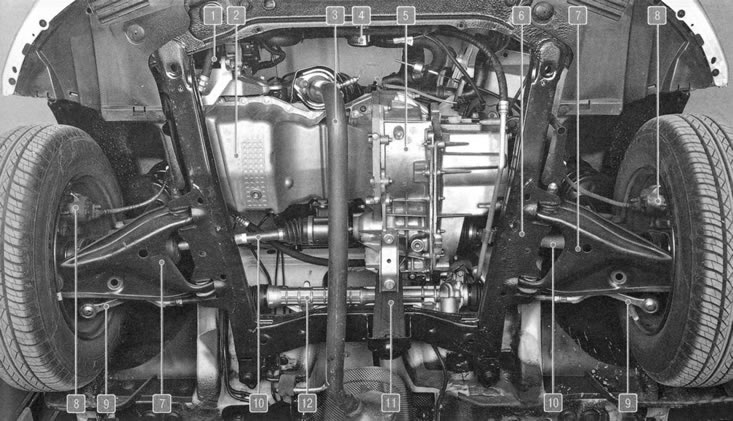
Fig. 1.4. Main units and assemblies of a car with a K7J or K7N engine (view from below, front, engine crankcase protection removed for clarity): 1 - air conditioning compressor (in a variant design); 2 - engine; 3 - intake pipe; 4 - electric fan of the engine cooling system; 5 - gearbox; 6 - subframe; 7 - front suspension arms; 8 - front wheel brake mechanisms; 9 - steering rod; 10 - front wheel drive; 11 - rear support of the power unit suspension; 12 - steering mechanism.
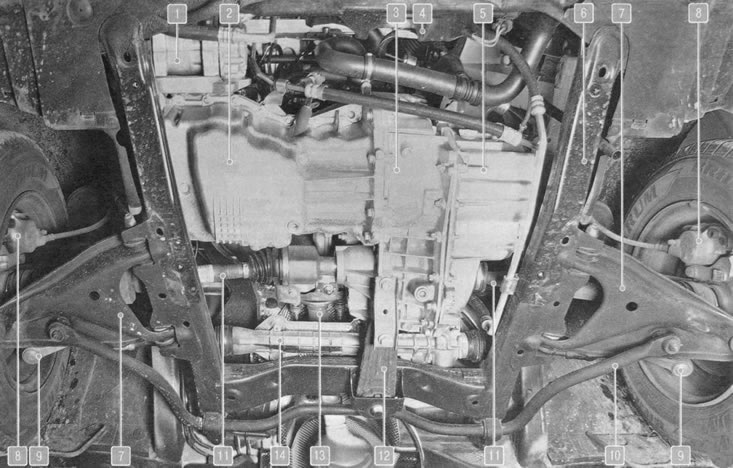
Fig. 1.5. Main units and assemblies of a car with a K4M engine (view from below, front, engine crankcase protection removed for clarity): 1 - air conditioning compressor (depending on the configuration); 2 - engine; 3 - clutch housing; 4 - electric fan of the engine cooling system; 5 - gearbox; 6 - subframe; 7 - front suspension arm; 8 - front wheel brake mechanism; 9 - steering rod end; 10 - transverse stability stabilizer bar; 11 - Front wheel drive; 12 - rear support of the power unit suspension; 13 - intake pipe; 14 - steering mechanism
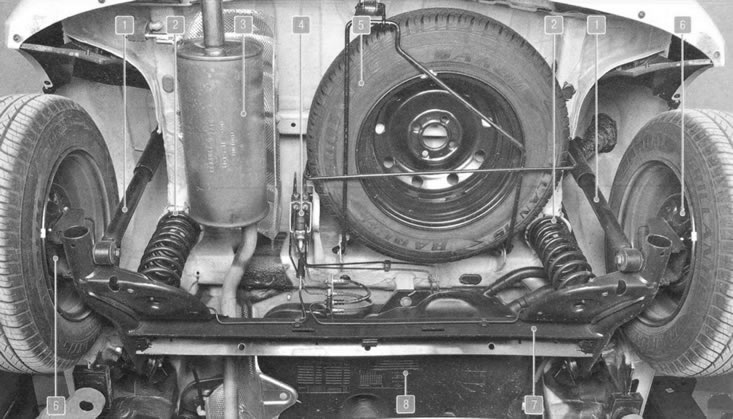
Fig. 1.6. Main units and assemblies of the car (bottom view from behind): 1 - shock absorbers; 2 - rear suspension springs; 3 - muffler; 4 - brake force regulator in the rear brake hydraulic drive; 5 - spare wheel; 6 - rear wheel brake mechanism; 7 - rear suspension beam; 8 - fuel tank.