
As for the diesel engine, it does not need the ignition system required by gasoline engines.
In diesel engines there is a strong compression of the incoming air, accompanied by a significant increase in temperature. When fuel is injected into compressed and heated air, it self-ignites.
RENAUL MEGANE gasoline engines are equipped with an ignition system, the control unit of which contains parametric data determined during bench and road tests of the engine. The control unit gives a command to the ignition coils by supplying the appropriate pulses. The synchronization of the ignition system is performed on the basis of the impulse sensor signals received by the control unit. The pulse sensor is mounted on the gearbox flange and reads the number of revolutions of the engine crankshaft.
Vehicles with a 1.4 liter petrol engine (E7J). The high voltage generated by the ignition coil is supplied to the appropriate spark plug through the distributor runner via the high voltage wire. A spark jumps between the electrodes of the spark plug, igniting the air-fuel mixture in the cylinder.
Vehicles with a 1.6 liter petrol engine (K7M) and 2.0 liters. The ignition system does not have a distributor. The distribution of the ignition voltage between the cylinders is carried out electronically. The high voltage is generated by two twin coils mounted on the cylinder head.
Vehicles with a 1.4-/1.6-liter petrol engine (K4J/ K4M). This engine has basically the same ignition system as the 1.6 and 2.0 liter petrol engines. The difference is that each spark plug has its own ignition coil. All four coils are built into the tips of the spark plugs, which are in turn seated on the spark plugs and thus there are no high voltage wires.
To determine the optimal ignition timing, the system control unit uses parametric data embedded in its memory, which allows the system to quickly and easily adapt to different operating conditions (see illustration 1.0).
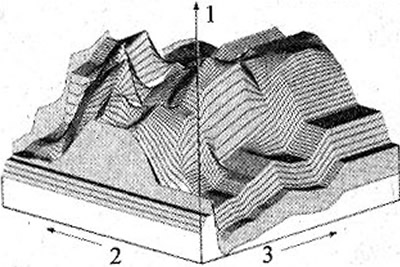
1.0 Schematic display of parametric data stored in the memory of the ignition system control unit
1 - ignition timing
2 - operational load
3 - engine speed
The ignition timing is also determined using knock sensors. Due to the fact that fuel consumption at high compression is minimal, the compression of modern engines is quite high. However, high compression can lead to uncontrolled ignition, called detonation of the fuel. Knocking combustion of fuel negatively affects the condition of the engine, which is damaged over time. To avoid knocking the fuel, a knock sensor must be installed that provides a later ignition angle.
All components of the ignition system are adjusted relative to each other and ensure that the ignition timing remains unchanged.
When repairing the ignition system, certain safety measures should be followed to prevent damage to the service personnel or damage to the system itself.