



Contents: Removal 🠛 Installation 🠛
Metal pipes are used as connecting elements for the brake system hoses between the main brake cylinder and the wheel brakes. The installation of metal brake system pipes should be entrusted to a specialized workshop, because this operation requires a certain amount of experience and special tools.
Brake hoses, designed for a certain pressure, serve as flexible connections between moving parts of the car, such as calipers.
Removal
1. Place the car on jack stands and align the wheels.
2. Loosen the union nut 1 on the pipeline to release the pressure of the spring 3. This will disengage the toothed engagement 4 of the brake hose 2 (see illustration).
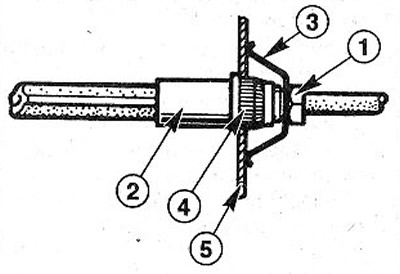
12.2 Loosen union nut 1 on the pipeline to release the spring pressure
3. Disconnect the brake hose from the wheel cylinder on the caliper. There is no sealing gasket at the connecting joint because the seal is made by a cone joint.
4. Plug the hole in the line with a suitable plug to prevent brake fluid from leaking out from the master cylinder side, or draw off brake fluid from the expansion tank before disconnecting the hose.
If the wheel cylinder brake hose needs to be replaced, the caliper must be removed for replacement.
Installation
5. Install only hoses approved for use by the RENAULT vehicle manufacturer.
6. Install the caliper.
7. Connect the brake hose, the front wheels should be in the straight position and the front should be raised so that the suspension (wheels) are unloaded. The tightening torque of the hose on the caliper is 15 Nm.
8. Insert the hose connector into the toothed lock 5 of the pipeline (see illustration 8.2). Do not allow the hose to twist. Make sure that the end piece 4 is properly engaged in the toothed connection.
9. Install spring 3 and tighten the union nut with a force of 15 Nm.
10. Make sure the hose follows all wheel movements and does not come into contact with nearby parts. Perform this check with the vehicle raised.
Caution: Do not expose brake hoses to oil or fuel, varnish, paint or apply underbody protection coating to them.
11. Remove air from the brake system.
12. Lower the car onto its wheels.
Attention! Make sure that
- a) the brake hoses are securely connected;
- b) the brake hose is secured in the holder;
- c) the brake drive bleed nipples are screwed in;
- d) there is a sufficient volume of brake fluid in the expansion tank.
13. Perform a leak test of the brake system with the engine running.
To do this, press the brake pedal with a force of 200-300 I (20-30 kg) for about 10 seconds. The pressure in the system and, accordingly, on the brake pedal should not drop. Check all connections for leaks.
14. Perform several braking maneuvers on a lightly trafficked road.