English Русский
Български
Беларускі
Український
Српски
Hrvatski
Română
Polski
Slovenský
Magyar
Bookmark Contacts Articles Sitemap
Company vehicles Peugeot Company vehicles Opel Company vehicles Skoda Company vehicles Land Rover Company vehicles Mitsubishi Company vehicles Volkswagen Company vehicles Honda
RenaultBook.ru


Duster   Fluence   Kangoo   Laguna   Logan   Megane   Sandero   Scenic   Symbol   Clio   Other
Scenic 1 (1996-2003)

General description of the body and precautions (Renault Scenic 1)

  • Main
  • Scenic
  • Scenic 1 (1996-2003)
  • Body and interior
  • Exterior (external elements)
  • General description of the body and precautions
0
Contents: Precautions when performing bodywork 🠛 Gaps between body parts 🠛
RENAULT MEGANE/SCENIC cars have a monocoque body. The body base, its sides, roof and rear wings are welded together. Therefore, serious body repairs should be entrusted to a workshop.

The hood, trunk lid, doors and front fenders are connected with bolts and therefore can be easily removed and replaced. But in this case, when installing, it is necessary to maintain the required gaps, otherwise, for example, the door may knock, or increased air flow noise will be observed during movement. The gap should always be parallel, this means that the indentation between the body parts should be the same along the entire length of the gap. Permissible deviations should not exceed 1 mm.

To fasten body parts, RENAULT uses so-called TORX bolts. The difference between these bolts and conventional ones is that they do not have the usual external or internal hexagon. Instead of a hexagon, there is a star-shaped hexagonal profile, which more easily transmits the applied force when tightening or unscrewing. This increases the service life of bolts and screwdrivers. To perform the work, you need a set of appropriate TORX inserts (screwdrivers). For RENAULT MEGANE, a set of T8, TI5, T30 and T40 is recommended.

Precautions when performing bodywork


During repair work, heating of the vehicle in the dryer or its chamber is permitted within the limits of no higher than +85°C. Otherwise, the electronic control devices may be damaged.


If welding or other work that generates sparks is to be performed during bodywork, it is absolutely necessary to completely disconnect the battery (remove the terminals from the negative (-) and positive (+) terminals and carefully insulate them). When performing work near the battery, it should be removed.

Attention! When disconnecting the battery, data is deleted from some electronic units. Therefore, before removing the battery, read the instructions in the chapter "Battery - removal and installation".


When performing welding work, the clamp of the welding unit must be attached directly to the workpiece. In any case, the plugs of the airbag units and seat belt tensioners must be disconnected. They are located under the cover of the central console.

Body work involves strong vibration, such as hammer blows. For this reason, always switch off the ignition and disconnect the power cable terminals from the battery terminals. After disconnecting the battery, wait 5 minutes to allow the capacitors of the airbag units and seat belt tensioners to discharge.

Gaps between body parts


When installing new body parts, it is necessary to maintain the required gaps, otherwise, for example, the door may knock, or increased air flow noise will be observed during movement. Permissible deviations along the entire length of the gap should not exceed 1 mm (see illustrations).
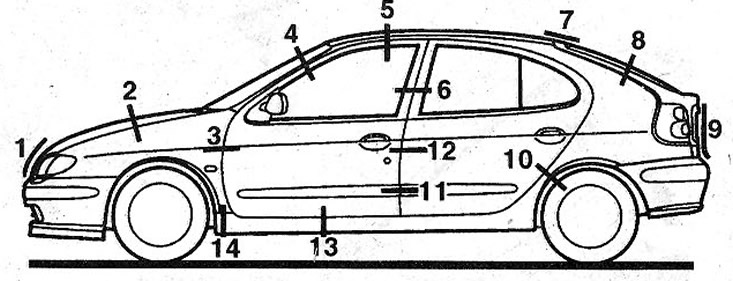
1.0 Gaps for cars with a sedan body: 1 - 6 mm; 2 - 4 mm; 3 - 5 mm; 4 - 5 mm; 6 - 5 mm; 7 - 6.5 mm;…

1.0 Gaps for cars with a sedan body: 1 - 6 mm; 2 - 4 mm; 3 - 5 mm; 4 - 5 mm; 6 - 5 mm; 7 - 6.5 mm; 8 - 4.5 mm; 9 - 6 mm; 10 - 6 mm; 11 - 5 mm; 12 - 11 mm; 13 - 5 mm; 14 - 4 m
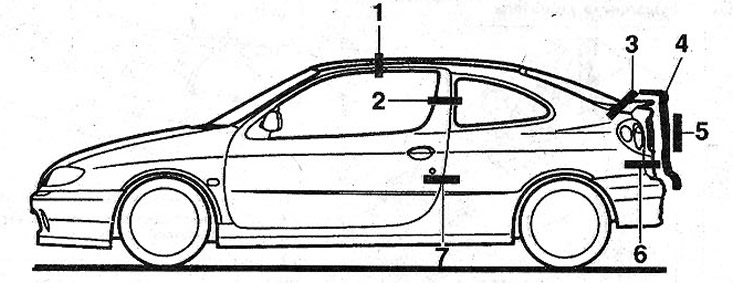


1.0a Cars with a coupe body. Only the differences in clearances from cars with a sedan body are…

1.0a Cars with a coupe body. Only the differences in clearances from cars with a sedan body are given: 1 - 6 mm; 2 - 6 mm; 3 - 6 mm; 4 - 6 mm; 5 - 4.5 mm; 6 - 6 mm; 7 - 6 mm
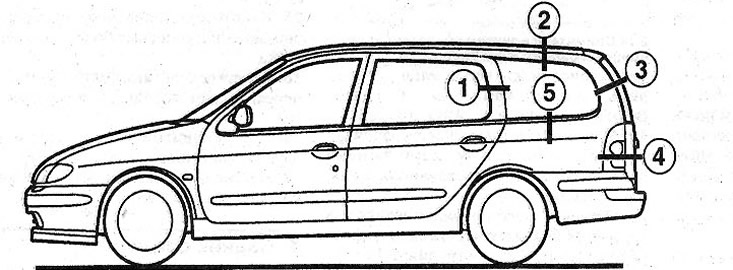

1.0 b Cars with a «station wagon» body (Grandtour). Here are just the differences between…

1.0 b Cars with a "station wagon" body (Grandtour). Here are just the differences between clearances and cars with a sedan body: 1 - 4 mm; 2 - 3 mm; 3 - 4 mm; 4 - to the drop door 4 mm, to the wings 2 mm; 5 - 3 mm


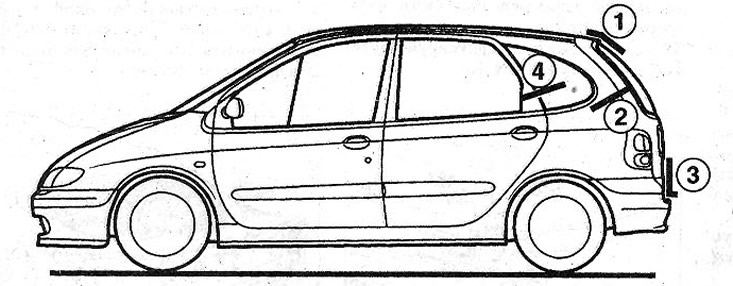
1.0v SCENIC cars. Only the differences in clearances from cars with a «sedan» body are given: 1 -…

1.0v SCENIC cars. Only the differences in clearances from cars with a "sedan" body are given: 1 - 6.5 mm; 2 - 5 mm; 3 - 6 mm; 4 - 6 mm
This article is available on: russian, bulgarian, belarusian, ukrainian, serbian, croatian, romanian, polish, slovak, hungarian
Article has been reviewed by editor: Fedoseev Denis
Share with friends:
 
Scenic 1: Exterior (external elements)
Next

 
Front bumper — removal, installation, disassembly
Rear bumper — removal and installation
Radiator grille — removal and installation
Fairing — removal and installation
Front wheel arch protection (fender liner) — removal and installation
Other articles on other Renault models

➽ General information and precautions when repairing the cooling… Renault Fluence 1 (2009-2020, petrol)
➽ General information and precautions when repairing the cooling… Renault Laguna 2 (2001-2007)
➽ General description and precautions of the air conditioning… Renault Megane 1 (1995-2002)
➽ General information about car body care Renault Sandero 1 (2007-2012, petrol)
➽ General description of the body and gaps between elements Renault Symbol 2 (2008-2013, petrol)
Link to this article in different formats
Reviews and comments of visitors
No comments yet


Add two numbers 10 + 46


Scenic 1 (1996-2003) 
  • General information
  • User manual
  • Maintenance
  • Troubleshooting
  • Power unit
  • Engine repair
  • Cooling and ventilation
  • Injection system (petrol)
  • Fuel system (diesel)
  • Fuel system
  • Exhaust system
  • Ignition system
  • Transmission
  • Clutch
  • Car gearbox
  • Chassis, running gear
  • Brake system
  • Car suspension
  • Steering
  • Body and interior
  • Exterior (external elements)
  • Interior (internal elements)
  • Doors, locks and windows
  • Electrical equipment
  • Equipment and devices
  • Headlights and lighting
  • Power devices
  • Electrical circuits
RenaultBook.ru © 2018–2026 | Mobile version | News and articles | Sitemap: EN BG BY UA RS HR RO PL SK HU | Administration | Site search | Bookmark
Duster 1 (2009-2017) | Fluence 1 (2009-2020, petrol) | Kangoo 1 (1997-2007) | Laguna 2 (2001-2007) | Logan 1 (2004-2012, petrol) | Logan 2 (2012-2020) | Megane 1 (1995-2002) | Megan 2 (2002-2009, petrol) | Sandero 1 (2007-2012, petrol) | Scenic 1 (1996-2003) | Symbol 1 (1999-2008, petrol) | Symbol 2 (2008-2013, petrol) | Renault 19 (1988-1996) | Espace I and II (1984-1996) | Espace III (1996-2002) | Clio 1 (1990-1998) |
We want your visit to be comfortable 😌 and use cookies 🍪 to do so.