



Note: You will need a pressure gauge to perform this test.
1. By checking the compression you can determine the mechanical condition of the upper part of the engine (pistons, rings, valves, cylinder head gasket). Compression may be low due to leakage caused by worn piston rings, faulty valves and valve seats, or a blown head gasket.
Note: The engine must be at normal operating temperature and the battery must be fully charged.
2. Clean the area around the spark plugs to prevent dirt from entering the cylinders.
3. Remove all spark plugs from the engine (see Section 1).
4. Disconnect the wiring connector from the electronic ignition control unit. Also disable the engine management system by removing the main protection fuse from the fuse box in the engine compartment (No. 1 in the fuse box - see. "Electrical connection diagrams").
5. Install the pressure gauge into the spark plug hole of cylinder No. 1 (see illustration).
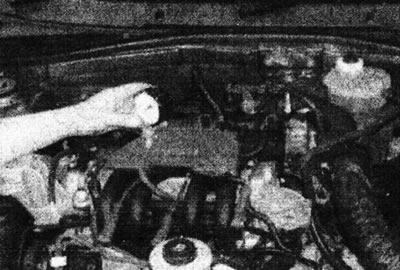
2.5. Performing a compression test.
6. Ask an assistant to hold the gas pedal all the way down while simultaneously turning the engine over with the starter several times. Monitor the pressure gauge readings - in a healthy engine, compression should increase quickly. Low compression on the first revolution and its subsequent gradual increase indicates wear of the piston rings. If compression remains low, the valves or head gasket are burnt, or the head is cracked. Carbon deposits on the backs of the valve heads can also cause low compression. Record the highest reading on the gauge, then repeat the procedure on the remaining cylinders.
7. Add a little engine oil to each cylinder through the spark plug hole and repeat the test.
8. If after this the compression increases for a while, the cylinder or piston is worn. Lack of improvement indicates that there may be a leak through burned or bent valves, or a blown head gasket.
9. Low compression in two adjacent cylinders is almost certainly caused by a blown head gasket between them. The presence of coolant in the engine oil will confirm this.
10. If one cylinder has compression that is approximately 20 percent lower than the others and the engine idles roughly, the camshaft lobes may be worn.
11. If the compression is significantly higher than the nominal value, the combustion chambers are probably covered with carbon deposits. In this case, the cylinder head must be removed and cleaned of carbon deposits.
12. Compression values for the engines described in this manual are not specified by the manufacturer. However, based on the information given in the previous points, the condition of the engine can be determined.