



Contents: Air temperature regulation 🠛 Adjusting the air distribution in…🠛 Regulating the amount of air…🠛 Temporary isolation mode of the cabin 🠛 Air Conditioner Controls 🠛
Heating and ventilation control panel
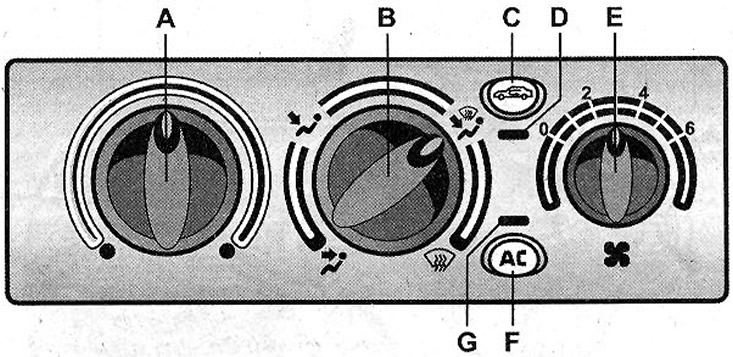
A - Air temperature regulator
B - Air distribution regulator
C - Button for turning on the temporary isolation mode of the passenger compartment (air recirculation mode)
D - Air recirculation mode indicator light
E - Regulator of air intake into the passenger compartment
G - Air conditioner on/off button
G - Air conditioning indicator light
Original version on our portal: RenaultBook
Air temperature regulation
Produced by handle A.
Right extreme position of the handle: maximum possible air temperature.
Left extreme position of the handle: minimum possible air temperature.
Adjusting the air distribution in the cabin
Produced by handle B.
Position

Air enters the passenger compartment only through the central and side ventilation grilles located on the control panel. This position of the regulator is not used if all ventilation grilles are closed.
Position

Air is distributed between the instrument panel vents and the front and rear lower vents, which direct air to the front and rear passenger footwells.
Position

Air enters the passenger compartment through all ventilation grilles, nozzles and blower slots on the front side windows and windshield.
Position

It is recommended to close the ventilation grilles in the control panel for more effective blowing of the glass.
All air enters the passenger compartment through the front side window blower nozzles and the windshield blower slot nozzles.
In this position of the control handle, condensation removal from the glass occurs more effectively if the air conditioner is turned on at the same time.
Regulating the amount of air entering the cabin
It is produced by handle E, which can be in one of the positions from "0" to "6".
The passenger compartment is ventilated by means of a fan. The fan mode determines the amount of air entering the passenger compartment. The vehicle speed has little effect on the intensity of ventilation.
The use of forced ventilation of the passenger compartment with a fan ensures high stability of the air temperature in the passenger compartment. The operating mode of the fan and the amount of air supplied to the passenger compartment depend on the position of the regulator E: the further from the "0" position the regulator handle is turned, the greater the air supply to the passenger compartment.
Temporary isolation mode of the cabin

Button C.
It should be borne in mind that for normal operation of the ventilation and heating systems, an influx of fresh outside air is required. Enabling the mode of isolating the interior from the outside atmospheric air may be useful when driving in dusty areas or in polluted air conditions.
To activate the temporary interior isolation mode, press button C.

The air recirculation mode allows for maximum acceleration of heating of the passenger compartment.
Button C is used both to turn on and off the air recirculation mode. When the air recirculation mode is on, the indicator lamp D lights up. This stops the communication between the passenger compartment and the atmosphere, and no fresh outside air enters the passenger compartment.
Long-term use of cabin isolation mode (in the absence of fresh outside air supply) not recommended. This may lead to condensation of moisture ("fogging") and frost formation on the glass in cold weather, as well as the appearance of foreign odors.
Therefore, after passing through a section of land with polluted air, it is recommended to return to normal ventilation operation at the first opportunity by pressing button C again.
Air Conditioner Controls

The F button is used to turn the air conditioner on and off.
The air conditioning system does not operate if the control knob E is in the "0" position. The air conditioning system provides:
- reducing the air temperature in the cabin, which is especially useful in hot weather when driving around the city or when parking the car in an open space under direct sunlight;
- reducing the humidity of the air entering the passenger compartment (this reduces the tendency for the windows to fog up).
Note: The air conditioning system can be used in all conditions except at low ambient temperatures.
F button is off (control lamp G does not light)
The air conditioning system is not working.
The ventilation and heating systems can function similarly to the case discussed above, when there is no air conditioning system in the car.
F button pressed (control lamp G is on)
The air conditioning system is on.
Fresh outside air constantly enters the car's interior.